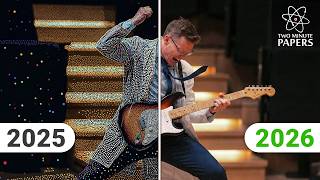
Károly uses ray tracing to show how millions of samples transform a noisy image into a clean render, drawing a parallel to persistence in life. He announces a free master course from the Technical University of Vienna on light physics and building a light-transport simulation, then demonstrates running a 671-billion-parameter AI model on Lambda's GPU cloud.
Chapters
I learned a really important life lesson during my research. You see, I do this kind of thing. This is ray tracing, or a light transport simulation as we call it. And it has a superpower. What is that? Well, it can simulate reality. Yes, this is really possible. No AI needed at all. You can give it a scene, and it will simulate the path of light rays bouncing around. And give you an image of what that scene would look like in reality. It is absolutely insane that we can do that. I love it. But wait, not so fast. Even if you do it perfectly, at first, this is what it looks like. Oh my, this is terrible. What is going on? Well, that is the life lesson. This was just simulating one ray going through each of these pixels. This is what we call one sample. One sample is not enough. But if you do 2 samples, you get something like this. Better? Maybe a bit. Getting better, but still a long way off. And after millions and millions of rays, we get the beautiful final image. When you first do it, it is a very emotional moment. When we started, I thought this would be impossible, And yet, here it is. So here are two things I'd like to share with you. One is a life lesson that I learned. Even if you have the perfect system, at first, it might seem that it does not work at all. But you have to keep at it. And it may take a long time. And two, I'd love to share this feeling with you, but it's impossible. Because when you first succeed, it is beyond words. But wait, I think I found a way to actually share this feeling with you. Through a song. A popular request from you Fellow Scholars, so here it is. And if you watch until the end of the video, I'll give you something so you can also create a simulation like this yourself for free. Alright, with that said, this is Károly and The Papers.
Late night screen glow, pixels looking thin. Shadows are hard to render and see. Highlights lie, edges fight. Nothing here is looking right. But then I saw the future, a path to the light. Won't he Colors sampling, one bounce at a time. Roll the dice, let the physics speak. Choose expensive, but it's unique. One sample, two samples, still looking. The world looks round, not bottomy. Energy in, energy out. No room for faith, no room for doubt. One sound more, two sounds more, if the brain is dying. But a million rays later, the image is bright. Noise builds up, structure shakes, reality burns out. Oh my grace. The universe says yes, that's right. We trace our path. We follow the light. String goes still, but truth is light. Every shadow now alights. We follow the light. We follow the light.
All right, that was so much fun! I hope you enjoyed it as much as we did. I am not sure if I ever heard a song written about ray tracing. All right, I promised you something. And it is for free. I taught this master-level course at the Technical University of Vienna, and I think knowledge should be free for everyone. So, it's not like the courses you see elsewhere, it is completely free. In fact, you can't even pay for it, even if you wanted. Although this Fellow Scholar was hilarious. Alright, so in this one, I try my best to teach you the physics of light. And then, we code up a light simulation program together from scratch. Enjoy! Here you see me running the full DeepSeq AI model through Lambda GPU cloud. 671 billion parameters, running super fast and super reliably. This is insane. I love it. And I use it on a regular basis. Lambda provides you with powerful NVIDIA GPUs to run your own chatbots and experiments. Seriously, try it out now at lambda.ai/papers or click the link in the description.