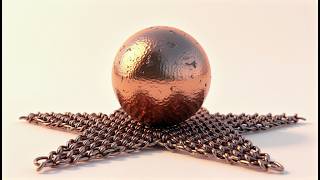
Károly Zsolnai-Fehér demos why physics simulators fail when balls drop or chains snap under weight, then shows a new method that fixes these problems and runs over 10× faster. It handles heavy friction, tiny contacts, and complex setups like a 9,000-grain pyramid without breaking.
Questions this video answers
October 15, 2024.
Károly Zsolnai-Fehér.
LARRUZ.
More than 9,000 grains.
More than 10 times faster.
Chapters
Let's throw this heavy ball into this interlocking chain link. What happens now? Whoa. Lots of things. First of all, what you are seeing here is not reality. This is a virtual world like the ones you see here. These are done by essentially turning the laws of physics into a computer program. Now, what are the problems here? Well, these are supposed to be interlocking chain links. They shouldn't break. Yet they do. Why is that? Well, this is a classical simulation technique, and there are cases that it simply cannot compute properly. One is dropping a large weight onto a smaller object. Ouch. That's not good. We will try to fix that. And the other is when we have lots and lots of friction happening. Unfortunately, it is not doing well on those. So are we completely lost? Just forget about doing anything meaningful in a virtual world. Well, don't despair, because a new technique just appeared that completely changes the game, and the results are simply unexpected and incredible. Let's have a look. We drop the ball again and. Oh, boy. Finally, the chain links are able to hold the ball. The impossible suddenly becomes possible. Beautiful. And look, if we use the previous method to run these grains of sand through an hourglass. Hmm. Did you notice it? Did you see what I just saw? It is almost as time is slowing down and speeding up like in an action movie sequence. So can the new technique help with that? Look carefully. Did you find any jarring time jumps? I think not. Beautiful. Another difficult problem solved. But here comes the twist. We had this case with the big weights dropping onto the smaller objects, and if we wait just a little for the simulation. Oh, boy. That is completely wrong. Now we can rerun this simulation, but wait a little longer, see if it is more accurate. Is it? Oh, yes. So are we done yet? Do we not need the new technique? Well, let's have a look at the new one, just in case. Aha. The scene and objects are carefully chosen to make sure that they don't fall apart. But we only know that if we try the new method. So why do they fall apart with previous methods? Well, because the scene had two key challenges. One, big things dropping on smaller things and lots and lots of friction. So. So now let's give more of those to the new technique and put it to the real test through four more experiments. And let's see the incredible things that it can now do. There is going to be a huge surprise in the finale one. Let's try to screw in this bolt. I am a little worried about this. You see, previously these programs could become really unstable because we have tons and Tons of friction. And the new method. Lets see. I can't believe it. It doesn't even break a sweat. Now too. Let's destroy a castle. Whoa. Look at that beauty. I'll try to slow it down for you so we can enjoy this a bit longer. And watch how the friction finally slows down the armadillo. And the journey of this piglet is also a sight to behold. And as research scientists, we are even getting paid to write these programs. That is incredible. Three a pyramid of more than 9,000 grains. Just think about this. It has to compute the friction between all of these objects one by one. Goodness. And here is where things get really interesting. Now don't forget that this is a computer program. And in the real world there are rules. But in virtual worlds, we make up all the rules ourselves. So yep, we. We can even change the laws of physics too. For instance, let's change how much friction there is in this world. And watch how differently this scene unfolds. The lower the friction, the more the balls just fly away. But if we make it higher, it gets easier for this little pyramid to hold together. Absolutely loving it. So when 4 we look at this funnel experiment, we already learned that this probably has a higher friction coefficient. That means more friction. And all this because we saw how different worlds work and have some experience just by looking so cool. And finally, this new work doesn't just make the impossible possible. Things that were possible can now be done much, much faster. How much faster exactly? Well, in some cases more than 10 times faster. I can now imagine that just one or two more research papers down the line and we will have amazing games where scenes like this would run in real time. And these are our worlds. So just imagine that we could also tailor the laws of physics to be as we please. Wow. What a time to be alive. We need new tools for the era of LLMs and weights and biases. Now has weave a lightweight toolkit to confidently iterate on LLM applications. Use traces to debug how data flows through each step of your app. And use evaluations to measure your progress. It is the best. Try it out now at WNB Me papersllm or click the link in the description below.