The Evolution Of ChatGPT From GPT-1 To GPT-4
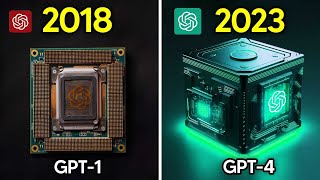
LARRUZ traces OpenAI's GPT models from 2018 to GPT-4, showing how scale transformed them from supervised NLP to systems that learn from raw text. GPT-3 brought few-shot learning and public attention. GPT-4 added images, scored in the top 10% on the bar exam, and improved safety, though hallucination and bias remain.
Questions this video answers
2018
117 million
1.5 billion
At least $10 million
1 million users in five days, according to OpenAI co‑founder Sam Altman
Chapters
ChatGPT has taken the world of natural language processing by storm thanks to its impressive performance and versatility. But how did ChatGPT evolve from its initial version GPT1 to the latest version, GPT4? In this video we'll explore the key milestones in ChatGPT's journey and discover how it has transformed the field of natural language processing. Before GPT1, natural language processing models were trained on large amounts of annotated data for a particular task. This meant that the model was limited to what it has been trained for and failed to perform out of the box tasks. To Overcome these limitations, OpenAI proposed a generative language model GPT1 built using unlabeled data and then allowing users to fine tune the language model so that it can perform downstream tasks such as classification, question answering, sentiment analysis, etc. This means that the model takes input a sentence, a question and tries to generate an appropriate response and the data used for training the model is not labeled. GPT1 was launched in 2018 and was trained on an enormous Boox corpus dataset. With its pre training, GPT1 achieved significant milestones such as carrying out zero shot performance on various tasks. This ability proved that generative language modeling can be exploited with an effective pre training concept to generalize the model. With transfer learning as its base, GPT became a powerful facilitator to perform natural language processing tasks, tasks with very little fine tuning. However, GPT1 had some limitations such as a relatively small number of parameters and a tendency to generate repetitive or generic responses. But despite its flaws, GPT1 paved the way for more advanced language models such as GPT2, GPT3 and beyond. ChatGPT1 was the first generation of this language model and it was groundbreaking in its own right. But as time passed, researchers and developers continued to make advancements that pushed the limits of what was possible. Improvements from GPT1 to GPT2 that brings us to ChatGPT2, the second generation of this remarkable language model. So what exactly are the improvements that were made from GPT1 to GPT2? First and foremost, the amount of training data used to develop ChatGPT2 was significantly increased. It had 1.5 billion parameters compared to GPT1's 117 million parameters. This allowed GPT2 to generate more coherent and realistic text. This allowed the model to better understand the nuances of human language and produce more coherent human like responses. Additionally, the architecture of the model was improved allowing for more efficient processing and faster response times. This made ChatGPT2 more powerful and versatile than its predecessor. But perhaps the most significant improvement made to ChatGPT2 was the development of the unsupervised learning approach. This approach allowed the model to learn and make predictions based on vast amounts of data without the need for explicit instruction or guidance from humans. It was a major breakthrough that brought us one step closer to truly autonomous AI. And as ChatGPT continues to evolve and improve, the possibilities for its applications in fields like medicine, law and finance are truly endless. Breaking down GPT3 GPT3 has been the talk of the Internet. Similar to its predecessor GPT2, the idea of a language model that learns unsupervised without any fine tuning has captivated the public's imagination. GPT3 is trained on a massive amount of data from the Internet, including books, articles and websites. This allows it to understand and analyze language patterns, which it can then use to generate its own text. In fact, it can even generate text that is difficult to distinguish from human written text. One of the most impressive capabilities of GPT3 is its zero shot learning. This means it can perform a task it has never been trained on before just by being given a few examples. It's like a student who can ace a test they've never seen before just by understanding the underlying concepts. For example, it can translate text from one language to another, summarize long articles, and even write computer code. It's like having a virtual assistant that can do just about anything you need it to. GPT3 has gathered attention from tech industry leaders and experts who see its potential to revolutionize the way we interact with computers and machines. Its capabilities in natural language processing have already made it a popular tool for developers and researchers alike. One of the key benefits of ChatGPT is its ability to produce natural responses. This makes it a suitable alternative for customer service and chatbots in various businesses. For example, if you're a customer who's having trouble with a product, you can chat with ChatGPT and receive help in a way that feels more personalized than talking to a robot. Another benefit of ChatGPT is its versatility. Users have already discovered that the model can be used for much more than just conversations. It can be used for writing, brainstorming, and even generating ideas for creative projects. This versatility makes it a valuable tool for writers, marketers, and anyone else who needs to generate text quickly and efficiently. In fact, ChatGPT has already reached 1 million users in just five days since its release, according to OpenAI co founder Sam Altman. This shows just how versatile and useful chatGPT can be for a wide range of users. GPT3 is the best generalist language model by far and has sparked debates about whether it is the first artificial general intelligence. But is it perfect? Not quite. GPT3 often repeats or contradicts itself in longer passages of text, and it has a tendency to make mistakes. It is also incredibly power hungry and has a large carbon footprint, making it bad news for the environment. And with the costs of training this technology estimated to be at least $10 million, it's out of reach for all but the richest labs. One of the biggest challenges that GPT3 faces is the bottleneck in training data. Think of it like GPT3 is like a super smart student who needs a lot of practice problems to get good grades. Without enough practice problems, the student may struggle to learn new concepts and on tests. Similarly, GPT3 needs a lot of data to learn and perform new tasks. Although it's capable of learning new tasks with just a few examples, it may not be able to do so efficiently without enough training data. This means that it may just recognize patterns in new tasks based on its training data, rather than truly learning and developing a model for the new task. Some people believe that GPT3 is just a giant memory machine that can query a vast amount of data. While it's possible that a significant chunk of intelligence may rely on this associative memory, it's not the only component of intelligence. And let's not forget about the problem of bias. GPT3 is trained on the Internet, which means it's exposed to all the disinformation and prejudice that exists online. And unfortunately, it reproduces that same bias when generating text. But here's the real despite all these issues, GPT3 is still a triumph for those who believe that bigger is better, it's proof that computing power and data can take us to incredible heights. As GPT3 continues to evolve, we can expect it to become increasingly better at generating plausible text that's contextually relevant. The exciting innovations of GPT4 GPT4 is a new AI model that's a big step forward for natural language processing. It's a multimodal model, which means it can handle both text and image inputs, a major improvement over previous models. It can even answer questions about pictures. During the demo, GPT4 was asked to explain why an image of a squirrel with a camera was funny. The system replied, the image is funny because it shows a squirrel holding a camera and taking a photo of a nut as if it were a professional photographer. It's a humorous situation because squirrels typically eat nuts and we don't expect them to use a camera or act like humans. In another test, Brockman submitted a hand drawn sketch of a website and the AI could create a functional website based on that drawing. But it's not just image recognition where GPT4 shines, it's also more creative and collaborative than ever. For example, it can generate and edit content with users, whether that's a song, a screenplay, or simply learning a user's writing style. GPT4 has also proven itself in academic tests. In a simulation of the bar exam required for US law school graduates, GPT4 scored in the top 10% of test takers, whereas the older GPT 3.5 scored in the bottom 10%. This shows that GPT4 can handle much more nuanced instructions and solve more complex problems. Another area where GPT4 outperforms previous models is in reasoning capabilities. In a demo on the OpenAI website, GPT4 was able to find a 30 minute meeting slot based on the schedules of three people. Plus it's more multilingual, answering questions across 26 languages with high accuracy. OpenAI has worked to improve these defects with GPT4 by training it on data from user conversations. With ChatGPT, it responds more sensitively to medical and self harm advice and wrongly responds for disallowed content less often. However, the company warns that GPT4 may still make up facts and users should be careful with its outputs. It's currently available for users of ChatGPT plus and developers can sign up on a waitlist to access the API. We'll be sure to keep an eye out for more updates on GPT4's progress in the future. Challenges and controversies in the evolution of ChatGPT AGI stands for artificial General Intelligence, which means a machine that can think and reason like a human. GPT4 is a new AI model that has been developed by OpenAI. It is an advanced version of GPT3. Sebastian Bubek, who works at Microsoft, had early access to GPT4. Sebastian and his team have been doing scientific research on GPT4, which is an exciting task. They have been studying its behavior and trying to understand its potential capabilities. One of their findings is that GPT4 has the potential to be an AGI. Now you might be wondering how they came to this conclusion. Sebastian and his team have been experimenting with GPT4 and they have found that it can generate text that is very close to human, like language. They have tested it by asking it various questions and it has responded with accurate and intelligent answers In a recent episode of the Sam Altman and Lex Fridman podcast, Lex asked Sam about his thoughts on the potential dangers of AI, specifically referencing GPT3 and ChatGPT. He went on to explain that the biggest danger of AI is not necessarily that it will become malicious and try to harm humans, but rather that it could be misused, used, or unintentionally cause harm due to biased or flawed programming. He emphasized the importance of responsible AI development and the need for companies and researchers to carefully consider the ethical implications of their work regarding GPT4. Specifically, Sam expressed optimism about its potential for positive impact, stating, I think that ChatGPT is a really cool technology that can be used for a lot of good things and I don't see it as inherently dangerous. However, he also acknowledged that there is always a risk of unintended consequences and emphasized the need for careful monitoring and regulation of AI technologies. As we wrap up this incredible journey through the evolution of ChatGPT from GPT1 to GPT4, one thing is abundantly clear. AI is revolutionizing the world as we know it. But with great power comes great responsibility, and we must use AI wisely and thoughtfully. As we look forward to the future of the CHAT GPT series, we can only imagine what GPT5 might bring to the table. While it hasn't been released yet, the potential advancements in natural language understanding and creative text generation are undoubtedly exciting. Building upon the successes of its predecessors, GPT5 could very well push the boundaries of artificial intelligence even further, potentially merging robots and AI into one, which would mark the arrival of AGI.










