The Hottest AI Breakthroughs of the Week You Might Have Overlooked!
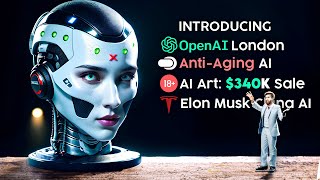
This content was created by LARRUZ. This content was uploaded by LARRUZ. This is a YouTube video titled "The Hottest AI Breakthroughs of the Week You Might Have Overlooked!" (published July 10, 2023). It is a single-host AI news roundup (Speaker A) that summarizes recent developments: OpenAI opening a London office; Huawei's Pangu 3.0 and the Pangu Weather Nature paper; Elon Musk praising China's AI (short quoted clip); an AI-driven senolytic discovery by Integrated Biosciences; YouTube testing AI-generated quizzes; Samsung opening an AI research center in Montreal led by Yoshua Bengio; OpenAI hiring a superintelligence control researcher; the $340,000 Sotheby's sale of an AI-generated nude painting; and Pleobot, a krill-inspired underwater robot from Brown University and UNAM. The piece is a narrated commentary aimed at viewers interested in current AI news and implications.
Chapters
It's been another busy week with lots of exciting AI developments, so today I'm going to share some of the most important news from this week. This includes OpenAI setting up its first worldwide office in London, Huawei's new AI tool called Pangu 3.0 and Elon Musk complimenting China on their impressive work in AI. We'll also talk about new AI research aiming to slow down aging, and how OpenAI is building a team to manage superintelligence. Like lastly, we'll talk about a piece of AI generated nude art that was recently sold for $340,000 and a robot inspired by Krill for ocean navigation. So let's jump right in. Okay, the first topic I want to Talk about is OpenAI, which has just announced that it is opening its first global office in London. They chose London because it's buzzing with AI activity from top notch universities, startups and experts. OpenAI's aim is to work with local scholars and officials ensuring AI aligns with human values and benefits. All their ultimate goal is creating artificial general intelligence AGI that's as smart as humans and trustworthy and accessible for everyone. This news is a big win for the AI community and the uk. London is already a hotspot for AI talent and innovation and OpenAI's presence will raise its profile even more. This could also spark more partnerships and knowledge sharing between AI enthusiasts like researchers, developers, entrepreneurs and regulators. I can't wait to see what OpenAI does next from its new base in London. On the other side of the world, Huawei released the latest edition of its advanced language tool, Pongu 3.0 on Friday. This is part of Huawei's strategy to use AI to speed up digital changes across many industries. Zhang Pingan, the head of Huawei Cloud, explained that Pongu 3.0 is made up of three a basic language model, an industry specific model and a scenario specific model. These layers will transform thousands of business sectors. Huawei's Pangu tool is already helping in areas like finance, manufacturing, government, energy, coal, mining, healthcare and railways. It's supporting AI uses in over 400 business situations. Also, Nature, a leading science journal, has published a Huawei paper about Pangu Weather, their revolutionary AI weather predictor. This is the first time a Chinese tech company's staff have been the only authors of a Nature paper. The paper details how to make a highly accurate AI weather forecast system that uses a deep learning approach applying 39 years of data. Years of data. It was featured in The Journal on July 5, 2023 and Pangu Weather is the first AI model that's more precise than traditional weather forecast methods. It's 10,000 times faster, taking only seconds to make global weather predictions, huawei says. The paper Accurate Medium Range Global weather forecasting with 3D neural networks verifies these abilities. Next up, we'll discuss how Elon Musk recently praised China's advancements in AI at the World Artificial Intelligence Conference in Shanghai. Musk, who's been involved with AI development for years despite voicing concerns after OpenAI released ChatGPT, has a strong rapport with China. He appreciates the vast talent and determination in China, saying, I've always been a.
Tremendous admirer of the sheer amount of talent and drive that exists in China. So I think really, China is going to be great at anything it puts its mind to. So that includes, you know, many different sectors of the economy, but also artificial intelligence. So I think China will have very strong AI capability as my prediction.
These comments come amidst US and China tensions over technology. In 2022, the US restricted chip and semiconductor exports to China, potentially hindering Beijing's tech advancement efforts. Musk has substantial business ties in China, including a major Tesla factory in Shanghai. He met with China's Foreign Minister, Qin Gang in May and has previously praised China's competitiveness in the automobile industry. His comments reveal his diplomatic approach towards China, recognizing their AI accomplishments and potential. He skillfully navigates potential controversy, aware of China's importance in the global AI market. His observations align with the reality of China's significant AI development, indicating that the country will remain a key player in the AI field. The fourth thing I'd like to chat about is a new study by Integrated Biosciences. They found a way to use artificial intelligence to help find new chemicals that can slow down aging. These chemicals, known as senolytics, can help get rid of zombie cells in our bodies. These zombie cells are damaged and can't multiply anymore, but they're still active and can cause problems. For instance, they release proteins that cause inflammation and can spread to other cells. Over time, they pile up and can lead to diseases like diabetes, lung fibrosis, arthritis, and even cancer. Researchers have found that getting rid of these zombie cells using senolytics can help manage these diseases. There are about 80 senolytics that we know of, but only two have been tested in people. The problem is finding more senolytics is time consuming and expensive. It can take up to 20 years and billions of dollars to bring a new drug to market. That's why the team at Integrated Biosciences used AI to make the process faster and cheaper. They trained their AI to learn from past experiments and then used it to predict if any of the 800,000 chemicals they tested could be used as senolytics. The AI found three new potential senolytics that could increase the lifespan of a worm used in aging research by 80%. These new chemicals come from natural sources like fruits and vegetables, fats and oils, and organic compounds that contain oxygen. They're more likely to be absorbed and used by the body safely, have fewer side effects, and are less likely to interfere with other medications. This study is a big win for aging research and drug discovery. It shows how AI can speed up the process and find more potent and safer chemicals. Alright. Another big News is that YouTube has just started testing a cool new feature, AI generated quizzes. This idea aims to enhance the educational value of its videos. After you've watched an educational video on your mobile app, you'll see a quiz pop up based on the video content. This AI powered quiz gives you multiple choice questions to test your understanding. It's up to you whether you take the quiz or skip it. If you decide to play along, a link to the video is provided so you can refresh your knowledge if needed. Right now, this feature is only available to a limited number of English language learners. YouTube is doing this to make learning easier and more engaging. It's a clever way to check what you've learned, make study sessions fun and personalize your learning experience. Okay, now Samsung is introducing some cool new AI updates they've been working on. They recently announced a new AI research center in Montreal, Canada. The this center will focus on language understanding, computer vision and learning techniques. It will be run by Yoshua Bengio, a leading figure in deep learning and winner of the prestigious 2022 Turing Award. He'll also act as Samsung's main AI advisor. This new AI hub is expected to enhance Samsung's products and services like Bixby, SmartThings and Samsung Health. The center will work with Samsung's other AI units worldwide, local universities and research bodies. Samsung's big move into AI could give it an edge in the tech industry. Their experience and resources could help them develop unique AI solutions. However, they face competition from other tech giants like Apple and Google, and need to navigate technical and ethical issues around AI like data privacy and accountability. Now back to OpenAI again. So OpenAI is putting together a team to control superintelligence, which is a hypothetical level of AI that surpasses human intelligence in all domains. They posted a job listing on its website for a superintelligence control researcher who will be responsible for developing methods for controlling superintelligent systems. This person will develop ways to control these ultra smart systems and put these methods to the test. The company wants someone skilled in math or computer science, with a background in machine learning or AI and an interest in long term risk scenarios. They should be able to work both independently and as part of a team. OpenAI's goal is to create artificial general intelligence, an AI as smart as a human in all tasks, but they want to ensure this AGI aligns with human values and is beneficial to all. They're worried about the possibility of creating an AI more intelligent than humans and the risks it could bring if not aligned with human goals. Their project of controlling ASI is ambitious and important, and it highlights their focus on both AGI development and its safe alignment with humans. But it also raises questions. Is it realistic to create asi? Can we control it? If it's possible, is it even ethical? I actually made a detailed video all about this topic, so if you're interested you can go to my channel and watch it. Or you can also find a link to the video in the description below. Okay, the eighth topic I want to talk about is a recent auction that made history in the world of art and AI. A nude painting created by AI just fetched a whopping $340,000 at Sotheby's, the highest price ever paid for AI generated art. The painting Nude One was made by an unknown artist using AI tech called a generative adversarial network known for producing realistic images from scratch. The piece portrays a woman nude on a bed, her face hidden by her hair. It's got a soft, dreamlike feel to it, much like Impressionist art. It was part of a collection, the Faux Real, made up of 10 AI artworks curated by Mario Klingaman, an AI art pioneer with ties to Google Arts and Culture. The idea was to display the range and creativity of AI art while also challenging what we think of as real art. This auction caused quite a stir. Some people praised the innovation of AI art. Others weren't happy about the lack of human touch. There were also concerns about the moral and legal implications of AI created nudity. A lot of people wonder about the right and wrong of it all, like who gives permission and who owns what. Some might even find it tough to tell apart real pictures from those made by AI, or how these pictures are even created in the first place. It's exciting to think about how AI artwork might change the art world. Will people accept it or avoid it? Will it inspire or put human artists to the test? Or maybe even team up with them? We'll just have to wait and see. Alright, the ninth and final topic I want to talk about is a new robot that is inspired by Krill, which are tiny crustaceans that live in large swarms in the ocean. This creation comes from the mines at Brown University and Universidad National Autonoma de Mexico with the aim of exploring the ocean's depths. Pleobot copies the unique way krill swim, a synchronized wave like movement of appendages that allows them to navigate tricky ocean terrains and move up and down in large groups. The hope is that understanding this swimming style can lead to nimble underwater robots working in groups. These could be used in a variety of tasks such as scientific research, monitoring the environment, rescue missions, and even space exploration. As of now, Pleobot is made up of three sections mirroring the legs of krill, but plans are in place to expand it with more parts and sensors. It will also be tested in various water settings. This innovative project underscores how nature can guide us in building versatile machines. It highlights how robotics can open up a new understanding of our oceans. This venture is exciting in the realm of biomimicry, replicating nature's methods for technological advancement, fostering fresh forms of intelligence and teamwork among artificial entities. Alright, that concludes this week's AI News. If you enjoyed this video, don't forget to hit the like button. Subscribe to my channel and click the Bell icon to stay updated on all my future uploads. Thanks for tuning in and I'll catch you in the next one.










