The Impact of AI for Social Good
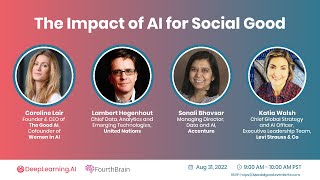
A recorded YouTube panel discussion convening UN, industry and nonprofit leaders to explore how AI can advance the UN Sustainable Development Goals and other social-good priorities. Panelists describe concrete use cases (disease and disaster response, carbon accounting, regenerative agriculture, precision medicine), barriers (data quality, dataset availability, complex ‘wicked’ problems), and practical entry paths (public datasets, community/hackathons, upskilling). The session closes with audience Q&A on governance, disaster prediction, and career transitions into social-impact work.
Chapters
Sam hi everyone and welcome to the.
Impact of AI for Social Good. My name is Greg Lochnane. I'm the Head of Product and curriculum at 4th brain and I'll be your host and moderator. We appreciate you taking the time to join us for this event. We're so glad to see you tuning in from all over the world. We have attendees from over 140 countries today. If it's late for you, thanks for staying up to join us. Our event today focuses on how to make AI do good things for societies around the world as our data and our lives become more interconnected. We're going to get right into it today. If you hear anything during our discussion that prompts a question you'd like to ask to one of our panelists, please follow the slido link in the YouTube description box. Even if you're just listening, you can click the link and check out the questions that have already been asked and upvote your favorites. Our speakers will do their best to answer all of the most upvoted questions during the Q and A portion of today's event. Without further ado, let's welcome our speakers. Lambert Hoganhout is the Chief Data Officer for Analytics and Emerging Technologies at the United nations where he studies the societal impact of AI around the world and works to understand how AI can be used to support the UN's 17 sustainable development goals or SDGs, including ending poverty and hunger, improving health and education, reducing inequality, spurring economic growth, tackling climate change, working to preserve our oceans and forests, and more. Caroline Lair is the Founder and CEO of the Good AI where she focuses on empowering companies and talent that use AI to help deliver on the UN's 17 Sustainable Development Goals. She is also a co founder of the nonprofit Women in AI where she works towards shaping a more gender inclusive AI for our common future. Sonali Bhavsar is the Managing Director of Data and AI at Accenture, where in her executive role she serves as a champion of diversity and inclusion in consulting services and software development. She also works with organizations and individuals to help underrepresented students and minorities build successful STEM careers. And Katya Walsh is the Chief Global Strategy and AI Officer at Levi Strauss Co. And also serves as Director of the Board at Securian Financial. An award winning business technologist who has spent her career helping iconic brands go through digital transformation and prepare for the future, she's passionate about AI, social responsibility, encouraging diversity and mentoring youth. Thank you all for being here today. What I'd like to start off with is to ask Each of you to say a few words about what you're working on right now in the world of AI for social good. Katya, will you kindly start us off?
Yes, Well, I always consider AI to be part of social good. And my job is really to help an iconic brand like Viva Strauss Co. Position itself for its next 170 years. It has been a company that has stood for what's right in the world since its very inception. It has always pioneered social change and it has been a vocal supporter of. Of human rights, diversity, equality. Just as one example, the founder of the company personally created scholarships for 12 people back in the 19th century, six of which were for women. That was at a time when women were not even allowed to vote anywhere in the world. So the company I work for, in addition to being a business, stands for social good. It has two foundations. So everything we do for this brand is in AI. In technology, in data also supports the platform that a business today represents in society. So a healthy business that is also standing for what's right in society actually contributes to AI for social good.
Thank you, Katya. Yeah. Speaking of iconic brands, Lambert, can you talk a little bit about what is going on at the United nations these days with AI for social good?
Sure, yeah. Thanks, Greg. So a lot of projects going on with AI, obviously, both sort of practical projects where we use AI and also at the policy level. I think maybe one interesting project to highlight, because we just finished that, and I'm very excited about it, is a study that we did on what youth, young people between 10 and 24 years old think about AI and robots and what kind of future we want. Obviously, AI is going to be pervasive in our society in the coming 10, 20 years, and the young people now are going to live in that world, and I think they deserve to have a say in how we shape that future. So we did a survey and we did an imagination exercise where the young people wrote essays on how they imagine that future. And we really wanted to know both their hopes about AI and robots and their fears and maybe their ideas, brilliant ideas. And actually, we got a lot of good ideas out of that. And we just finished the report of that. It's public. You can find it. Go to our website, unite.un.org and you'll find the report somewhere. And very interesting results coming out of that. We're going to follow that up with a workshop with industry and policymakers to turn these ideas into action later this year. So that's. That's the most exciting thing for me that we're doing right now.
Very cool, very cool. Sonali, over to you. What, what are you working on right now related to AI for social good?
Thank you Greg for giving the opportunity. Kind of a lot of excitement around AI. Coming from a consulting background, we see a lot of ask for scaling AI, adoption of AI and then with the current ESG focus that we keep hearing in different aspects, it has both profit and non profit implications across the board. But at a personal level, I just went through a health crisis and one of the things I've started to notice is a lot of the health data can be used for prevention rather than for reactive purposes itself. Just basic data on how care is given to individuals or patients who go through that kind of situation and crisis mode. And that's become kind of a little bit of my personal mission to bring different data sets which are publicly available and as I do a day to day living is more on data. AI is the organic next step and more to come. But I see AI very foundational to what we are doing in innovation. But this is something which is a very passionate and a close topic for me to see it through. If we can make a difference from what our data sets speak to us and how we can make a difference.
Very cool, very cool. Caroline, I wonder if you could say a few words about the good AI and what's going on in women AI today. Maybe we'll. Looks like we've, we've frozen on Caroline for a minute, so let's, let's go ahead and circle back around. So what we'll do now is we'll just go ahead and dive into our discussion. So for the next half hour I'll be asking questions directed to specific members of our panel. I also encourage other panelists to jump in and offer their own input to enhance the conversation. Similarly, all of you out in the audience across the world, if you have any feedback or comments to add to the discussion, please post them directly in the YouTube live chat. And definitely if you have questions, put them in slido as well so we can upvote them and we can get those questions answered at the end of today's session. So thanks to all for giving those great examples. It seems like there are many examples today of AI for social good wins. Lambert, I'm going to start with you. Given your broad view of the world at the un, what's your take on why AI for social good projects? There just aren't more of them happening. What makes creating beneficial applications using AI so challenging?
Right. Yeah, that's a very puzzling question because obviously the potential of AI is so great and we keep seeing these examples of AI being trained and being able to do something amazing. So why haven't we yet solved all the world's problems with AI? And I think that one of the reasons for that is that the hardest problems in the world are also the most intricate problems, the sort of wicked problems. They are such complex situations, complex systems with many different factors. Now if you want to train an AI system to do something, you have to give it all the information it needs to learn the entire environment and learn all the different aspects of it, and then at some point it will learn it. But with these kind of complex problems, it's almost impossible to give it all the access to all the different dynamics and inputs. If you want to train AI on climate change, of course we're trying to do that and to predict models of climate change, but there's so many factors that come into play and to model all of those to create an AI system is very, very hard. So I think that's one of the challenges.
Yeah, the wicked problem of collecting all of the data you need to solve the specific issue. I wonder, Katya or Sonali, have you seen this kind of inability to collect enough data to solve a big enough problem thing happening in your industries?
Well, that's always a problem, Greg. You never have enough data. At the same time though, data is like life. You cannot govern it fully, you cannot control it fully. So in many cases, if not all the time, we just have to do what we get. Of course, always making sure that the data is not biased and potentially liable to create models that could be discriminating. But it's just part of life. When we approach this in business, we have to also be very practical and understand that it's not going to be perfect, but it will still be better than if we were not applying this tool that we now have in our hands compared to the past.
Yeah, yeah, 100%. So, you know, speaking of data and trying to make sure that it's high quality, you know, we take data centric approaches to solving these business and higher level strategic global problems. You know, Sonali, I want to go over to you, given your experience working across industries in consulting and at scale, what are some things that you found are best to keep in mind to ensure that we get high quality data that's also trustworthy when we're designing AI applications that are purpose built for social good?
It has multiple factors. And coin back to what Lambert said, it's A wicked problem. Even when we take the universe of data sources that are going to be the first cycle of doing AI, whether it's supervised or unsupervised learning, you are going to get some form of contribution of saying what is that use case that you're really trying to solve for? And it's not going to be 100% in the first go. So that's like the first rule of thumb of acceptance that when you get into creating that machine learning model to support that AI, it's going to be iterative process, that time commitment, getting that quality of data, saying the insights are really reflecting the quality of data where they are coming from. 9 out of 10 if you don't know what you're solving for. And I'll get to the point where you're trying to connect the dots, right? I mean, that's a bigger challenge that a lot of practitioners kind of get caught in. But if we were just to go after what we know and what we are trying to solve for, start with some trusted authoritative data sources and I think publicly available data sets have evolved over a period of time and they have truly added good data value to bring in pivots that make a difference. We still are at a point where some really good third party data sets sit in. Because of privacy constraints or because of challenges that we have with personal and policymaking, we can't share a lot of data, but a lot of that public data can be really put to good use for social good itself. And I think some of the things that are happening which will probably pick up traction down the road is working with an IST or working with institutions on policymaking, on AI initiatives and working with academia can make a big difference. Where these data sets then really involve what are the third party data sets that combine with your internal data sets that you're trying to solve for to really make a difference and start doing that AI modeling that becomes iterative in nature. The last piece to that data transformation is a feedback loop. What you learn is it has to be fed back to figure out what data sources to drop. If anything. You can't just take openly available social media data as part of your feed to making some of those judgment calls. So I think it has constraints on biases. But at the same time, if you trust the data and that's kind of accepted as part of your machine learning model, you have a good beginning to build that off of. And once it starts, you kind of know that you're going to get 2x or 3x in the first go and then you will get a little bit of plateau and. But then you will get only this much output as part of that iterative effort. Right. You won't see spikes coming as part of that machine learning model unless you add some other third party data sets as part of it. So it's an interesting journey, but it is a most essential journey and especially for social good. We just have to catch up and do that much more quickly and in a much more aggressive fashion to really make some of those decisions. I just feel very passionate about it. There is a lot that we can do and I think we are not, we are talking, but we are not. It's the how. We know the what, but we are not getting to the how and not making it more actionable down the road.
Yeah, I really like this idea of using public data sets. I saw a little bit of head nodding there. Katya, I wonder if this is something that you've leveraged in this, in this day where we're, we're using pre trained models and we're looking for data sets that are already available to, to try not to spend a ton of money on projects just to collect data, but to not really take it all the way. Is this something that you've leveraged in any of your, you know, companies that you've helped in these digital transformations is previously existing data sets or public data sets?
Absolutely, Greg. It's a great point. For example, at Vodafone Group in London where I was the first chief big Data analytics officer between 2015 and 2019. So not that long ago we had a treasure trove of data mobility data from 500 million consumers across 25 operating countries. But we were very careful about the use of the data. In fact, the, the company won a European Commission award for privacy, which is almost unheard of for technology and data companies. That's how careful we were. But we did use anonymized and aggregated data to track the mobility of people, particularly in Africa, which helped us track and help prevent the spread of Ebola and malaria in West Africa and it was hailed by governments in on the continent is something that was really helpful and we could really see the impact of that. And moreover, when Covid came to the world, the company was able to use that same approach, perhaps enriching the models with more data to make it of course relevant to the battle at the time. But we, it did use the same approach with more data and was able to help governments in Europe and Africa track and prevent the spread of the COVID 19 virus. So it has been very powerful. It's a great example of impact of business on social good across governments, across different countries.
Very, very cool. Yeah. I wonder Lambert, is, is the UN paying particular close attention to, you know, generating these data sets or making them more available for people that are interested in doing social good projects? Is this, is this a big push or, or is this, or is this something that, that you, you're spending a lot of time on in the last few years that you're paying attention to today? This idea of public data sets that others can use to generate business and social good value?
I think it's, it's definitely going to be important issue in, in the coming years. We try to do our bit and we're opening up more data from, from the UN side and also try to organize that better because I, I think there's a little word of caution here that in the past we've collected data for a particular purpose and that data might have been very useful and, and correct for that purpose. Now feeding that into an AI system that are going to make conclusions out of that data for a very different purpose might in some cases backfire. The data might need not be as, as high quality or as generically useful as we think. So I think it's a good direction that we're going into, but we have to take care of the data quality and that's going to be a tricky issue.
Yes, great point, great point. You know Caroline, I want to, I want to go over to you. Given your experience and your work with the good AI, helping from individual contributors to CEOs sort of build startups that think green, that as they develop these AI products they're trying to do so in a sustainable way. Can you talk a little bit about the role of that data is playing as they're trying to get their companies up and going? Is this often a purpose built data collection effort or are they often leveraging pre built models and data sets? What are you seeing from founders and your work in the good AI as they put together these products and startups?
So first of all, sorry, I did disappear so I'm right now from, from my phone. So really sorry about that and I may just take a couple minutes to just explain what exactly what we're doing at the good AI. So basically we build this community of AI experts last year and they're focusing on AI application for sustainable development, especially for corporate sustainability. So we have around 115 startups and 140 plus individual experts today. So AI professional from companies, researchers, PhD student students, around 30 countries represented and, and they come so with expertise but also many other different sciences like life sciences, electrochemical, social fields. So there is really different expertise because of course, as you may have already said, AI is interesting when you combine it with other, with other fields. And so basically what we do is that we organize events, workshop and collaboration with major companies, especially in the food and beverage sector, but also in the tiring industry to help them, to help them think out of the box. So we for instance we working with sustainability department and most of the time they have no clue what they can do thanks to technology and even less with AI. And we're also working with data and AI departments, IT departments. Green IT is one initiative that we find a lot in companies and basically we are making this bridge between corporates and our experts. So by the way to all of us that are listening, if you have a startups in the field, if you're interested in leveraging your skills for sustainability, we're super happy to, to have you joined it the community. So this is, this is basically what we're doing now. Regarding your, your question, I think it's a bit of everything you said, like I'm not identifying yet.
Okay. So I think that, you know, I'm noticing that there's a thread of green that's running throughout a lot of what we're doing. And Caroline, do we have you back and threat of sustainability as well? And so you know, I want to kind of go over to you Katya, and given your decades of experience doing digital transformation, sustainability has obviously been growing in popularity over time. Can you talk a little bit about your perspective to Sonali's point, going from what to sort of how, you know, what is your perspective on how AI can really be used to promote not just sustainable development, but also global health to maximize social good.
Thank you, Greg. I gave an example about how AI has already been used to track and prevent the spread of various viruses. And you can imagine what else the world can be doing. There is a whole field of precision medicine and of course that is both a business but a social good at the same time. But to your question about going from what to how many businesses today are struggling with at least three seemingly different and conflicting goals? One could be profitability. A healthy business has to be profitable. Another goal and challenge could be creativity, particularly in companies like apparel or even consumer packaged goods. There is always a creative element and that can be seen as being at odds with profitability. And at the same time, all organizations today have A goal to become more sustainable as organizations and to help combat the threat of climate change and really become green. And by the way, I love the name, the good AI and the mission that Caroline shared with all of us. And I would love to stay in touch with her and her organization. But back to the three seemingly conflicting goals. It used to be that businesses would have to make a trade off if they were to be profitable. Perhaps they would have to sacrifice creativity or sustainability if they were to reach their sustainability goals, perhaps they would have to trade off profitability, etc. With the combination of more data than ever before and the application of machine learning to that. We are now at the point in time when we can optimize all three goals at the same time. And that is not a new goal. But we never had that capability at our hands. That is a great and exciting time for organizations around the world to cease today. And that's really the motto. You can be sustainable, creative and profitable all at the same time. If you used this capability.
Is this something that you're seeing as well, Sonali, in companies that you work with and elsewhere?
Yeah, I am. I mean, it has become very mainstream, especially in banking and financial services that are my clients. Sustainability is right on top of the radar to support initiatives led by NGOs, led by, you know, underprivileged and underrepresented communities startups, how do you fund it? But it also comes with controls around it to make sure that they have a business plan, they are vetted out with how the funding mechanics would go through, what would be the process, when the funds are allocated, what would be the output, so the profitability and sustainability. But tied to a goal is something very, very essential to bring to light. And if I were to quote an example that literally happened yesterday, I heard Reliance, which is one of the biggest firms in India, they're going through a transition of where the ownership is changing on the consumer side. And one of the things that has been pointed out is they want to bring sustainability as front and center and bringing that underprivileged and underrepresented communities products and consumer goods onto their portal and be representative of that. So we are seeing major companies kind of making some of those changes, both from finance point of view, the production point of view. So that change to Katya's point, right, it's not one or the other, it is together. And that together is what's going to really make a difference down the road. Again, with all the controls around it to make sure it is successful, it's not just something that is taken for a grant of saying, hey, I got this and we are going to make it happen. But taking it all the way to execution is going to be an essential part of that journey.
Yeah. So I really like this idea of sustainability, but I know that it's such a broad term and it can mean so many different things to different people. For example, we heard the food and beverage industry and you know, I want to go over to you, Lambert, like, when you think of sustainability from your level, I mean, what, what comes to mind? What comes top of mind to you for sustainability?
Yeah, right. I'll answer your question, but I just wanted to continue on what Katya and Sonali were saying, that in my view, AI is not just a new technology that we adopt. Like, at some point we started using word processors on the computer and this is a new thing. No, I think for many companies, AI requires them to rethink their entire business model and the way they operate. Now, if they're going to rethink the way they operate anyway, then they might as well bring in that sustainability aspect as well. Because as we all know, being a good corporation, being a good corporate citizen is good business. And many companies try to do that. But instead of doing ESG as a sort of separate unit somewhere in the corner, as an afterthought, make it front and center of your strategy as part of your digital transformation or your adaptation of AI. And then from our side, if people ask, well, how can I be good? What is good for the world? To us, the SDGs are the clearest formulation of that, of what is wrong with the world and what is it that we want to fix? And of course, you don't have to go after all of these 17. There's probably one or two of them that are very close to the kind of industry you're in, the kind of business you're in. And I think that's, it's. It's a great opportunity to do both, to adapt your business to AI and become more sustainable.
Yeah, I love that perspective. You know, it seems that's what we're hearing from businesses all over is that need to adopt AI. And in doing so, I love the idea. It's like, why not do it in the best possible way for the good of all of us, and pick an SDG and sort of, you know, which. Whichever one is more aligned with your business. That's a great way to sort of start adding value in ways beyond just the bottom line and to really, really be a great corporate citizen. I think that that's something that isn't talked about enough. That's, that's phenomenal, phenomenal insight there. And so I want to, I don't know if you, if you've caught any of that, Caroline, but we're talking about sustainability and we're talking about these Sustainable development goals, the SDGs from the UN. I wonder what your perspective is on being a good corporate citizen and what people in your community are doing to ensure that they're integrating AI at the same time as they're integrating sustainability into their businesses.
Okay, so for us, and I think Lambert was explaining before the Sustainable Development Goal, adjust the way society should, should move towards. And so as a community, we believe today that like as an AI community we've believed that we don't have, I mean we cannot afford to continuing developing tech solutions only to maximize profit or having fun in the, in the metaverse. I mean we are facing very like very important challenges today with climate change. That has a very strong impact on the environment, on biodiversity. It really make living on earth even harder for certain populations. And so if you've been already talking about that, but so there is a high risk of starvation, pandemics, increasing migration crisis. So really again, as a tech industry, as an AI community, and I think that should be the case for any other industry in the world, I think we should really, I mean, use our expertise to solve those challenges. I mean we don't have a lot of choice here. And when it comes to corporates, so they're coming very strong with sustainability promise today. And so our goal is really to help them accelerate with AI. So we're focusing on five different areas of sustainability. Sustainability, corporate sustainability at the good AI. The first one is how we can help them reduce the carbon emissions and protect biodiversity. So you have a lot of startups today working on carbon accounting. It's a very complex topics. And ESG regulation is coming harder and stronger, so companies are really focusing on it. And it's again, it's complex. Even above all, when you have super complex supply chains, it's really hard to, you know, measure basically your carbon emissions before even thinking about reducing them. Then we look at use cases around circularity. Here again, AI and data can help companies, you know, work in a more regenerative way. For example, we have one startup doing regenerative agriculture. So they building environment control modules where you can basically grow any kind of crop anywhere in the world. And they're using AI to monitor macroclimate inside it. So this is a kind of technology that is super interesting when it comes to food security. And so major food companies are looking at this kind of technology, pharmaceutical as well to grow medicine, medicinal plants. What else do we have? We, of course we're looking at human rights, a future of work. Again, you can leverage AI NLP for instance, to measure mental health, mental health within the company to identify case of. More. Yeah, okay, back. Oh, big recall. So mental health at work. You can also leverage AI to NLP again. So NLP is natural language understanding to for example, analyze company statement about modern slavery. Regulation is coming very strong here. So companies are doing massive statements, but people are still analyzing them manually. So it takes a lot of time. Here again, you can use AI techniques such as NLP for this and the list is super long. There are a lot of, really a lot of use cases where you can use AI, waste management, recycling. So yeah, it's really exciting to see that we can apply AI basically everywhere because this is such a powerful technology to measure, to optimize, to predict. But we also need to educate to have more and more, to have more and more AI engineers, more and more data scientists that are, that are willing to use the expertise for those purposes.
Yeah, you know, in sort of double clicking in on this, going beyond tech solutions, you know, speaking to our audience directly, you know, we've got people all over the world, a lot of them clearly have interest in AI for social good. Maybe many of them are sitting out there thinking like, yeah, this all sounds great, but I'm not sure what I can do to have an impact right now. Should I go download a public data set on something that fascinates me and interests me and try to put together an AI project on my GitHub account? What should I do to get started? I don't feel like I can put together a social entrepreneur venture today. I don't feel like I have the sort of resources and funding that a lot of the projects you're talking about, you know, maybe have at their disposal. You know, what steps can people start taking today from wherever they are to have an impact if they're interested in the tech and they're also interested in AI for social good. Let's start with, with you, Lambert. What would you recommend to all the youth out there that you've been asking, hey, what do you think this world's going to look like? Let's take it a step further and say, how do you think those youth can, can work towards shaping it so it's a little bit better in the future?
Sure, yeah. Let me Let me say two things. First, you're right that not everybody at the moment has the sort of technical capabilities and the equipment and the data to, to start doing their own AI systems. But I would think that that time is coming pretty fast within the next couple of years. The trends that I'm seeing is that five years ago you might need a huge server at Amazon or Google to run an AI system. Three years ago you could do the same thing on your laptop. And right now there is systems, for example, to use computer vision to monitor agriculture, etceter, etc that can run on a cell phone. So people can actually use that in the field. And there's more and more AI applications that everybody can use. Not literally everybody, but you need very simple equipment like a cell phone to start using that. The second thing I, I'd say that people can do is just awareness because I think technology in general, and AI in particularly in particular is moving so fast that if we're not careful, we're just at the mercy of what AI is going to be able to do. I think we should be more intentional about it. We should be intentional about how we embrace AI, how we adopt it into our societies, what we want from it and what we don't want. And that starts with awareness and understanding. So educate yourself, understand what AI is doing, what the issues are. That is one of the most useful things you can do right now.
100%. Yeah. So in terms of steps that, that people can start taking today, what are you recommending Sonali to, to people that you're mentoring about how to get started in a STEM career today? What's your advice to them?
It's kind of, you know, back to Lambert and Caroline's point earlier. Take a use case, take that problem statement to define what it takes to, I wouldn't say solve it in totality, but at least make a pivot of where you can see certain outputs. And being an engineer, this is something I did in computer science all the time. You figure out what are your different data sets, what you're going to build out and kind of start the same logic and use what is available out there and you know, have that community of whether it's GitHub or somewhere where you can get that kind of hackathon experience to get the inputs on really bringing that use case to light. The one thing I do see is the passion for understanding the problem statement is equally important on what you're really solving for. And not solving for the sake of just calling it out. You're really solving because you feel very strongly about it or you know, what are the gotchas that have come into being. So I would say, you know, from high school kids, even middle school kids, they are very good at creating machine learning models and exploring them and getting them upfront in solving their own challenges of seeing what they see that they can explore and have that entrepreneurial mind. Being curious and creative is the first step to it. And then tying it back to a use case is something where you can use public access data to really figure it out. And even starting with basic code like Python coding and bringing it from GitHub and getting public data sets, it's a good beginning. Not the ultimate beginning or the ultimate solution, but at least it's a good beginning to kickstart a thought process on solving some of the public challenges that you have on hand.
And Katya, what are you telling your mentees today that are interested in making an impact?
I'm learning all the time from my mentees, but I would summarize the waste in which we can start contributing to AI for social good in three parts. 1. Volunteer to volunteer with a favorite charity or foundation and use the skills that you have to help solve these problems. You may not be able to donate money, but you have immense skills already. I see on the chat people from literally all over the world and you can use open source data, open source tools and your precious skills to help solve these problems. It's not about asking new questions, it's about applying those skills to solve agile problems that we now can actually start solving. The second part is use the power of the crowd and using those skills join a community. The community can be a hackathon as Sonani mentioned, it can be the good AI that we have right here with us or any other organization. But there's more power in numbers. So to the extent that you can join that crowd, and I'll give an example, at my current company we have a foundation where employees actually donate funds to help other employees. It's one of the first in the world and we recently held a hackathon where data scientists use this precious skills and time of their own and created models to help personalize the email campaigns that the foundation sense for fundraising. It also created models or the data scientists created models to predict weather events and disasters so that we can warn people in advance. This may sound basic, but it actually can be very, very powerful. Even the basics can help these organizations. And the third way to help is actually by lifting your own skills and helping others get ups and and companies today are Very sincere. In digital upskilling, they're spending a lot of money and effort to upskill employees. And at Levi Strauss Co. We actually led an industry first machine learning boot camp in which we have trained over 160 people from all over the world. And these are people who have had no experience and no exposure to code. Most of them had never seen code in their life before. We took people from retail stores, from distribution centers, from all corporate functions, HR and finance, of course, technology as well, in 25 locations around the world. And during the pandemic we actually used that opportunity to upskill people who are now dispersed around the company. They're in their old jobs, but they have, they're using these new skills to upgrade those jobs to deliver automation and optimization and transform them. And yes, it's good for business, as Lambert mentioned, but it's also great for society.
Yeah, that's amazing. That is amazing. You're really speaking to me about upskilling and taking people from zero to doing good with AI. You know, that's, that's, that's amazing. You know Caroline, let's go ahead and close out this question with you of what can we do to make an impact today? Of course we can engage with a community like yours. What other advice do you have for our listeners out there?
Well, my advice is above all around engaging with communities and there are so many today. And maybe because I totally agree with Lambert, Sonali and Katya, there's not so much to add but I want to name a few communities that you guys can join. Omdena OM D E N A is a, is a very interesting big platform for data scientists where you can, you know, enroll into three months project and really increase your skills if you're into climate. And Omdena by the way is really focusing on AI for social good. I found out about a new community today which seems really amazing. It's called Work on climate. So it's not only about AI but it's about any kind of tech. And I also invite people to look at complementary technologies and science next to AI again. And so I think they have more than 10k people, they have a very active slack. And last but not least, and we haven't had a chance to talk about it again, sorry for all the connection problems today but women in AI and all the women related AI organizations are a great place to start for any ladies. By the way, if you want from getting to know people in the industry to learn the basic of AI and get in touch with researcher at higher level of expertise. I really recommend to join this community as a first step. And then of course, education. You have a lot of MOOC online, more and more on AI and sustainability, even if it's the beginning, but you can find, you find them. And if you're even younger, you can also check some curriculum. I know in Europe that I think UCL in London is launching a first master on AI for system. I'm very, very happy about it and I hope there will be other, you know, other masters and even curriculum for younger students to, to start early. We need it.
Awesome. Awesome. Yeah, so it sounds like, you know, really to get started, it's like pick a problem that you're passionate about. You know, pick a wicked problem and figure out what it is that you're trying to solve for and use those tech skills that maybe you have today, maybe you need to wait until tomorrow to pick up. But you can start from wherever you are and you can start working towards making an impact for social good today.
And what I want to add, what I want to just add is that you don't need necessarily to go and work for startup. That's really cool. But we really, we need people as well working in big corporates, we need people to join United nations, we need people in research. You know, startups are cool, but it's not the only place. We need people everywhere.
Yes, we do. We need people everywhere. So I want to go ahead and switch over to the audience questions now and we're gonna, we're gonna focus on.
The.
Top slido questions that we've received. So the, the first one here, this one, this one is definitely for you, Lambert. This one is how concerned are nations in preventing an AI arms race? Do you ever see this emerge in a serious way among political discourse?
Wow, that's, that's, that's a tough one. You know, it's, it's logical that with AI being so powerful, it becomes, it has a strategic value. Right. It as potential as a strategic weapon. And that makes things very, very sensitive. Of course, as the un, we will advocate for using AI for good and sort of to curtail the use of AI in weapons. I don't see that we can completely avoid that. If I look at the study we did with youths, I think they were very realistic about it. What where they said they found a red line, something that they really do not find acceptable is AI autonomously attacking people or killing, killing people. But I think they, they also realize that the inclusion of AI in the way weapons function is, is definitely, you know, in in the future, in, in some way, hopefully we can create some kind of international dialogue to put some sort of international standards similar to what we've done on nuclear energy, for instance, and nuclear weapons. So hopefully that, that can happen. The other thing that I wanted to mention is that the negative effects of AI are also the brain drain from countries where AI is not that prevalent yet and where they don't have such high salaries to be concentrated, all in a few countries in the world, mainly two countries in the world where AI is growing very rapidly and that creates a sort of an imbalance in the world. And I hope we can also find a way to share knowledge and expertise of AI more equitably around the world.
Yeah, yeah, that was a, that was a bit of a hard pivot. Thanks for, thanks for that answer, Lambert. Looks like that was the most upvoted question we've got. Our next question is on AI for fire or other natural disasters predictions. This can help in anticipating disasters or in rescue missions. Any promising projects that anybody knows of in the audience here. If, if, if nothing comes top of mind, I'm going to throw back to you.
I, what I can say is one of the applications where AI, I think has a lot of potential is where you need to react very, very fast. Because humans in some cases can do things just as well as AI, but not in 12 milliseconds and that is fires is one another. Natural disasters are situations where you need to react very, very quickly. So I think there's potential of AI.
There and there are existing projects and startups. I just don't have the word now and my computer is already working work and so but there are definitely startups, nonprofit working on that. If you, if you look a bit on the Internet, you'll find them. Mark.
Fantastic. Yeah, so we've got one here that sort of aligns with some of the things we've discussed today already. Daniel Ramos asks which skills do I need in order to transition from business projects. So presumably Daniel's already working on business projects for AI to social impact projects with AI. Can you recommend some resources to make this transition? Let's see. Maybe over to you, Katya, what would you recommend as somebody who's business minded but wants to do more social good?
Yeah, business mind and skills are great for social good applications. You don't need to change that. It really is applying these skills and mindset about solving problems to an area that is equally important to society. And again, business and social good are not at odds with each other. They do not have to be different and they do not have to be in conflict with each other. So it's really about taking these skills, solving the problems, but mostly about curiosity, resilience, perseverance when something doesn't work out, not giving up iterations, making mistakes and being able to forgive yourself for those mistakes. And most importantly, learning from those and working with others and really using the power of what you have been able to apply in business. There's so many resources out there. Coursera is one. There are lots of boot camps as I mentioned earlier. There's so many of them in the world right now, a lot of them actually, that societies and governments are sponsoring. I would also say that it's not about the degree, it's not about getting a PhD or a master's. It's really about a certain mindset. So if you're already solving the problems in business, you're probably very well suited already to solve problems for society and social good.
I may just add that I had Daniel, I had this, this situation because before starting the good AI I used to work as a. I have a business background but I had the chance to join an AI startup working on embedded voice recognition. So basically private by design voice assistant, respecting your privacy. So I was part of the business team. So I was somehow selling something for good because it was the anti alexa, if you know what I mean. So you can also keep doing business but just choose an AI company that is developing services that, that is linked to, to social goods basically and, and then you don't have to do any huge transition that's possible as well. We have plenty of startup by the way at the good AI that are looking for business developers and, and like the one on for instance on regenerative agriculture culture. So you can, you can find a. I guess I'm sure you can find what you want.
Awesome. Awesome. Well, it looks like that about wraps up our top questions from the audience. Q and A So I want to go ahead and just thank all of you today for your participation. This brings us to the end of today's event. So as a special thank you to everyone out there who's watching today, 4th Brain is offering a $500 scholarship toward our next MLOPS cohort that starts on September 13th or our next machine learning Engineer cohort that starts on October 18th. If you're looking to upskill in September, I'll also be personally available for 30 minute one on one career coaching opportunities, consultations with applicants where I'll demonstrate exactly what level of code coding experience you need to get started with an upscaling program so that you can achieve your goals today. Look for an email later this week from 4th Brain for more information. DeepLearning AI is also going to send a follow up email. We love getting your feedback on these events. We'd love to hear how to make them better in the future for you. A selected 100 attendees will also receive a promo code for 50% off a one month subscription to any Deeplearning AI Coursera course as well. Again, thank you Lambert. Thank you. Sonali, Caroline, Katia, this was phenomenal. We really appreciate your insights, your time, your expertise teaching us today about AI for social good. So thank you to all the speakers and for everyone joining us today. Always keep learning. Stay safe and see you next time.
Thanks so much. Thanks for all the Christians.
Bye bye.
Thank you.










