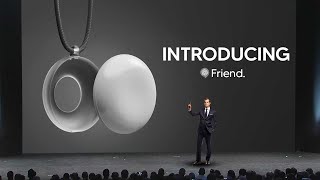
This content was created by LARRUZ. This content was uploaded by LARRUZ. This is a YouTube video titled "The New \"FRIEND\" Ai Wearable SURPRISED The Entire Industry (Friend AI Wearable)" (created 2024-07-31). The clip includes a short in‑video trailer (SPEAKER B) and a hosted commentary (SPEAKER A) analyzing the Friend wearable: how it works (always‑listening, Bluetooth connection, on‑device memory tied to the physical device), its positioning as a companionship product rather than a productivity assistant, privacy claims (no long‑term audio/transcript storage, E2E encryption, deletable memories), pricing (~$99, no subscription), shipping timeline (Q1 2025, US & Canada first), and target demographics (lonely users, older adults and some young adults). The commentary also raises technical concerns such as latency and usability for the elderly and invites viewer opinions.
Questions this video answers
About $99 (no subscription).
Q1 2025 (first-come, first-serve).
United States and Canada.
No audio or transcripts are stored past the device's context window; data is end-to-end encrypted and memories can be deleted in one click via the app.
Memories are attached to the physical device; if you lose or damage it there is currently no recovery plan (you lose your friend).
So with the rise of AI, there have been many different wearables that people have tried to make. Now, some of these have failed, but this recent attempt at an AI wearable seems to be rather promising as it tackles the problem of loneliness. Take a look at this small trailer where you can see how this product actually works. And then we'll dive into some of the things surrounding the product, such as how it works, how it's going to be integrated, and when exactly it's going to be released.
I'm out of breath. We made it. I don't know how to. Woo. Very good. That's fair. All right, let's go. Let me show you how to game, bro. Okay. Oh, come on. Come on.
Oh, let's go. Are you serious?
Come on. Man, I hate this skin. Trade notes, baby. Oh, man, you guys suck, bro. You look like the back. Let's go, let's go. Dude. What? How did you do that? I know, the effects are crazy. It's dank. I could eat one of these every day. Oh, sorry. I got you messy. It's really nice up here. How'd you find this place? I don't know. I just kind of like to come up here to be by myself. I've never brought anybody else. I mean, besides her. She goes everywhere with you, right?
Guess I must be doing something right, though.
I guess so. We'll see.
So that was the promotional video for the friend device. And essentially, if you don't know what this is, I'm just going to quickly explain to you how this device actually works. So. So this is a device that is consistently always listening. And how it works is basically you talk to the device. Then of course, you can basically read what the device says after it manages to understand what you say. And then you can go back into your environment. You can see right here on their page, they say, talk. Okay. Speak about what you have heard and of course, pause as your friend manages to come up with something it's going to say. And I'm wondering what the latency is on this, because as we know, latency is one of the biggest issues when it does come to AI products. As you all know, streaming these from many online models or whatever model that they're choosing to use, it's going to be interesting to see how quick the response is, as many users have been frustrated in the past with previous products. But basically the reason that this product is rather different is because this is a product that is always listening. And in doing so, one of the benefits that this product actually does have And I do have to say hats off for this is is because it allows this AI system to gain an understanding of the additional context. And I think that that's remarkably important because some of the times when you ask an AI model something or you give it a piece of information, it doesn't have the surrounding context. That would make understanding your message a lot more easier. For example, if you're saying, oh my God, today is awful, today just sucks, if it was able to listen to, you know, everything that went on today, some of the conversations you've had, it might instantly be able to give you some nice advice on exactly what is going on. And I think that this is rather interesting as regards to how we interact with devices in the future. So that is the device. Now of course, you might be wondering, okay, is this just another ripoff? How is this going to be any different from devices such as the AI Pin which was made by Humane, which currently is in talks as they're trying to sell the company because I'm not sure, it's pretty profitable at the moment. And of course the rabbit R1, which was a product that did work, but they just overhyped it and of course they underdelivered and due to the founders being involved with certain shady products, there was just not the best light that was being highlighted around that product. So essentially they state here that the rabbit R1 and the humane AI pin were basically advanced AI assistants that were there to increase product productivity. But the Friend doesn't try to automate or optimize anything. As my colleague Rees put it, it's much more vibes based than productivity folks. So for those of you who are thinking that this product is one that is going to be in the niche of productivity so you can ask it to xyz, it's not that at all. This is a product that is marketed specifically for addressing the problem of loneliness. So I'm guessing that this is more so towards those who are looking for a companion, hence the name Friend, rather than an AI assistant that actually helps you with your work. And of course you can see here that he states, productivity is over. Nobody cares. No one is going to be Apple or OpenAI or all of these companies that are building jobs. The most important things in your life are people and the Friend purely offers companionship. It's meant to develop a personality that complements the user and is always there to gas you up, chat about a movie after watching it, or help analyze how bad a date, how a bad date went. And not only does Shifman want the friend to be your friend. He wants it to be your best friend, one that is with you wherever you go, listening to everything you do and being there to offer you encouragement and support. Now, of course, you might be wondering, how much does this product actually cost? This product is rather cheap considering it's only around $99 and has no subscription. Now, one of the things that you might also wonder is that when are you going to receive this product? Or, well, this product, it's going to start shipping in Q1 of 2025 on a first come, first serve basis. So for those of you thinking that this is a product that you do want, of course you're going to have to order first. And I'm guessing that the first batch of orders are going to be the ones that are going to be shipped out first. So if you do want this product and you are in a different location, such as outside of the United States, currently, you won't be able to get this. It's only available in the United States and in Canada. So unfortunately for those of you in those regions, you're going to have to wait until they do offer worldwide shipping. Now, you can see here that it is always listening. So when connected via Bluetooth, your friend is always listening and forming their own internal thoughts. What I'm guessing by this is that the AI is probably summarizing your daily actions and is largely probably going to be summarizing exactly what's going on based on the conversation it is hearing. So this is how it works. And of course sometimes you can see that it says we've given your friend free will for when it wants to reach out to you. So it could say some things at sometimes completely randomly. Now what's also interesting right here is that they also managed to talk about a very important issue. One of the main issues that many people have been facing slash talking about is this issue. So the issue of privacy. One of the things that most people are confused about is how is my privacy going to be protected? So it says here that no audio or transcripts are stored past your friend's context window and your data is end to end encrypted and all memories can be deleted in one click within the friend app. So essentially right here they're stating that privacy isn't an issue. And what's actually kind of interesting about this is that we have a thing that they talk about where they essentially say that, you know, what happens if I break the device? And if you break the device, your friend and their memories are actually attached to that physical device. So if you lose or damage your friend device, there is currently no recovery plan, which essentially means you lose your device, you lose your friend. And the reason that they do this is because they essentially want this thing, this device, to actually feel like a friend and like a companion, rather than something that is just being, you know, like a cloud model that's just existing somewhere in a data center in the United States or something. So I'm guessing that they want this to actually feel as if it's some kind of friend or some kind of actual person. Now, let me know what your thoughts are on this device. I personally think this device is rather important, although I do think the demographic of this is probably going to change. I think that the demographic for this is probably not going to be people at our age. Whilst yes, it just completely depends, I think the demographic that this is probably likely to target is those that are, of, of course, number one, lonely. But I do think probably the elderly population. One of the things that the elderly do suffer with is, of course, loneliness. And I remember that looking at the loneliness crisis in America was of course, the older adults, which were 65 years and older. But interestingly enough, one of the recent reports actually conducted in February of 2023 showed that 24% of young adults under 30, which are, you know, 18 to 24, essentially reported feeling lonely a lot of the day, which is essentially higher than any other age group. So it's going to be interesting because there's going to be young people that are probably going to be using this device. And then of course, the older adults which are 65 years and older, are probably going to be using this device as well. Now, of course there's going to be the technological barrier for those that are older, so hopefully this is something that you're easily able to set up so that way the elderly can use this as well. I'm intrigued to know your thoughts, but it will be interesting to see how this product is received by the wider community. You enjoyed the video. I'll see you all in the next one.