The Physics Bug That Stumped Everyone Is Finally Gone!
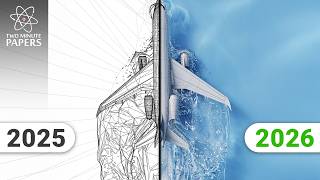
A new fluid-solid simulation technique using the lattice Boltzmann method solves a long-standing physics problem: stable two-way coupling between air, water, and solid objects at extreme density ratios. The method runs four times faster than previous approaches while handling effects like stone-skipping, coin fluttering, and propellers without the clipping and stickiness that plagued older simulations.
Chapters
Finally! Yes! This amazing technique solves the problem of this physics glitch where objects just clip through water. By the end of the video, I'll tell you how it works in very simple words. But it turns out there is more to this. There is excellent life advice in this research paper, and you will see if this can get close to reality or not. That is an incredibly tough test. Spoiler alert, there is no AI here. No neural networks guessing the pixels. None. This is Physics fueled by nothing but human brilliance and the beauty of nature. Okay, now, there are research works on how to simulate liquids moving around in a computer program. And yes, they can do this, and this, and this. But very few people know that almost all of them are missing one key ingredient. Let me show you. Here is a propeller put into water, and wow! That is a beautiful turbulence simulation. Wait, what? What is going on in this one? This one isn't even in the water. What are we expecting to happen here? Ooh, air-driven turbulence. That is crazy! Let's slow it down a bit. Absolute pandemonium. And it is beautiful. What an incredible detail. I really want to know how this is possible. This technique can pull off this sort of miraculous simulation, and you'll see a bunch of others as well. Like this, and this, and this. And look at this one. It is raining cows and bunnies. What? I have heard of raining cats and dogs, but this is ridiculous. But look closely. Beautiful bubbles and swirls appear. Words fail me to describe how beautiful these are. And not just beautiful. The physics remains rock solid despite many of them being of different densities. Also, here is an airplane ditching into water. I learned a new word here, this is a controlled landing. If you look at the top of the container, the splash actually hits the ceiling. That is the level of energy we are dealing with here. Okay, question: why is this so hard to do? Well, because water is heavy, and air is light. About 800 times lighter, to be exact. In the simulation world, this is a nightmare. It is like a sumo wrestler trying to dance with a mouse without stepping on it. Usually, researchers resort to cheats or ignore these effects to keep the math stable. Otherwise, it blows up. But not here. These researchers said, no sir, we do it the hard way. Okay, so most computer games are a bit like a mosh pit. This is where rockers do— whatever these rockers are doing. Just let them be and keep your distance if your life is dear. This is how solids and fluids behave in most programs. They don't know the rules, they step on each other's toes, and they crash into each other. When you are 20 years old, really cool. When you are 40, life hazard. No thanks. Now, this technique turns this crazy mosh pit into a synchronized ballet. The input is your 3D objects and water. And the output is, look, The most well-mannered physics you've ever seen. Of course it is. It was developed in France. Partially. Mon Dieu! Now, this ballet is what experts like to call two-way coupling. It allows us to simulate this incredible situation. Look. Notice the air bubble forming in front of the windshield? That is not some fake effect. That is the air particles realizing they have no room to dance and getting out of the way naturally. Note that I haven't forgotten about the testing against reality part, that is coming soon. And in the wake of the car, you get these incredible flow patterns too. It can simulate disk sliding, stone skipping, it can simulate how a coin flutters when thrown into the water. Wow. I am getting really excited here. I think I need a little break to cool down. Okay, I'm back. Let's unpack the secrets of this paper. This uses the lattice Boltzmann method. Traditional techniques are a bit like a manager shouting to the whole crowd with a megaphone. But this one instead whispers instructions into the ears of every single dancer. It operates with two steps: one, particles moving freely, and two, interaction. Ever had a day at work where you have hours and hours of meetings, and the time you actually have left to work is in small 15-minute blocks? Ooh, it's terrible, right? Of course it is. You cannot flow and collide at the same time. Just like these particles, you need a block of time carved out to move forward alone, and then separate time slots to interact with others. Once again, excellent life advice right there. Loving it. Then, it has a hybrid moving bounce-back technique that teaches the particles to dance properly. This says, if you collide with someone, here's what you need to do. Bounce back with exactly this much energy, and take some of the object's momentum with you. This is an etiquette guide for dancers, if you will. Now that is incredibly important. Why? Because this creates something called two-way coupling. That is the magic of this work. The water starts pushing the object, but in return, the object also pushes the water. There is a two-way communication between them. Again, that is actually incredible life advice. Successful relationships require two-way coupling. Both parties need to be able to influence each other. You cannot just push through with every decision without hearing out the other one. Power needs to be shared, or it is lost. Now, what if we don't do that correctly? Well, here is a previous technique that does not implement this properly. Now, hold on to your papers, Fellow Scholars, and look at the new one. Oh goodness, now we're talking. That's a dance! So, how much do we have to pay for this new one in terms of simulation time? It takes how much longer? 10x longer? Hmm, let's see. Excuse me? What? This is not only so much better than the previous method, but it is also 4 times faster at the same time! This sounds like a dream. Wow. And it not only looks better, but it can perform things that previous techniques can't even dream of. For instance, this was the stone skipping across the water. Most simulations cannot do this. Why? Because they are too sticky. But this method simulates the air layer between the stone and the water. Our little dancers can get to have their own personal space on the dance floor. This way, the stone can actually bounce multiple times. Okay, and now, the toughest test. This is almost impossible to do well, so I am really excited for this. Let's compare it to the ultimate judge. Reality: Phase 1: The breach. As the key slices through the surface—I am loving this already!—there is no clipping here. The water is forced to part ways. So good! Phase 2: The veil. This is the critical moment. Oh my, look at that long pocket of air trailing behind the key! It looks like a bridal veil made of bubbles. Beautiful beyond words. Just like real life. And now, phase 3: the end of the wedding. This is where the math shows its muscles. That smooth veil you saw a moment before now becomes unstable. The water pressure crushes it, and it becomes a cloud of bubbles. An incredible story in 3 phases. And I see absolutely nobody talking about this work. Nobody. Think about what a tragedy this is. This is why I am doing Two Minute Papers. To give a voice to incredibly brilliant works like this, and if we don't do it here, I am worried that no one else does. Also, seeing things like this is why I go out there in nature and go watch a mountain stream. Or any stream. Seriously, go and observe how water flows around rocks. This is the original two-way coupling that Mother Nature computes millions and millions of times each moment, whether we are there or not. And nature does all this perfectly and with the speed of light. Isn't it incredible? What a time to be alive! Try it out, this will teach you patience and beauty. And if you enjoyed this, don't forget to subscribe, hit the bell, and leave a really kind comment. Thank you so much! Here you see me running the full Deepseek AI model through Lambda GPU cloud. 671 billion parameters running super fast and super reliably. This is insane. I love it. And I use it on a regular basis. Lambda provides you with powerful NVIDIA GPUs to run your own chatbots and experiments. Seriously, try it out now at lambda.ai/papers or click the link in the description. Schön.










