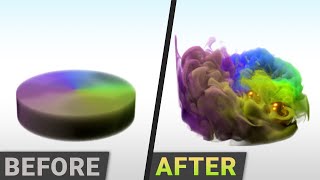
Károly Zsolnai-Fehér explains a new smoke simulation technique that works inside any shape and runs fast with incredible detail. The catch: it needs tens of gigabytes of memory, though compression and GPU implementation might help.
Chapters
Dear fellow scholars, this is two minute papers with Dr. After reading a physics textbook on the laws of fluid motion. With a little effort we can make a virtual world come alive by writing a computer program that contains these laws, resulting in beautiful fluid simulations like the one you see here. The amount of detail we can simulate with these programs is increasing every year. Not only due to the fact that computer hardware improves over time, but also the pace of progress in computer graphics research is truly remarkable. And this new paper promises detailed spiral spectral, fluid and smoke simulations. What does that mean? It means that the simulations can be run inside a torus, spheres, cylinders, you name it. But wait, is that really new? When using traditional simulation techniques, we can just enclose the smoke in all kinds of domain shapes where a simulation will take place. People have done this for decades now. Here is an example of that. So what is new here? Well, let's have a look at some results and hopefully find out together. Lets start with the details first. This is the new technique. Hmm, I like this one. This is a detailed simulation. Sure, I'll give it that. But we can already create detailed simulations with traditional techniques. So once again, what is new here? You know what, actually let's compare it to a traditional smoke simulation technique and give it the same amount of time to run and see what that looks like. Wow, that is a huge difference. And yes, believe it or not, the two simulations run in the same amount of time. So yes, it creates detailed simulations. Check mark. And it has not only the details, but it has other virtues too. Now let's bring up the heat some more. This is a comparison to not an older classical technique, but a spherical spectral technique from 2019. Let's see how the new method fares against it. Well, they both look good. So maybe this new method is not so much better after. Wait a second. Ouch. The previous one blew up and the new one. Yes, this still keeps going. Such improvement in just about two years. So it is not only fast, but it is robust too. That is super important for real world use. Details and robustness. Check mark. Now let's continue with the shape of the simulation domain. Yes, we can enclose the simulation within this domain where the spherical domain itself can be imagined as an impenetrable wall. But it doesn't have to be that way. Look, we can even open it up. Very good. Ok, so it is fast, it is robust, it supports crazy simulation domain shapes and even better it looks detailed. But are these the right details? Is this just pleasing for the eye? Or is this really how smoke should behave. The authors tested that too. And now hold on to your papers and look. I could add the labels here, but does it really matter? The two look almost exactly the same. Almost pixel perfect by the way. Here you go. So, wow, the list of positives just keeps on growing. But we are experienced fellow scholars here, so let's continue interrogating this method. Does it work for different viscosities? At the risk of simplifying what is going on, the viscosity of a puff of smoke relates to how nimble the simulation is. And it can handle a variety of these physical parameters too. Ok, next, can it interact with other objects too? I ask because some techniques look great in a simple empty simulation domain, but break down when placed into a real scene where a lot of other objects are moving around. Well, not this new one. That is a beautiful simulation. I love it. So I am getting more and more convinced with each test. So where is the catch? What is the price to be paid for all this? Let's have a look for the quality of the simulations we get. It runs in in a few seconds per frame and it doesn't even need your graphics card. It runs on your processor. And even then this is blazing fast. And implementing this on the graphics card could very well put this into the real time domain. And boy, getting these beautiful smoke puffs in real time would be an amazing treat. So once again, what is the price to be paid for this? Well, have a look. Aha. There it is. That is a steep price. Look. This needs tons of memory, tens of gigabytes. No wonder this was run on the processor. This is because modern computer graphics card don't have nearly as much memory on board. So what do we do? Well, don't despair, not even for a second. We still have good news. And the good news is that there are earlier research works that explore compressing these datasets down and it turns out their size can be decreased dramatically. A perfect direction for the next paper down the line. And what do you think? Let me know in the comments below what you would use this for. And just one or two more papers down the line and maybe we will get these beautiful simulations in our virtual worlds in real time. I can't wait. I really cannot wait. What a time to be alive. Weights and Biases provides tools to track your experiments in your deep learning projects. Using their system, you can create beautiful reports like this one to explain your findings to your colleagues better. It is used by many prestigious labs including OpenAI, Toyota Research, GitHub and more. And the best part is that Weights and Biases is free for all individuals, academics and open source projects. Make sure to Visit them through wnb.com papers or just click the link in the video description and you can get a free demo today. Our thanks to Weights and Biases for their long standing support and for helping us make better videos for you. Thanks for watching and for your generous support and I'll see you next time.