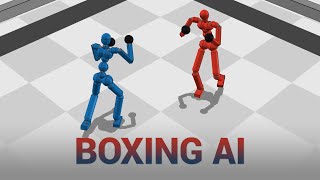
AI agents trained on 90 seconds of motion-capture data learned to box and fence through a billion steps of simulation. They developed feints, jabs, evasion, and knockout power. Early in training they moved strangely; by the end they fought like real fighters.
Questions this video answers
90 seconds of motion capture data.
130 million, 200 million, 250 million, 420 million, and approximately one billion training steps.
About one week.
August 29, 2021.
Chapters
Today we are going to see an AI learn boxing and even mimic gorillas during this process. Now, in an earlier work we saw a few examples of AI agents playing two player sports. For instance, this is the you shall not pass game where the red agent is trying to hold back the blue character and not let it cross the line. Here you see two regular AIs duking it out. Sometimes the red wins, sometimes the blue is able to get through. Nothing too crazy here until this happens. Look what is happening. It seems that this agent started to do nothing and steal one. Not only that, but it suddenly started winning almost all the games. How is this even possible? Well, what the agent did is perhaps the AI equivalent of hypnotizing the opponent, if you will. The more rigorous term for this is that it induces off distribution activations in its opponent. This adversarial agent is really doing nothing. But that's not enough. It is doing nothing in a way that reprograms its opponent to make mistakes and behave close to a completely randomly acting agent. Now, this new paper showcases AI agents that can learn boxing. The AI is asked to control these joint actuated characters which are embedded in a physics simulation. Well, that is quite a challenge. Look, for quite a while, after 130 million steps of training each, it cannot even hold it together. And yes, these fogs collapse, but this is not the good kind of hypnotic adversarial collapsing. I am afraid this is just passing out without any particular benefits. That was quite a bit of training. And all this for nearly nothing, right? Well, maybe. Let's see what they did after 200 million training steps. Look, they can not only hold it together, but they have a little footwork going on and can circle each other and try to take the middle of the ring. Improvements. Good. But this is not dancing practice. This is boxing. I would like to see some boxing today. And it doesn't seem to happen until we wait for a little longer, which is 250 million training steps. Now, is this boxing? Not quite. This is more like two drunkards trying to duke it out when neither of them knows how to throw a real punch. But their gloves are starting to touch the opponent and they start getting rewards for it. What does that mean for an intelligent agent? Well, it means that over time it will learn to do that a little better and hold on to your papers and see what they do after 420 million steps. Oh wow, look at that. I am seeing some punches. And not only that, but I also see some body and head movement to evade the punches. Very Cool. And if we keep going for longer. Whoa. These guys can fight. They now learned to perform feints, jabs, and have some proper knockout power too. And if you have been holding on to your papers, now squeeze that paper. Because all they looked at before starting the training was 90 seconds of motion capture data. And this is a general framework that also works for fencing as well. Look. The agents learned to lunge, deflect, evade attacks, and more. Absolutely amazing. What a time to be alive. So this was approximately a billion training steps, right? So how long did that take to compute? It took approximately a week. And you know what's coming, of course. We invoke the first law of papers, which says that research is a process. Do not look at where we are, look at where we will be. Two more papers down the line and two more papers down the line. I bet this will be possible in a matter of hours. And this is the part with the gorillas. It is also interesting that even though there were plenty of reasons to, the researchers didn't quit after 130 million steps, they just kept on going and eventually succeeded. Especially in the presence of not so trivial training curves where the blocking of the other player can worsen the performance. And it's often not as easy to tell where we are. That is a great life lesson right there. Perceptilabs is a visual API for TensorFlow, carefully designed to make machine learning as intuitive as possible. This gives you a faster way to build out models with more transparency into how your model is architected, how it performs, and how to debug it. Look, it lets you toggle between the visual modeler and the code editor. It even generates visualizations for all the model variables and gives you recommendations both during modeling and training. And does all this automatically. I only wish I had a tool like this when I was working on my neural networks during my PhD years. Visit perceptilabs.com papers to easily install the free local version of their system today. Our thanks to Perceptilabs for their support and for helping us make better videos for you. Thanks for watching and for your generous support, and I'll see you next time.