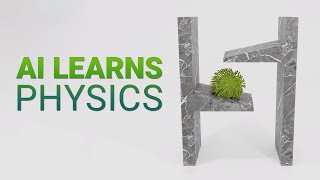
Dr. Zsolnai compares traditional physics simulators to a neural network trained on physics. The AI version matches or beats accuracy, runs 30 to 60 times faster, and handles unseen shapes without retraining. It enables real-time interaction on mid-sized meshes.
Chapters
Dear fellow scholars, this is Two Minute Papers with Dr. Zsolnai. Today we are going to engage in the favorite pastimes of the computer graphics researcher, which is, well, this and this. And believe it or not, all of this is simulated through a learning based technique. Earlier we marveled at a paper that showed that an AI can indeed learn learned to perform a fluid simulation. And just one more paper down the line, the simulations it was able to perform extended to other fields like structural mechanics, incompressible fluid dynamics and more. And even better, it could even simulate shapes and geometries that it had never seen before. So today the question is not whether an AI can learn physics, but the question how well can an AI learn physics? Let's try to answer that question by having a look at our first experiment. Here is a traditional handcrafted technique and a new neural network based physics simulator. Both are doing fine. So nothing to see. He Whoa. What happened? Well, dear fellow scholars, this is when a simulation blows up, but the new one is still running even when some traditional simulators blow up. That is excellent. But we don't have to bend over backwards to find other situations where the new technique is better than the previous ones. You see the reference simulation here and it is all well and good that the new method does not blow up. But how accurate is it on this challenging scene? Let's have a look. The reference shows a large amount of bending where the head is roughly in line with the knees. Let's memorize that. Head in line with the knees. Got it. Now let's see how the previous methods were able to deal with this challenging simulation when simulating a system of a smaller size. Well, none of these are too promising. When we crank up the simulation domain size, the physical model derivative PMD in short, does pretty well. So what about the new method? Both bend quite well, not quite perfect. Remember the head would have to go down to be almost in line with the knees. But amazing progress nonetheless. This was a really challenging scene. And in other cases the new method is able to match the reference simulator perfectly. So far this sounds pretty good, but PMD seems to be a contender. And that, dear fellow scholars, is a paper from 2005 from 16 years ago. So why showcase this new work? Well, we have forgotten about one important thing. And here comes the key. The new simulation technique runs from 30 to almost 60 times faster than previous methods. How is that even possible? Well, this is a neural network based technique and training a neural network typically takes a long time. But we only need to do this once. And when we are done querying the neural network typically can be done very quickly. Does this mean yes? Yes it does. All this runs in real time for this dinosaur, bunny and armadillo scenes, all of which are built from about 10,000 triangles and we can play with them by using our mouse on our home computer. The cactus and hairball scenes require simulating not tens but hundreds of thousands of triangles. So these took a bit longer as they are running between one and a half and two and a half frames per second. So this is not only more accurate than previous techniques, not only more resilient than the previous techniques, but is also 30 to 60 times faster at the same time. Wow. And just think about the fact that just a year ago an AI could only perform low resolution fluid simulations, then a few months ago more kinds of simulations, and then today, just one more paper down the line simulations of this complexity. Just imagine what we will be able to do. Just two more papers down the line. What a time to be alive. Perceptilabs is a visual API for TensorFlow, carefully designed to make machine learning as intuitive as possible. This gives you a faster way to build out models with more transparency into how your model is architected, how it performs and how to debug it. Look, it lets you toggle between the visual modeler and the code editor. It even generates visualizations for all the model variables and gives you recommendations both during modeling and training and and does all this automatically. I only wish I had a tool like this when I was working on my neural networks during my PhD years. Visit perceptilabs.com papers to easily install the free local version of their system today. Our thanks to Perceptilabs for their support and for helping us make better videos for you. Thanks for watching and for your generous support and I'll see you next time.