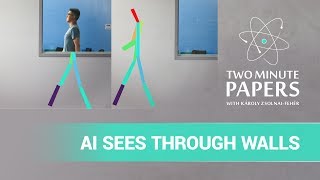
Short explainer video (Two Minute Papers) describing a technique that estimates human poses from Wi‑Fi radio signals. The narrator highlights capabilities: pose estimation in darkness, through walls, and for multiple people; and explains the method uses a teacher–student neural network where a vision-based teacher trains a radio-signal-based student. The video ends with channel support requests.
Chapters
Dear fellow scholars, this is two minute papers with pose estimation is an interesting area of research where we typically have a few images or video footage of humans and we automatically try to extract the pose a person was taking. In short, the input is one or more photo and the output is typically a skeleton of the person. So what is this good for? A lot of things. For instance, we can use these skeletons to cheaply transfer the gestures of a human onto a virtual character. Fall detection for the elderly, analyzing the motion of athletes and many, many others. This work showcases a neural network that measures how the WI FI radio signals bounce around in the room and reflect off of the human body. And from these murky waves, it estimates where we are. Not only that, but it is also accurate enough to tell us our pose. As you see here. As the WI FI signal also traverses in the dark, this pose estimation works really well in poor lighting conditions. That is a remarkable feat. But now hold on to your papers because that's nothing compared to what you are about to see. Now have a look here. We know that WI FI signals go through walls, so perhaps this means that that can't be true, right? It tracks the pose of this human as he enters the room and now as he disappears. Look, the algorithm still knows where he is. That's right. This means that it can also detect our pose through walls. What kind of wizardry is that? Now note that this technique doesn't look at the video feed we are now looking at. It is there for us for visual reference. It is also quite remarkable that the signal being sent out is a thousand times weaker than an actual wifi sign signal. And it can also detect multiple humans. This is not much of a problem with color images because we can clearly see everyone in an image. But the radio signals are much more difficult to read when they reflect off of multiple bodies in the scene. The whole technique works through using a teacher student network structure. The Teacher is a standard pose estimation neural network that looks at a color image and predicts the pose of the humans therein. So far, so good. Nothing new here. However, there is a student network that looks at the correct decisions of the teacher, but has the radio signal as an input instead. As a result, it will learn what the different radio signal distributions mean and how they relate to human positions and poses. As the name says, the teacher shows the student neural network the correct results and the student learns how to produce them from radio signals instead of images. If anyone said that they were working on this problem 10 years ago, they would have likely ended up in an asylum today. It is reality. What a time to be alive. Also, if you enjoyed this episode, please consider supporting the show at patreon.com twominutepapers you can pick up really cool perks like getting your name shown as a key supporter in the video and more. Because of your support, we are able to create all of these videos smooth and creamy, in 4K resolution and 60 frames per second and with closed captions. And we are currently saving up for a new video editing rig to make better videos for you. We also support one time payments through PayPal and the usual cryptocurrencies. More details about all of these are available in the video description and as always, thanks for watching and for your generous support and I'll see you next time.