THIS Company Just Created the Body for AGI - AI Robot Climbs the Great Wall of China!
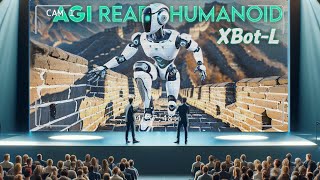
Roboterra's humanoid robot XBOT L walked the Great Wall of China to test its ability to navigate cracked stone, steep stairs, and poor lighting using real-time sensing and reinforcement learning. The company, founded in 2023, is racing toward general-purpose robots for industrial and service work, raising questions about AGI safety and the need for transparency as AI labs push forward.
Questions this video answers
June 5, 2024
LARRUZ
XBOT L
5 foot 5 (165 cm)
Roboterra
Chapters
You might remember a little while back when I covered Robot Era, that ambitious startup that unveiled their crazy dexterous X hand AI robot. Well, they just one upped themselves in a major way by becoming the first company ever to have a full size humanoid robot walk on the Great Wall of China. So their latest robot, called the XBOT L, conquered one of the most iconic and challenging landscapes in the world. The ancient stone pathways and steep, steep stairs of the great freaking Wall of China. This is a huge milestone, not just for Roboterra, but for humanoid robotics as a whole. So a 5 foot 5, 165 cm tall robot, looking kind of like a slimmed down Terminator, marching its way across those uneven century old stone surfaces without faltering. It was waving hello, practicing kung fu moves, climbing up and down stairs, the whole nine yards. And to be honest, the Great Wall is no walk in the park even for us humans. Those paths are cracked and the stairs are crazy steep with no railings. There are random potholes everywhere. It's an obstacle course designed to trip up any bipedal robot. But the XBOT L handled it all with surprising ease, thanks to roboterra's advanced perceptive reinforcement learning algorithms. Basically, this robot can actually perceive and make sense of its environment in real time. Using sensors and AI, it can identify obstacles, changes in terrain, and literally adapt its walking gait and balance on the fly to deal with whatever the Great Wall throws at it. According to Yue Xi, one of the co founders, their perceptive reinforcement learning tech gives the XBOT L something like human level awareness and decision making capabilities in unfamiliar environments. The robot can essentially think for itself about the best way to navigate complex areas safely and efficiently. And we're not just talking about some basic pre programmed motions here. The XBOT L was climbing rugged castle stairs, dealing with slopes and inclines, avoiding obstacles, adapting to poor lighting conditions, all without any human guidance or help. It was basically pulling off the kind of adaptive, intelligent, situationally aware movement that we associate with people. Roboterra says this was one of the biggest challenges, developing end to end AI algorithms that could translate perceived data from the robot's sensors into precise stable locomotion in the real world across an ultra complex environment like the Great Wall. Sounds like they cracked that nut though, based on this demo. What's really crazy is that this Great Wall feat comes just a couple weeks after they showed off the X hand dexterous robot I mentioned earlier. Between these two products, it's clear Robot Era is going all in on embodied AI building robots with human like physical capabilities. To operate in our world. And they're not messing around either. Despite only being founded in 2023, they've already invested heavily into cutting edge AI tech like reinforcement learning, neural networks, synthetic sim to real transfer and more. Basically everything needed to create robots that can tackle the real world just like we do. Their goal seems to be keeping that competitive edge by iterating and churning out smarter, more capable humanoid robot products at a rapid pace. And they want to keep perfecting ways to transfer all that AI training from simulations into physical machines, enabling those robots to become more versatile in real life scenarios. The endgame seems to be developing ultra flexible general purpose humanoid robots for countless valuable applications across industries like manufacturing, healthcare services and more. I've got to give roboterra props. Deliberately putting their robot through the wringer on the Great Wall as some kind of extreme stress test shows serious confidence in their tech. Most companies would avoid something that risky with a brand new product, but the fact that the Xbot L could pull it off so smoothly is really impressive. It's an amazing proof of concept for their embodied AI approach and perceptive reinforcement learning systems with working in one of the toughest real world environments. To me, this demonstrates Robotera's outstanding core capabilities in fields like robotics, AI, mechatronics and more. They are clearly at the cutting edge when it comes to embodied intelligence and making it work reliably in the real world. I'm really looking forward to whatever crazy robot robotira comes up with next. If they keep raising the bar like this, they could legitimately help usher in the age of advanced human human like robots that can operate autonomously in our world on an unprecedented level. We're potentially on the cusp of some big breakthroughs in artificial general intelligence, or AGI, becoming a reality over the next few years. And if anyone can build the physical robotic bodies to house and manifest that future AGI, it might just be an ambitious little pioneer like Roboterra. When it comes to developing super advanced AI systems like AGI, the situation with whistleblowers at OpenAI shows just how high the stakes really are. Robotera's achievement with their robot on the Great Wall is definitely impressive from an embodied AI perspective. But achievements like that could potentially seem tiny compared to the impacts, both positive and negative, that creating a general artificial intelligence on the same level as human cognition could have on society. On one hand, AGI represents this incredible technological breakthrough that could help solve countless challenges humanity is facing, from unsolved scientific mysteries to global crises. A generalized AI mind that matches human intelligence has always been viewed as something that could be a catalyst for transformative advances across every field. But on the other hand, the existential risks of an unaligned super intelligent AGI that's smarter than humans simply can't be overstated. We're talking about the potential for an advanced AI system to break free from human control, with catastrophic consequences for our species and the planet if it's not developed safely and responsibly. The OpenAI insiders are ringing alarm bells about this exact scenario playing out. They allege the company is recklessly rushing towards AGI supremacy without taking proper safety precautions, driven more by competitive pressures to be first rather than doing it the right way. Damning claims like OpenAI, ignoring their own safety review processes, muzzling employees with really strict non disparagement agreements and and deprioritizing safety work after founding members raised concerns paint a very worrying picture. If true, it suggests one of the leading AI labs is taking an extremely risky and unethical approach in this existential race for AGI. The fact that respected researchers like Ilya Sutskever felt compelled to resign due to OpenAI's perceived lack of commitment to keeping AGI safe and aligned only adds more credibility to the whistleblower's grievances. In my opinion, their letter calling for greater transparency, protecting employees, and ultimately having the government regulate this powerful technology to keep bad actors in check feels like a reasonable and perhaps necessary step to prevent potential disaster scenarios. Because, let's be real, we simply can't afford a situation where the first superintelligent AGI that emerges is catastrophically misaligned with human ethics and values. Exercising restraint and prioritizing responsible development have to be the top priorities. Of course, the whistleblowers likely have some level of bias given their philosophical views and ties to effective altruism movements, so I'd encourage taking more of a neutral stance personally. But even accounting for that bias, the sheer magnitude of what's at stake with AGI certainly warrants a strong commitment to prioritizing safety measures and ethical boundaries over competitive pressures and commercial interests from companies like OpenAI. Not properly aligning an emergent AGI could risk irreparably disrupting human civilization as we know it. And any private entity recklessly brushing off those concerns in their pursuit of being first is essentially playing a potential extinction level game of Russian roulette with humanity's future. So while I'm impressed by the cutting edge AI and robotics breakthroughs from companies like Roboterra, I really hope the broader AI community, whether researchers, executives, policymakers or others is taking the OpenAI whistleblower's warnings about these existential risks just as seriously. Because we may only get one shot at developing AGI in a controlled, responsible way that ensures this game changing technology remains an asset that allows humanity to flourish rather than an unintended catalyst for our potential downfall. The stakes are that high? Alright, don't forget to hit that subscribe button for more updates. Thanks for tuning in and we'll catch you in the next one.










