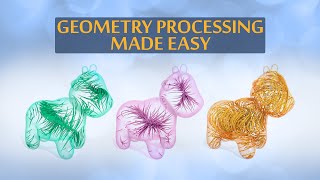
Monte Carlo integration, the technique behind light rendering, can solve geometry problems too. A new paper shows it working on ant scans, frog CT slices, curve editing, and denoising, often with huge speedups and less memory needed.
Questions this video answers
July 4, 2020.
Monte Carlo Geometry Processing.
Rohan Sawni.
Keenan Crane.
SIGGRAPH.
Chapters
Dear fellow scholars, this is two minute papers with Dr. Zsolnai. I think this might be it. This paper is called Monte Carlo Geometry Processing. And in my opinion, this may be one of the best, if not the best, computer graphics paper of the year. There will be so many amazing results. I first thought this one paper could be the topic of ten two minute papers videos, but I will attempt to cram everything into this one video. It is quite challenging to explain, so please bear with me. I'll try my best to even have a fighting chance at understanding what is going on here. First, we start out with one of the most beautiful topics in computer graphics, which is none other than light transport. To create a beautiful light simulation, we have to solve something that we call the rendering equation. For practical cases, it is currently impossible to solve it like we usually solve any other equation. However, what we can do is that we can choose a random ray, simulate its path as it bounces around in the scene, and compute how it interacts with the objects and materials within this scene. As we do it with more and more rays, we get more information about what we see in the scene. That's good, but look, it is noisy. As we add even more rays, this noise slowly evens out and in the end we get a perfectly clean image. This takes place with the help of a technique that we call Monte Carlo integration, which involves randomness. At the risk of oversimplifying the situation, in essence, this technique says that we cannot solve the problem, but we can take samples from the problem. And if we do it in a smart way, eventually we will be able to solve it. In light transport, the problem is the rendering equation, which we cannot solve, but we can take samples. One sample is simulating one ray. If we have enough rays, we have a solution. However, it hasn't always been like this. Before Monte Carlo integration, light transport was done through a technique called radiosity. The key issue with radiosity was that the geometry of the scene had to be sliced up into many small pieces and the light scattering events had to be evaluated between these small pieces. It could not handle all light transport phenomena, and the geometry processing part was a major headache. And Monte Carlo integration was a revelation that breathed new life into this field. However, there are still many geometry processing problems that include these headaches. And hold on to your papers because this paper shows us that we can apply Monte Carlo integration to many of these problems too. For instance, one, it can resolve the rich external and internal structure of this ant. With traditional techniques, this would normally take more than 14 hours and 30 gigabytes of memory. But if we apply Monte Carlo integration to this problem, we can get a somewhat noisy preview of the result in less than one minute. Of course, over time, as we compute more samples, the noise clears up and we get this beautiful final result. And the concept can be used for so much more. It truly makes my head spin. Let's discuss six amazing applications while noting that there are so many more in the paper which you can and should check out in the video description. For instance, 2 it can also compute a CT scan of the infamous Shovelnose frog that you see here, and instead of creating the full 3D solution, we only have to compute a 2D slice of it, which is much, much cheaper. 3 It can also edit these curves and note that the key part is that we can do that without the major headache of creating an intermediate triangle mesh geometry for it. 4. It also supports denoising techniques so we don't have to compute too many samples to get a clear image or piece of geometry. 5. Performing Helmholtz Hodge decomposition with this method is also possible. This is a technique that is used widely in many domains. For instance, it is responsible to ensure the stability of many fluid simulation programs, and this technique can also produce these decompositions. And interestingly here it is used to represent 3D objects without the usual triangle meshes that we use in computer graphics. 6. It supports multiple important sampling as well. This means that if we have multiple sampling strategies, multiple ways to solve a problem that have different advantages and disadvantages, it combines them in a way that we get the best of all of them. We had a mega episode on multiple important sampling. It has lots of amazing uses in light transport simulations, so if you would like to hear more, make sure to check that out in the video description. But wait, these are all difficult problems. One surely needs a PhD and years of experience in computer graphics to implement this, right? When seeing a work like this, we often ask, ok, it does something great, but how complex is it? How many days do I have to work to reimplement it? Please take a guess and let me know what the guess was in the comment section. And now what you see here is none other than the source code for the core of the method. And what's even more, a bunch of implementations of it already exist. And if you see that a paper has been reimplemented around day one, you know it's good. So no wonder this paper has been accepted to siggraph perhaps the most prestigious computer graphics conference. It is immensely difficult to get a paper accepted there and I would say this one more than earned it. Huge congratulations to the first author of the paper, Rohan Sawni. He is currently a PhD student and note that this was his second published paper. Unreal. Such a great leap for the field in just one paper. Also congratulations to Professor Keenan Crane who advised this project and many other wonderful works in the last few years. I cannot wait to see what they will be up to next and I hope that now you are just as excited. This episode has been supported by Linode Linode is the world's largest independent cloud computing provider. Linode gives you full backend access to your server, which is your step up to powerful, fast, fully configurable cloud computing. Linode also has one click apps that streamline your ability to Deploy websites, personal VPNs, game servers, and more. If you need something as small as a personal online portfolio, Linode has your back. And if you need to manage tons of clients websites and reliably serve them to millions of visitors, Linode can do that too. What's more, they offer affordable GPU instances featuring the Quadro RTX 6000, which is tailor made for AI, scientific computing and computer graphics projects. If only I had access to a tool like this while I was working on my last few papers. To receive $20 in credit on your new Linode account, visit linode.compapers or click the link in the video description and click and give it a try today. Our thanks to Linode for supporting the series and helping us make better videos for you. Thanks for watching and for your generous support and I'll see you next time.