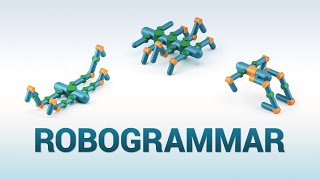
Dr. Zsolnai reviews a paper that uses grammar rules to automatically design robot bodies for different terrains. The system generates morphologies from joints, links, and wheels, then searches for optimal designs across flat ground, gaps, stairs, ice, and walls. A follow-up applied the same approach to figure skating and breakdancing robots.
Chapters
Dear fellow scholars, this is Two Minute Papers with Dr. Zsolnai. Today we are going to generate robots with grammars. Wait a second. Grammars of all things? What do grammars have to do with robots? Do we need to teach them grammar to speak correctly? No, no, of course not. To answer these questions, let's invoke the second law of Papers, which says that whatever you are thinking about, there is already a Two Minute Papers episode on that. Even on grammars, let's see if it applies here. In this earlier work we talked about generating buildings with grammars. So how does that work? Grammars are a set of rules that tell us how to build up a structure, such as a sentence properly from small elements like nouns, adjectives, and so on. My friend Martin Ilchick loves to build buildings from grammars. For instance, a shape grammar for buildings can describe rules like a wall can contain several windows. Below a window goes a window sill. One wall may have at most two doors attached, and so on. A later paper also used a similar concept to generate tangle patterns. So this grammar thing has some power in assembling things after all. So can we apply this knowledge to build robots? First, the robots in this new paper are built up as a collection of these joint types, links and wheels, which can come in all kinds of sizes and weights. Now our question is, how do we assemble them in a way that they can traverse a given terrain effectively? Well, time for some experiments. Look at this robot. It has a lot of character and can deal with this terrain pretty well. Now look at this poor thing. Someone in the lab at MIT had a super fun day with this one. I am sure. Now these can sort of do the job. But now let's see. The power of grammars and search algorithms in creating more optimized robots for a variety of terrains. First, a flat terrain. Let's see. Yes, now we're talking. This one is traversing at great speed. And this one works too. I like how it was able to find vastly different robot structures that both perform well here. Now let's look at a little harder level with gapped terrains. Look. Oh wow. Loving this. The algorithm recognized that a more rigid body is required to efficiently step through the gaps. And now I wonder what happens if we add some ridges to the levels so it cannot only step through the gaps, but has to climb. Let's see. And we get those long limbs that can indeed climb through the ridges. Excellent. Now add the staircase and see who can climb these. Well, the algorithm says, well, someone with long arms and a somewhat elastic body. Let's challenge the algorithm some more. Let's add, for instance, a frozen lake who can climb a flat surface that is really slippery. Does the algorithm know? Look, it says someone who can utilize a low friction surface by dragging itself through it or someone with many legs. Loving this. Now this is way too much fun, so let's do two more. What about a walled terrain example? What kind of robot would work there? One with a more elastic body, carefully designed to be able to curve sharply, enabling rapid direction changes, but it cannot be too long or else it would bang its head into the wall. This is indeed a carefully crafted specimen for this particular level. Now of course, real world situations often involve multiple kinds of terrains, not just one. And of course the authors of this paper know that very well and also asked the algorithm to design a specimen that can traverse walled and rich terrains really well. Make sure to have a look at the paper, which even shows graphs for robot archetypes that work on different terrains. It turns out one can even make claims about the optimality, which is a strong statement. I did not expect that at all. So apparently grammars are amazing at generating many kinds of complex structures, including robots. And note that this paper also has a follow up work from the same group where they took this a step further and made figure skating and breakdancing robots. What a time to be alive. The link is also available in the video description for that one this episode has been supported by Lambda GPU Cloud. If you're looking for inexpensive cloud GPUs for AI, check out Lambda GPU Cloud. They've recently launched Quadro RTX 6000, RTX 8000 and V100 instances and hold on to your papers. Because Lambda GPU Cloud can cost less than half of AWS and Azure plus they are the only cloud service with 48gb RTX 8000. Join researchers at organizations like Apple, MIT and Caltech in using Lambda Cloud instances, workstations or servers. Make sure to go to lambdalabs.compapers to sign up for one of their amazing GPU instances today. Our thanks to Lambda for their long standing support and for helping us make better videos for you. Thanks for watching and for your generous support and I'll see you next time.