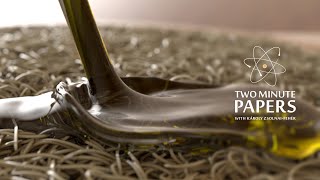
Károly Zsolnai-Fehér explains a graphics simulation that models thin noodles interacting with viscous fluids like oil, mud, and pesto. The technique extends the Material Point Method to handle thin fluid layers at centimeter scale rather than micrometer scale, simulating tens of millions of particles in minutes per frame on CPU.
Questions this video answers
Papers20
$20
On the order of centimeters (not micrometers).
Up to tens of millions of particles.
Measured in a few minutes per frame (on CPU).
Chapters
Dear fellow scholars, this is two minute papers with fluid Simulation is a mature research field within computer graphics with amazing papers that show us how to simulate water flows with lots of debris, how to perform liquid fabric interactions, and more. This new project further improves the quality of these works and shows us how thin elastic strands interact with oil paint, mud, melted chocolate and pesto sauce. There will be plenty of tasty and messy simulations ahead, not necessarily in that order, so make sure to hold on to your papers just in case. Here you see four scenarios of these different materials dripping off of a thin strand. So why are these cases difficult to simulate? The reason why it's difficult, if not flat out impossible. Because the hair strands and the fluid layers are so thin, it would require require a simulation grid that is so microscopic. Or in other words, we would have to perform our computations of quantities like pressure and velocity on so many grid points, it would probably take not from hours to days, but from weeks to years to compute. I will show you a table in a moment where you will see that these amazingly detailed simulations can be done on a grid of surprisingly low resolution. As a result, our simulations also needn't be so tiny in scale. With one hair strand and a few drops of mud or water, they can be done on a much larger scale. So we can marvel together at these tasty and messy simulations. You decide which is which. I particularly like this animation with the oyster sauce because you can see a breakdown of the individual elements of the simulation. Note that all of the interactions between the noodles, the sauce, the fork and plate have to be simulated with precision. Love it. And now the promise table. Here you can see the delta X. That means how fine the grid resolution is, which is in the order of centimeters and not micrometers. That is reassuring. And don't forget that this work is an extension to the material point method, which is a hybrid simulation method that both uses grids and particles. And sure enough, you can see here that it simulates up to tens of millions of particles as well. And the fact that the computation times are still only measured in a few minutes per frame is absolutely remarkable. Remember, the fact that we can simulate this at all is a miracle. Now, this was run on the processor and a potential implementation on the graphics card could yield us significant speed ups. So I really hope something like this appears in the near future. Also, make sure to have a look at the paper itself, which is outrageously well written. If you wish to see more from this paper, make sure to follow us on Instagram. Just search for 2 minute papers there or click the link in the video description now. I am still working as a full time research scientist at the Technical University of Vienna and we train plenty of neural networks during our projects which requires a lot of computational resources every time we have to spend time maintaining these machines. I wish we could use Linode. Linode is the world's largest independent cloud hosting and computing provider. If you feel inspired by these works and you wish to run your experiments or deploy your already existing works through a simple and reliable hosting service, make sure to join over 800,000 other happy customers and choose Linode. To reserve your GPU instance and receive a $20 free credit, visit linode.com papers or click the link in the video description and use the promo code Papers20 during signup. Give it a try today. Our thanks to Linode for supporting the series and helping us make better videos for you. Thanks for watching and for your generous support and I'll see you next time.