A material point method paper cuts simulation time in half while adding support for cutting effects and fluid-solid interactions. The researchers distilled the core algorithm into roughly 88 lines of code, available through the Tai Chi framework.
Chapters
Dear fellow scholars, this is two minute papers with. Today we are going to talk about.
The material point method.
This method uses both grids and particles to simulate the movement of snow dripping honey, interactions of granular solids, and a.
Lot of other really cool phenomena on our computers.
This can be used, for instance, in the movie industry to simulate what a.
City would look like if it were flooded.
However, it has its own limitations, which.
You will hear more about in a moment.
This paper showcases really cool improvements to this technique. For instance, it enables to run these simulations twice as fast and can simulate.
New phenomena that were previously not supported.
By the material point method.
One is the simulation of complex thin boundaries that enables us to cut things. So in this video, expect lots of.
Virtual characters to get dismembered.
I think this might be the only channel on YouTube where we can say.
This and celebrate it as an amazing scientific discovery. And the other key improvement of this.
Paper is introducing two way coupling, which means the example that you see here as the water changes the movement of the wheel, but the wheel also changes.
With the movement of the water.
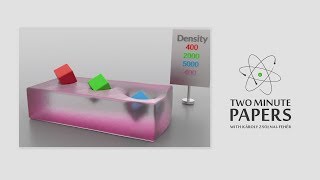
It is also demonstrated quite aptly here by this elastoplastic Jello scene in which we can throw in a bunch of blocks of different densities and. And it is simulated beautifully here, how they sink into the jello deeper and.
Deeper as a result.
Here you see a real robot running.
Around in a granular medium.
And here we have a simulation of the same phenomenon and can marvel at how close the result is to what.
Would happen in real life. Another selling point of this method is.
That this is easy to implement, which is demonstrated here in. And what you see here is the.
Essence of this algorithm implemented in 88 lines of code. Wow.
Now, these methods still take a while as there is a lot of deformations.
And movements to compute.
And we can only advance time in very small steps. And as a result, the speed of such simulations is measured not in frames.
Per second, but in seconds per frame.
These are the kinds of simulations that.
We like to leave on the machine overnight.
If you want to see something that is done with a remarkable amount of love and care, please read this paper.
And I don't know if you have.
Heard about this framework called Tai Chi.
This contains implementations for many amazing papers in computer graphics, lots of paper implementations on animation, light transport simulations, you name it.
A total of more than 40 papers are implemented. There are.
And I was thinking this is really amazing.
I wonder which group made this.
Then I noticed it was written by one person and that person is Yuan Ming Hu, the scientist who is the.
Lead author of this paper.
This is insanity. Thanks for watching and for your generous.