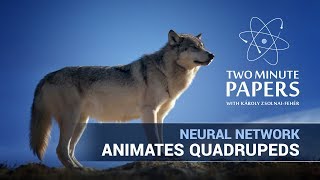
Károly Zsolnai-Fehér explains a neural network that animates four-legged animals with just one hour of motion-capture data. It fixes the foot-sliding problem of earlier methods and smoothly blends between different movement types, whether the ground is flat or uneven.
Chapters
Dear fellow scholars, this is two minute papers with. If we have an animation, movie or computer game with Quadrupeds and we are yearning for really high quality lifelike animations, motion capture is often the go to tool for that. Motion capture means that we put an actor, in our case a dog, in the studio. We ask it to perform sitting, trotting, pacing and jumping. Record its motion and and transfer it onto our virtual character. This generally works quite well. However, there are many difficulties with this process. We will skip over the fact that an artist or engineer has to clean and label the recorded data, which is quite labor intensive. But there is a bigger problem. We have all these individual motion types at our disposal. However, a virtual character will also need to be able to transition between these motions in a smooth and and natural manner. Recording all possible transitions between these moves is not feasible. So in an earlier work we looked at a neural network based technique to try to weave these motions together. For the first sight, this looks great. However, have a look at these weird sliding motions that it produces. Do you see them? They look quite unnatural. This new method tries to address this problem, but ends up offering much, much more than that. It requires only one hour of motion capture data and we have only around 30 seconds of footage for jumping motions, which is basically next to nothing. And this technique can deal with unstructured data, meaning that it doesn't require manual labeling of the individual motion types, which saves a ton of work hours. Beyond that, as we control this character in the game, this technique also uses a prediction network to guess the next motion type and the gating network that helps blending together these different motion types. Both of these units are neural networks on the right. You see the results with the new method compared to a standard neural network based solution on the left. Make sure to pay special attention to the foot sliding issues with the solution on the left. And note that the new method doesn't produce any of those. Now, these motions look great, but they all take place on a flat surface. You see here that this new technique excels at much more challenging landscapes as well. This technique is a total powerhouse and I can only imagine how many work hours this will save for artists working in the industry. It is also scientifically interesting and quite practical. My favorite combination. It is also well evaluated, so make sure to have a look at the paper for more details. Thanks for watching and for your generous support and I'll see you in next time.