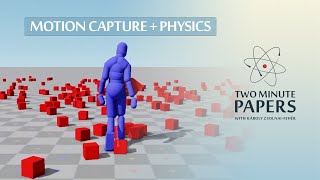
Ubisoft La Forge trained a neural network to blend motion-capture animation with physics simulation using deep reinforcement learning. After 30 hours of training, a simulated agent learned to mimic a motion-captured character and stay stable when pushed or hit. The technique could make game characters move more naturally and respond to unexpected impacts.
Questions this video answers
About 30 hours of training.
About 10 minutes of animation data.
The control system takes only a few microseconds (most time spent in the physics simulation).
2020-01-25.
Chapters
Dear fellow scholars, this is two minute papers with. In this series, we often talk about computer animation and physical simulations, and these episodes are typically about one or the other. You see, it is possible to teach a simulated AI agent to lift weights and jump really high using physical simulations to make sure that the movements and forces are accurate. The simulation side is always looking for correctness. However, let's not forget that things also have to look good. Animation studios are paying a fortune to record motion capture data from real humans and sometimes even dogs to make sure that these movements are visually appealing. So is it possible to create something that reacts to our commands with the controller, looks good and also adheres to physics? Well, have a look. This work was developed at Ubisoft La Forge. It responds to our input via the controller and the output animations are fluid and natural. Since it relies on a technique called deep reinforcement learning, it requires training. You see that early on the blue agent is trying to imitate the white character and it is not doing well at all. It basically looks like me when going to bed after reading papers all night. The white agent's movement is not physically simulated and and was built using a motion database with only 10 minutes of animation data. This is the one that is in the looks good category, or it would look really good if it wasn't pacing around like a drunkard. So the question naturally arises, who in their right minds would control a character like this? Well, of course no one. This sequence was generated by an artificial worst case player, which is a nightmare situation for any AI to reproduce early on, it indeed is a nightmare. However, after 30 hours of training, the blue agent learned to reproduce the motion of the white character while being physically simulated. So what is the advantage of that? Well, for instance, it can interact with the scene better and is robust against perturbations. This means that it can rapidly recover from undesirable positions. This can be validated via something that the paper calls impact testing. Are you thinking what I am thinking? I hope so, because I am thinking about throwing blocks at this virtual agent, one of our favorite pastimes at two minute papers. And it will be able to handle them. Whoops. Well, most of them anyway. It also reacts to a change in direction much quicker than previous agents. If all that was not amazing enough, the whole control system is very light and and takes only a few microseconds, most of which is spent by not even the control part, but the physics simulation. So with the power of computer graphics and machine learning, research, animation and physics can now be combined beautifully. It does not limit controller responsiveness. Looks very realistic and it is very likely that we'll see this technique in action in future Ubisoft games. Outstanding. This video was supported by you on Patreon. If you wish to watch these videos in early access or get your name immortalized in the video description, make sure to go to patreon.com twominutepapers and pick up one of those cool perks. Or we are also test driving the early access program here on YouTube. Just go ahead and click the join button or use the link in the description. Thanks for watching and for your generous support and I'll see you next time.