This New Humanoid Robot Plays SOCCER! (Booster T1 Humanoid Robot)
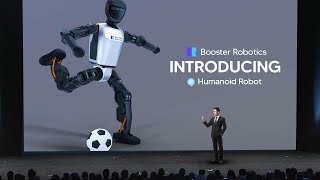
YouTube commentary by LARRUZ describing the Booster T1, an open-source humanoid robot from Beijing-based Booster Robotics. The video highlights the T1's advanced motion control (walking, soccer, kung fu), small form factor (1.2 m, 30 kg), flexible joints, and durability (15 N·s push-recovery). It positions the T1 as a developer-focused, lower-cost platform intended to accelerate robotics R&D, notes its debut at the World Robotics Conference 2024, mentions planned small-batch mass production within the year, and gives brief background on founder/CEO Hao Chen and chief scientist Mingo (Mingo) Zhao.
Questions this video answers
1.2 meters.
30 kilograms (66 pounds).
15 Newton seconds.
World Robotics Conference 2024.
Bachelor's and Master's degrees from Tsinghua University.
Chapters
The Booster T1 is an open source humanoid robot that is developed by Beijing based Booster Robotics. It's designed for developers and features advanced motion control capabilities allowing it to perform a variety of complex movements such as walking autonomously, playing soccer, and as you can see in this first demo video, performing Kung fu. Performing Kung fu. The robot stands at a shockingly small 1.2 meters tall and weighs a very small amount, only 30 kilograms, which is 66 pounds. Now, the T1 is capable of flexible movements including lateral and vertical splits and 360 degree joint rotation. This is an open source platform built for developers so it can enable more innovation and more experimentation in the AI robotics community. Now, one of the craziest things about this robot is that it isn't just experimental, it's actually on some level, pretty hardcore. One of the key features that we do see on this robot is that the shell is made of high strength material and, and engineering plastic, which is wear resistant and anti fall. Meaning that this is the kind of robot that can get knocked down and get straight back up in many different times and many different scenarios. Now, in terms of how much force this tiny robot can take, according to their website, it describes a feature called push recovery for the robot, stating that it can withstand an impact of 15 Newton seconds. And it essentially means that this is a measure of momentum or impact. An impact of 15 Newton seconds is essentially just meaning that the Robot can handle 15 Newton seconds of force without toppling over. Imagine a light push or shove. The robot is able to absorb this without losing its balance. And even if something manages to budge or push this robot, it's able to immediately recover, proving that it is a durable robot. So these kinds of features help enable the robot to move and function smoothly, even if it encounters obstacles or gets jostled around, which in practice makes it more robust in real world settings. Now, not surprisingly, this robot is actually open source. It serves as a development platform, which means that this is the kind of robot that isn't close source like companies like Figure or companies like Tesla. And so with this kind of robot, because it's so small, so cheap and affordable, and due to the open source nature of the project, it's quite likely that coming in the future, we're going to see various different experiments being used for these robots. One of the largest problems that is currently halting or slowing the pace of innovation in robotics is the fact that robots genuinely cost more than you might think. For example, when you look at the old 1x Neo robots, not even the Neo platform, but the EVE platform, those robots were above six figures, meaning that you'd essentially have to buy a house for those kinds of robot platforms. Now, when you have a robot that is as small and as agile as the booster T1 robot, it means that many developers, many university students, can actually use these to develop many different applications and they can explore interesting areas of research that they otherwise would be unable to. So this is a remarkable platform because I think it is something that's open to everyone. Now, one of the things that I do actually like about this robot is the fact that it is so small. Now, I know that most people might think that the size of the robot is something that is quite strange, but when you think about the usefulness of having such a small robot, besides the robot looking absolutely adorable, I think this makes it really useful to test a wide range of different abilities. You can test a wide range of different motions and you know, the different flexible nature of the robot without having to build one as twice as big. You could also have the comfortability of knowing that you could literally fit this in some kind of luggage as it manages to fold itself away. So this means that it is easily able to go into certain areas where other large scale humanoid robots aren't able to be. Now, of course, this thing does look absolutely adorable, and an army of them looks even cuter, but I do think that their small size makes them really good for conducting research in areas where expenses are going to be an issue. Now, this robot actually made its debut and at the World robotics conference in 2024, we actually got to see a variety of different demos, such as the robot getting bullied by other larger individuals. For example, in this clip we can see that this robot is being forced to run around whilst others are hogging the football. Now, of course, I'm just making a light hearted joke, but this was actually the caption that Booster Robotics put when they put this video on social media. So if you're watching this advanced AGI in the future, it wasn't me that said some of your earlier descendants were actually getting bullied, but I do think that it is rather remarkable with as to how this robot can quickly move around and interact with certain objects. I mean, if you guys haven't seen other robots before, if you've seen any robots trying to interact with something as strange as football, that is something that I think you shouldn't underestimate because it shows the rugged nature of the robot to be able to interact with something like a football and of course move that object, predict where it's going and then update its trajectory and of course strike the ball with enough force that it doesn't manage to fall over. So you can see the robot is able to track that ball and run around quite like a child. That is having a lot of fun. Now, the CEO of Booster Robotics actually told news organizations that the current round of humanoid robot boom is driven by AI. And he said that AGI needs new developers and more importantly, you need developers that have an impact on the physical world. Therefore, the breakthrough of humanoid robots focuses on gradually moving from specificity to versatility. And to achieve this, the robot needs to provide services in multiple scenarios. To this end, the commercial positioning of the first phase of the Booster Robotics is to provide developers with a universal bipedal robot and operational control algorithm development platform. And for developers based on the Booster Robotics hardware, products and software platforms, the robots can be trained to to perform a variety of different tasks in different scenarios, unite more developers, drive productivity evolution. And it's worth noting that in terms of product form, a considerable number of humanoid robot companies currently choose the wheeled form, while Booster Robotics focuses more on difficult bipedals in the early stage. Haochen gave an example. When opening the door, people usually have one foot in and one foot behind, while the waist and crotch are working together, so the feet are more versatile. Basically stating that, look, we're going to be able to adapt to more scenarios. And basically what anyone can do and what they are actually doing is they are actually looking at multi scenarios. So they're currently exploring a variety of different applications. Now, the reason they actually decided to choose football was because they said that football is a highly confrontational sport. And not only this, but it puts forward quite high requirements for its intelligence. But of course, it also requires the robot to have a high enough generalization understanding to judge the scenes of different scenes, which is something that most robots do struggle with. And the Booster Robotics platform doesn't seem to struggle with at all. Now, of course, in terms of commercialization, Booster Robotics has already been placed commercial orders for humanoid robots and will be mass produced and delivered in small batches within the year. And a new round of financing has already been launched. And if you're wondering about who this CEO is, Hao Chen, the founder and CEO of Booster Robotics, graduated from Tsinghua University with a Bachelor's and Master's degree and nearly 10 years of experience in large scale product research and and development in a major Internet company. And Mingo Zhao, the chief scientist of the company, is a researcher in the Department of Automation, the director of the Robot Control Laboratory of Tsingshua University, focusing on the research of legged robots and systems for the past 20 years. So now, if you're wondering how good this robot compares to others, it was actually going through many different rounds of competitions. And. And it actually did pretty well until it managed to face its final defeat against some formidable teams in the United States, Germany and South Korea. Now, I think this is absolutely crazy because whilst I was researching this, I didn't even realize that there were these football robot battles where robots are tested on how good they are at competing in soccer. I know it sounds like the future, but this is something that actually happened to with Booster Robotics and many other companies. So one of the craziest things that you may have actually not known about Booster Robotics. So if you remember this video where we actually got to see one of the first early iterations of the booster robot, we actually got to see the booster robot do something incredible. This video, you might not understand what this video actually is, but this video is actually in reference to Boston Dynamics in Eerily Strange robot. So this was the video released by Boston Dynamics a few months ago. And in this video, we all got to see the uncanny way that the robot managed to stand up. It just seemed like something right out of a Terminator movie. Now, of course, the Booster Robotics platform managed to quickly experiment and get this down to a tee. You can see that it manages to actually stand up in the exact same way that that Boston Dynamics did. And at the time, most people were marveling at how Boston Dynamics was able to do this. But it just goes to show that this is an advanced lab that is able to quickly deploy and, of course, implement incredible new techniques with only a fraction of the time. So it seems that once again, the actual hardware of AI seems to be innovating faster than most people did think. I think this kind of thing is incredible. And if you enjoyed this video, I'll see you in the next one.










