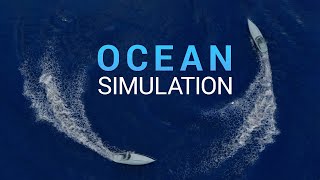
Dr. Zsolnai presents a new fluid-simulation technique that combines FLIP and BEM methods to simulate vast oceans with detailed splashes. FLIP handles high-frequency waves near moving objects while BEM efficiently covers large-scale water surfaces, with the two methods coupled at transition zones. The approach runs faster than pure FLIP while keeping local detail that pure BEM loses.
Questions this video answers
Lee Bo Huang
Siggraph Asia
October 9, 2021
Perceptilabs — perceptilabs.com
Chapters
Dear fellow scholars, this is Two Minute Papers with Dr. Zsolnai. Today we are going to put a fluid simulation in another fluid simulation and with that create beautiful videos like this one. But how? And more importantly, why? Well, let's take two fluid simulation techniques. One will be the fluid implicit particle flip, in short, and the other will be the boundary element method, bem. So why do we need two or perhaps even more methods? Why not just one? Well, first, if we wish to simulate turbulence and high frequency splashes near moving objects, FLIP is the answer. It is great at exactly that. However, it is not great at simulating big volumes of water. No matter, because there are other methods to handle that. For instance, the boundary element method that we just mentioned, bem. In short, it is great in these cases because the BEM variant that's been used in this paper simulates only the surface of the liquid. And for a large ocean, the surface is much, much smaller than the volume. Let's have a look at an example. Here is a pure flip simulation. This should be great for small splashes. Yes, that is indeed true. But look, the waves then disappear quickly. Let's look at what BEM does with this scene. Yes, the details are lacking, but the waves are lovely. Now we have a good feel of the limitations of these techniques. Small splashes, flip oceans, bem. But here is the problem. What if we have a scene where we have both? Which one should we use? This new technique says, well, use both. What is this insanity? Now hold on to your papers and look. This is the result of fusing the two simulation techniques together. Now if you look carefully. Yes, you guessed it right. Within the box there is a flip simulation. And outside of the boxes there is a BEM simulation and the two are fused together in a way that the new method really takes the best of both worlds. Just look at all that detail. What a beautiful simulation. My goodness. Now this is not nearly as easy as slapping together two simulation domains. Look, there's plenty of work to be done in the transition zone. And also, how accurate is this? Here is the reference simulation for the water droplet scene from earlier. This simulation would take forever for a big scene and is here for us to know how it should look. And let's see how close the new method is to it. Whoa. Now we're talking. Now worry not about the seams. They are there for us to see the internal workings of the algorithm. The final composition will look like this. However, not even this technique is perfect as a potential limitation. Look, here is the new method compared to the reference footage. The waves in the wake of the ship are simulated really well and so are the waves further away at the same time. That's amazing. However, what we don't get is look crisp details in the BEM regions. Those are gone, but just compare the results to this technique from a few years ago and get a feel of how far we have come. Just a couple papers down the line, the pace of progress in computer graphics research is through the roof. Loving it. What a time to be alive. And let's see. Yes, the first author is Lee Bo Huang. Again, if you are a seasoned fellow scholar, you may remember our video on his first paper on ferrofluids and this is his third one. This man writes nothing but masterpieces. As a result, this paper has been accepted to the Siggraph Asia conference and being a first author, there is perhaps the computer graphics equivalent of winning the Olympic gold medal. It is also beautifully written, so make sure to check it out in the video. Description Huge congratulations on this amazing work. I cannot believe that we are still progressing so quickly, year after year. Perceptilabs is a Visual API for TensorFlow, carefully designed to make machine learning as intuitive as possible. This gives you a faster way to build out models with more transparency into how your model is architected, how it performs, and how to debug it. Look, it lets you toggle between the visual modeler and the code editor. It even generates visualizations for all the model variables and gives you recommendations both during modeling and training, and does all this automatically. I only wish I had a tool like this when I was working on my neural networks during my PhD years. Visit perceptilabs.com papers to easily install the free local version of their system today. Our thanks to Perceptilabs for their support and for helping us make better videos for you. Thanks for watching and for your generous support and I'll see you next time.