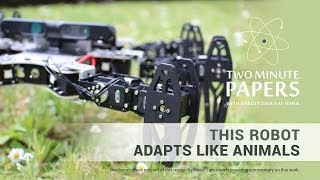
Researchers trained a robot to walk in over 13,000 different ways so it can keep moving after damage by switching to a working gait instead of stopping. The AI learns these alternatives in simulation, then adapts on the real robot without needing to recognize or repair the damage itself.
Questions this video answers
2018-05-01
Over 13,000
LARRUZ
Chapters
Dear fellow scholars, this is two minute papers with this work is about building a robot that works even when being damaged, and you will see that the results are just unreal. There are many important applications for such a robot where sending out humans may be too risky, such as putting out forest fires, finding earthquake survivors under rubble, or shutting down a malfunctioning nuclear plant. Since these are all dangerous use cases, it is a requirement that such a robot works even when damaged. The key idea to accomplish this is that we allow the robot to perform tasks such as walking, not only in one optimal way, but to explore and build a map of many alternative motions, relying on different body parts. Some of these limping motions are clearly not optimal, but whenever damage happens to the robot, it will immediately be able to choose at least one alternative way to move around, even with broken or missing legs. After building the map, it can be used as additional knowledge to lean on when the damage occurs, and the robot doesn't have to relearn everything from scratch. This is great, especially given that damage usually happens in the presence of danger, and in these cases, reacting quickly can be a matter of life and death. However, creating such a map takes a ton of trial and error, potentially more than what we can realistically get the robot to perform. And now comes my favorite part, which is starting the project in a computer simulation and then in the next step, deploying the trained AI to a real robot. This previously mentioned map of movements contains over 13,000 different kinds of gates, and since we are in a simulation, it can be computed efficiently and conveniently in software. We can also simulate all kinds of damage for free without dismembering our real robot. And since no simulation is perfect, after this step, the AI is deployed to the real robot that evaluates and adjusts to the differences. By the way, this is the same robot that surprised us in a previous episode when it showed that it can walk around just fine without any foot contact with the ground by jumping on its back and using its elbows. I can only imagine how much work this project took, and the results speak for themselves. It is also very easy to see the immediate utility of such a project. Very bravo. I also recommend looking at the press materials, for instance, in the Frequently Asked Questions, many common misunderstandings are addressed. For instance, it is noted that the robot doesn't understand the kind of damage that occurred and doesn't repair itself in the strict sense, but it tries to find alternative ways to function. Thanks for watching and for your generous support, and I'll see you next time. Thanks for watching.