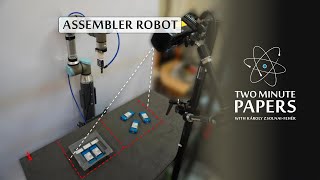
A robot arm learns to assemble objects it's never seen before by practicing disassembly hundreds of times, then reversing those steps. It achieves 86% success on novel assemblies, though it struggles with angled insertions like 45-degree screws and only works on flat surfaces.
Questions this video answers
January 4, 2020.
86%.
Several hundred times per object (speaker: 'several hundred times per object').
Lambda claims ImageNet can be trained to 93% accuracy for less than $19.
Chapters
Dear fellow scholars, this is two minute papers with have a look and marvel at this learning based assembler robot that is able to put together simple contraptions. Since this is a neural network based learning method, it needs to be trained to be able to do this. So how is it trained? Normally to train such an algorithm, we would have to show it a lot of pairs of the same contraption and tell it that this is what it looks like when it's disassembled. And, and what you see here is the same thing assembled. If we did this, this method would be called supervised learning. This would be very time consuming and potentially expensive as it would require the presence of a human as well. A more convenient way would be to go for unsupervised learning where we just chuck a lot of things on the table and say, well robot, you figure it out. However, this would be very inefficient and if at all possible, because we would have to provide it many, many contraptions that wouldn't fit on the table. But this paper went for none of these solutions as they opted for a really smart self supervised technique. So what does that mean? Well, first we give the robot an assembled contraption and ask it to disassemble it. And therein lies the really cool idea. Because disassembling it is easier and by rewinding the process, it also gets to know how to assemble it later. And the training process takes place by assembling, disassembling and doing it over and over again, several hundred times per object. Isn't this amazing? Love it. However, what is the point of all this? Instead, we could just add explicit instructions to a non learning based robot to assemble the objects. Why not just do that? And the answer lies in one of the most important aspects within machine generalization. If we program a robot to be able to assemble one thing, it will be able to do exactly assemble one thing. And whenever we have a new contraption on our hands, we need to reprogram it. However, with this technique, after the learning process took place, we will be able to give it a new previously unseen object and it will have a chance to assemble it. This requires intelligence to perform. So how good is it at generalization? Well, get this. The paper reports that when showing it new objects, it was able to successfully assemble new previously unseen contraptions 86% of the time. Incredible. So what about the limitations? This technique works on a 2D planar surface, for instance, this table. And while it is able to insert most of these parts vertically, it does not deal well with more complex assemblies that require inserting screws and pegs in a 45 degree angle. As we always say, two more papers down the line and this will likely be improved significantly. If you have ever bought a new bed or a cupboard and well, it just looks like a block, how hard can it be to assemble? Wait, does this thing have more than a hundred screws and pegs? I wonder why? And then four and a half hours later you find out yourself. I hope techniques like these will help us save time by enabling us to buy many of these contraptions pre assembled and it can be used for much, much more. What a time to be alive. This episode has been supported by Lamda if you're a researcher or a startup looking for cheap GPU compute to run these algorithms, check out Lambda GPU Cloud. I've talked about Lambda's GPU workstations in other videos, and I'm happy to tell you that they're offering GPU Cloud services as well. The Lambda GPU Cloud can train ImageNet to 93% accuracy for less than $19. Lambda's web based IDE lets you easily access your instance right in your browser and finally hold onto your papers. Because the Lambda GPU Cloud costs less than half of AWS and Azure, make sure to go to lambdalabs.compapers and sign up for one of their amazing GPU instances today. Our thanks to Lambda for helping us make better videos for you. Thanks for watching and for your generous support and I'll see you next time.