This STUNNING New Robot Is The Future Of Work
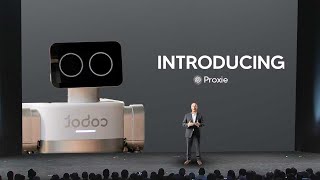
Brad Porter, former Amazon robotics VP, founded Proxy to build cobots that work alongside humans instead of replacing them. The robot uses LiDAR mapping, object recognition, and vision-language models to navigate factories autonomously and handle two-arm tasks. Factory workers say it improves their experience rather than threatening their jobs.
Chapters
So with the rise of humanoid robotics, a lot of people are wondering what other companies are doing. And one company that is doing something completely different is this company called Proxy. So Proxy today have introduced their robot, which they are calling a cobot, which is designed to actually work with humans. Instead of being a humanoid style robot that actually manages to replace humans, this is the kind of robot that's going to be in factories and, and in a variety of different areas and locations that's going to make working really efficient. Now, this was actually started by Brad Porter, who actually worked at Amazon as the VP of robotics. And if you know anything about Amazon, you'll know that their robotics division is completely insane. I think currently they're running something to the tune of around 700,000 robots that are doing everything from picking up your parcels to packaging them really, really effectively. So this new cobot robot is going to be something that is truly fascinating and effective. And I think this is a different take on the modern style of robotics where a lot of companies are trying to simply replace human workers. This is a robot that is designed.
To work with you every day. We wake up and we move. You see them every day, although you may not notice them. The early morning crews, the weekend shifts in the late night teams. Technology has transformed the world since I was first inspired by robots as a kid. But surprisingly simple manual tasks still take so much of our time and energy. We're designing these robots to help us, not replace us. In every sector, Proxy moves and swerves naturally in sync with the people working around it. And as AI and hardware evolve together, so will the ways it can handle items in the world. I'm here to help. It allows us to focus on those things that make us uniquely human, communicate, collaborate, and solve problems. A future that's even more alive with the help of robots.
Now, if you want to know exactly how these robots are being used in the day to day, we actually get a really nice interview clip where they interview someone who's working at the company and they basically talk about how this is going to change the future of work. So for those of you who think humanoid robots and robotics is just about, you know, replacing humans in various different means, this is going to show you that humans and robots are actually coexisting together in the future.
There are two large challenges today. One, the industrial robots can be next to human, so you need to cage them. You need to create some specific zones for those. The other problem is that most robots today are one use case. When I met Brad, he kind of Talked to me about the intention of what type of collaborative robots they are looking to create and how to enable those robots to support and help in our industry. We definitely like and prefer collaborative robots. And this is something that by the name of Cobot, they are already answering that. The team is amazing to work with. Really, we are excited. And not only us, of course, it's the operation team which is the most important guys for us. They are our internal stakeholders. Basically, after we kind of saw the prototype, liked it, the next step for us was really to find the right location to go and deploy that or test it. Definitely trying things in the real world is the key thing for us. I was recently visiting people that work with the robots and they say, I'm working with robots, I'm not working in a manual fashion pushing stuff. They come back much happier when they finish the day of work and not exhausted. They really enjoy into kind of now working with those type of tools. So exciting for them, you know. So definitely you have different elements that this can change the world for us. We are already talking to them to different use cases for the same robots. How can they start to pick goods from the shelves, how can they put stuff into the shelf, how can they lift it? That's going to be a very, very crucial element for us to bring us to the next level.
So one of the things that they actually talk about is the fact that they've designed their robot Proxy from the ground up to incorporate AI. And as AI and hardware evolve together, so will Proxy's ability to handle items in the real world, which focuses on what makes a us uniquely human. Now we also do get a look at their onboard intelligence and this is where we get a look at how the system manages to work really effectively in these factories. So one of the things that this robot is able to do is it's able to use its lidar world based perception, which is essentially a technology that it uses to just understand the world around it. Now this technology is basically like a super smart flashlight. It just sends out beams of light, like tiny laser pulses, and it waits to see how long it takes them to bounce back after hitting objects. And this basically lets Proxy figure out how far away things are and what shapes they have. And it's constantly doing this in a variety of different scenarios so that it's always aware of its surroundings. And basically it's creating a 3D map of the room every single second to help it know where to move and where everything is. Now they also have the visual object recognition. So this thing Actually has cameras and advanced imaging process software, which lets it see everything and understand objects in its environment. For example, it can look at a cart and recognize it as a cart and not just a random object. So this is like giving proxy the ability to name and identify specific things it comes across, Whether it's a cart to push, an item to avoid, or a tool to interact with. You can basically analyze these items, see what it is, and make quick decisions. Now, they've also got autonomous obstacle avoidance, which is where essentially it's built to move through dynamic spaces. So it can handle areas where things are constantly changing, like warehouses, offices, or even, you know, crowded public spaces. And it has sensors and cameras to help it detect those obstacles, such as, of course, you know, people walking by, big boxes on the floor, or even furniture. And when it notices something on its path, it instantly figures out the best way to move around it. Quite like how you'd, you know, avoid bumping into someone on the street. So, of course, we've got a really comprehensive system here that can navigate smoothly without someone needing to constantly guide or control it, making it really reliable and efficient in these busy environments. We also do have vision language models. So proxy is actually being enhanced with vision language models, which basically means that it can look at its surroundings, then describe what it sees in natural and understandable language. And then, for example, proxy is able to look into this area and say something like, this area as well lit, there are boxes stacked neatly along the walls, and. And there's a clear pathway for movement. And this capability not only helps it recognize its environment, but explains it in a way that humans can actually understand. And this is really useful because in situations where a human operator needs update or feedback, you know, we can understand exactly what is going on when we observe this robot. So this makes it a smarter and much more communicative robot than many others out there. This is where we actually get to look at visual slam. So visual slam is basically cutting edge technology. It stands for simultaneous localization and mapping. So this is where we have the technology that allows the robot to figure out exactly where it is and what its surroundings look like. So essentially, it combines images from its cameras with informations from its sensors, and it creates a detailed map of the area, whilst also keeping track of its own position within that map. So imagine proxy walking into an unfamiliar room.
It.
It doesn't just look around and guess. It actively builds a 3D picture of the space in real time, recognizing walls and pathways and furniture. And this technology is pretty much a huge deal because it allows proxy to navigate even complex, cluttered environments with precision. And not only does it see obstacles, but it understands what those obstacles are and adjusts its route to avoid them. And by creating rich maps, proxy becomes even smarter and more adaptive, which means it can handle challenging spaces like warehouses or offices or construction sites without getting stuck or needing constant human input. Now, here we have bimanual manipulation, and this is about teaching proxy to use both of its robotic arms together to handle complex tasks, much like how humans use their two hands. Think of it as giving proxy the ability to perform actions that need coordination between both arms, like picking up and opening a box or holding an object steady, whilst, you know, using the other hand for something else. So to make this happen, researchers are currently working on advanced technologies to improve proxy's brains. They're teaching it to combine skills in language, understand commands, vision, you know, all of that stuff. Basically, learn how to get this model to generalize. That means it's not just learning how to do one thing. It's, of course, learning how to generalize, adapt to completely new tasks it hasn't seen before. And the goal that they're trying to do here is basically trying to prepare this robot for more complex, challenging tasks in the future. So it's gonna be able to do a lot more things other than just, you know, pulling things around.










