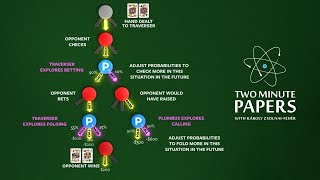
A poker AI trained purely through self-play beat five professional players at 6-player no-limit Texas Hold'em in just 20 hours, winning around $1,000 per hour. The bot uses a decision-tree evaluation method and cost only a fraction of what traditional AI training requires.
Questions this video answers
6‑player no‑limit Texas Hold'em
20 hours
$1,000 per hour
Five professional poker players
Weights & Biases
Chapters
Dear fellow scholars, this is two minute papers with today the game we'll be talking about is the 6 player no limit hold and poker, which is one of the more popular poker variants out there. And the goal of this project was to build a poker AI that never played against a human before and learns entirely through self play and is able to defeat professional human players during these tests. Two of the players that were tested against are former World Series of Poker main event. And of course, before you ask, yes, in a moment we'll look at an example hand that shows how the AI traps a human player. Poker is very difficult to learn for AI bots because it is a game of imperfect information. For instance, chess is a game of perfect information where we see all the pieces and can make a good decision if we analyze the situation well. However, not so much in poker because only at the very end of the hand do the players show what they have. This makes it extremely difficult to train an AI to do well. And now let's have a look at the promised example hand here. We talked about imperfect information just a moment ago, so I'll note that all the cards are shown face up for us to make the analysis of this hand easier. Of course, this is not how the hands were played. You see the AI up here marred with P2, sitting pretty with a jack and a queen. And before the flop happens, which is when the first three cards are revealed, only one human player seems to be interested in this hand. During the flop, the AI paired its queen and has a jack as a kicker, which if played well, is going to be disastrous for the human player. So why is that? You see, the human player also paired their queen but has a weaker kicker and will therefore lose to the AI's hand. In this case, this player thinks they have a strong hand and will get lots of value out of it and only to find out that they will be the one milked by the AI. So how exactly does that happen? Well, look here carefully. The bot shows weakness by checking here, to which the human player's answer is a small raise. The bot again shows weakness by just calling the raise and checking again on the turn, essentially saying, I am weak, don't hurt me. By the time we get to the river, the AI again appears weak to the human player who now tries to milk the bot with a mid sized raise. And the AI recognizes that now is the time to pounce. The confused player calls the bet and gets milked for almost all their money. An excellent slow play from the AI. Now note that one hand is difficult to evaluate in isolation. This was a great hand indeed, but we need to look at entire games to get a better grasp of the capabilities of this AI. So if we look at the dollar equivalent value of the chips in the game, the AI was able to win $1,000 from these five professional poker players every hour. It also uses very little resources, can be trained in the cloud for only several hundred dollars, and exceeds human level performance within only 20 hours. What you see here is a decision tree that explains how the algorithm figures out whether to check or bet. And as you see here, this tree is traversed in a depth first way. So first it descends deep into one possible decision and later, as more options are being unrolled and evaluated, the probability of these choices are updated above in simpler words. First, the AI seems somewhat sure that checking would be the good choice here, but after carefully evaluating both decisions it is able to further reinforce this choice. One of the professional players noted that the bot is a much more efficient bluffer than a human and always puts on a lot of pressure. Now note that this is also a general learning technique and is not tailored specifically for poker, and as a result, the authors of the paper noted that they will also try it on other imperfect information games in the future What a time to be alive. This episode has been supported by Weights and Biases. Weights and Biases provides tools to track your experiments in your deep learning projects. It can save you a ton of time and money in these projects and is being used by OpenAI, Toyota Research, Stanford and Berkeley. It is really easy to use. In fact, this blog post describes how you can visualize your Keras models with only one line of code. When you run this model it will also start saving relevant metrics for you. And here you can see the visualization of the mentioned model and these metrics as well. That's it. You're done. It can do a lot more than this, of course. And you know what the best part is? The best part is that it's free and will always be free for academics and open source projects. Make sure to Visit them through wendb.com papers wandb.com papers or just click the link in the video description and sign up for a free demo today. Our thanks to WeightsAndBiases for helping us make better videos for you. Thanks for watching and for your generous support and I'll see you next time.