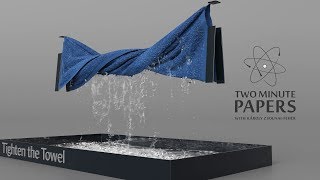
A short Two Minute Papers video by Károly Zsolnai-Fehér (uploaded Aug 3, 2019) that presents a research paper improving fluid–fabric interaction simulations using mixture theory. The video highlights realistic behaviors (absorption, saturation, diffusion along yarns, porous flow, sticky fluids like honey), shows visual demos, and notes that the paper includes comparisons to laboratory experiments for validation. The presenter encourages viewers to read the paper themselves.
Chapters
Dear fellow scholars, this is two minute papers with zsolnai. Today I've got some fluids for you. Most hobby projects with fluid simulations involve the simulation of a piece of sloshing liquid in a virtual container. However, if you have a more elaborate project at hand, the story is not so simple anymore. This new paper elevates the quality and realism of these simulations through using mixture theory. Now, what is there to be mixed, you ask? Well, what mixture theory does for us is that it helps simulating how liquids interact with fabrics, including splashing, ringing and more. These simulations have to take into account that the fabrics may absorb some of the liquids poured onto them and get saturated. How diffusion transports this liquid to nearby yarn strands. Or what you see here is a simulation with porous plastic where water flows off of and also through this material as well. Here you see how it can simulate honey dripping down on a piece of cloth. This is a real good one. If you are a parent with small children, you probably have lots of experience with this situation and can assess the quality of this simulation really well. The visual fidelity of these simulations is truly second to none. I love it. Now the question naturally arises, how do we know if these simulations are close to what would happen in reality? We don't just make a simulation and accept it as true to life. If it looks good, right? Well, of course not. The paper also contains comparisons against real world laboratory results to ensure the validity of these results. So make sure to have a look at it in the video description. And if you've been watching this series for a while, you notice that I always recommend that you check out the papers yourself. And even though it is true that these are technical write ups that are meant to communicate results between experts, it is beneficial for everyone to also read at least a small part of it. If you do, you'll not only see beautiful craftsmanship, but you'll also learn how to make a statement and how to prove the validity of this statement. This is a skill that is necessary to find truth. So please read your papers. Thanks for watching and for your generous support and I'll see you next time.