Tim Dillon: Comedy, Power, Conspiracy Theories, and Freedom | Lex Fridman Podcast #156
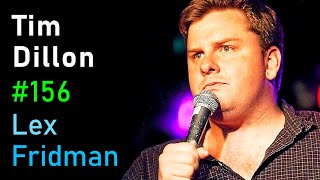
Conversation (recorded Jan 29, 2021) between Lex Fridman and Tim Dillon covering comedy, personal anecdotes (tombstone joke; family and mother), the role of comedians, concerns about AI and algorithms (YouTube moderation, titles driving recommendations), deplatforming and free-speech tradeoffs (Alex Jones, Parler), conspiracy theories (JFK, 9/11, Epstein, QAnon), and reflections on career, love, and mortality.
Chapters
The following is a conversation with Tim Dillon, a standup comedian who is fearless in challenging the norms of modern day social and political discourse. Quick mention of our sponsors NetSuite business management software, athletic greens all in one nutrition drink, Magic Spoon, low carb cereal, BetterHelp, online therapy and Rev Speech Detect Service. So the choices Business, Health, Sanity or Transcripts. Choose wisely my friends. And if you wish, click the sponsor links below to get a discount and to support this podcast. As a side note, let me say that I will continue talking to scientists, engineers, historians, mathematicians and so on. But I will also talk to the people who Jack Kerouac called the mad ones in his book on the Road that is one of my favorite books he wrote. The only people for me are the mad ones. The ones who are mad to live, mad to talk, mad to be saved, desirous of everything at the same time. The ones who never yawn or say a commonplace thing but burn, burn like fabulous yellow roman candles exploding like spiders across the stars. And in the middle you see the blue center light pop and everybody goes. Some of these conversations will be a bit of a gamble in that I have no idea how they will turn out, but I'm willing to risk it for a chance at a bit of an adventure. And I'm happy and honored that Tim this time wanted to take a chance as well. If you enjoy this thing, subscribe on YouTube, review it on Apple Podcast, follow on Spotify, support on Patreon, or connect with me on Twitter lexfriedman. And now, here's my conversation with Tim Dhillon. What would you like your tombstone to read? It's a good way to summarize the essence of a human being.
I would like it to say this has not been paid for and I want my living relatives to struggle to pay for it. And I think I would like them to be hounded every day. I would like people to call and go listen, we don't want to ever excavate a body, but we will because this has not been paid for. I love the idea of leaving the like debt, leaving the world in lots of debt that other people have to deal with. And I know people that have done that. I know people that have been in families where that's happened, where someone has to sit and just curse the sky because they don't have a physical person anymore to be angry at and they but they still have to deal with the decisions that person made. And that's deeply tragic, but that's always struck me as very funny.
Well, it's A kind of immortality, the debt. Because you can. If the debt lasts for a long time, the anger lasts for a long time. And then you're now immortal in the minds of many. You arouse emotion in the minds of many.
My mother's best friend in the town I grew up in, her husband shot himself in the. The driveway. And my mother's friend never got a chance to just grieve because he owed so much money. She would come over and go, I hate him. I fucking hate him. And it was just such an interesting thing to see somebody who. And her kids ended up getting angry at her for that because they didn't understand why she would hate a guy who was clearly, you know, suffering and. But she goes, he took the selfish way out. He fucked us. And it was always interesting for me to just remember that, like, you can leave Earth and still be a problem. That's kind of a special person. So that's, I think, what I'd like my tombstone to read.
Yeah, there's a. There's a show called Louis with Louis CK I don't know if you watched it.
I'm aware of it.
There's this moment, I think, where an old guy's talking to Louis about the best part about love is after you break up. And it's remembering that. Like, remembering the good times and feeling that loss, the pain of that loss. The worst part about love is when you no longer feel that pain. The pain of losing somebody lasts longer, is more intense and lasts longer than the actual love. So his argument was like, the pain is. The re. Is what love really is.
Wow.
In the same way that anger your tombstone would arouse is. Will last longer. And that's. That's deeply, like a human thing. Like, why do we attach happiness to the way we should remember others? It could be just anger.
I know so many people who will have deeply complicated feelings when I. I, you know, I did drugs for many years, so. And I. I spent time with some wild people, and their parents were also wild people. And some of their parents have done crazy things to them and, you know, have created situations that were not productive for child rearing. And so I know that when those people die, it's going to be a very mixed bag. Like, there's going to be a lot of complex emotions. Like, hey, we loved that guy. But also, when we look back, he was a horrible father, a horrible husband, but he was fun. And we don't put enough stock in that. But that will be a push and pull, and I'll be the one Kind of bringing up like, hey, he was a lot of fun. He was a lot. Remember when he stuck us? One of the things, this particular person I'm talking about, we were at a bar. Me and my friend were there. We're having dinner. And his father, who was young, you know, an alcoholic, and, you know, a guy that would go out every night and didn't work, you know, refused to work, would lie and say he was going to work and then go to a bar. I mean, just a fun person. And he. He. We were sitting at this bar restaurant, and the bartender. We see his father walk up to the bartender and say, point at us. Point at our table, and go and put the thumbs up. And the bartender nodded. And then the father walked over to our table, and he said, listen, I just want to let you know I just bought you dinner. And I looked at his son. I said, he's a pretty good guy. And then he climbed over the little fence down to the water and got in his little boat. It was a little cigarette boat. And he just drove away. And in about an hour later, we went. We said, I think that guy took care of the bill. She said, well, go talk to the bartender. So we talked to the bartender, and he goes. He handed us a bill, and the bill was for like $1,000. And we said, wait a minute. What the hell's going on? And he goes, the guy that left an hour ago said you were going to take care of his bill. He's been drinking here all week. And we go, what are you talking about? And he goes, remember, he pointed at you, he put the thumbs up and you guys waved. Yeah. You remember that? And the guy go. And we went, yeah. And I just looked at my friend's. My friend. And I went, you know, your dad is just. We're gonna remember him for all kinds.
Of reasons, but to you, he was fun.
He was a lot of fun. He wasn't my dad, but I spent a lot of time with him. I was in two boating accidents with him, you know. Two boating accidents, all involved drugs. Yes. He was usually alcohol was involved when he left his house and when he was at home as well. But I was in two boating accidents. And do you know how fun someone has to be to get in a second boating accident? Do you know what a good time someone has to be to get in a boat with them after you've already gotten in one wreck?
Never get fooled. What was that line? George Bush? Never get fooled again.
Right? Yes. If you're getting fooled again, know there's a reason for it. But he was a, he was a fun guy. He did have a death wish. The second boating accident, he grabbed me and said, you can't hang out with me anymore. And I said, why? He goes, I'm trying to kill myself. And I was like, oh. And then I understood that, like, oh, the fun. Under the fun lived a very destructive person who not only was destructive, but wanted to die.
So speaking of fun people that want to die, I. I don't know if you're. We can go Hunter S. Thompson, but Charles Bukowski, I don't know if you're aware of the guy.
I'm aware of him, sure. I've read some of his stuff.
So. His tombstone says, I just wanted to ask you a question about it. His tombstone says, don't try.
Interesting.
What do you think about that advice as a way to approach life?
I think for many people it's a good advice because the people that are going to try will do anyway. And the people that need to be told. There's a whole cottage industry now of motivational speakers and life coaches and gurus that tell people that they all have to own their own business and be their own boss and be a disruptor and get into industries. You know, that's incredibly unrealistic for most people. Most people are not suited for that. And you know, the Gary Vee's of the world that tell everybody that they should just hustle and grind and hustle and grind, very light on the specifics of what they should actually do. Yeah, I think a lot of people. That's not horrible advice to give to a lot of people. I think, I think my generation got horrible advice from our parents, from our teachers. And that advice was follow your dreams. And nobody. And that was it, by the way. There was no, like, what are your dreams? Are they realistic? What happens when they don't work out? Will your dreams make you happy? Are your dreams real? Do they exist on earth?
Yeah.
Can you follow anybody? Follow your dreams. You can be anything you want to be. Horrible advice, horrible advice. Worst advice you could ever give a generation of people. Really? Truly. I mean, think about, think about it. If you were talking to somebody and you were trying to make them succeed, are there any two worse pieces of advice to give them than follow your dreams and you can be anything you want to be? Those, to me, are the two most destructive pieces of information I've ever heard.
So let me push back because that's fair.
This is. Many people do. So.
Yeah, this is like a rigorous journalistic Interview. Larry King, by the way, passed away today, so I'm taking over the. I'm carrying the very sad RFP King.
Yeah.
What was I even gonna say? Oh, let me push back on the follow your dream thing is I come from an immigrant family where I was always working extremely hard at stuff. Like, in a stupid way, I would. I love. There's something about me that loves hitting my head against the wall over and over and over until either my head breaks or the wall breaks. Just like I love that dedication for no purpose whatsoever. It's like the mouse that's stuck in a cage or whatever. And no. And everybody always told me, my family, the people around me, the sort of. The epitome of what I could achieve is to be kind of a stable job. You know, the, the, the old, like lawyer, doctor. In my case, it's like scientist and so on. But I had these dreams at this fire, you know, about I love robots and that nobody ever gave me permission to pursue those dreams. I know you're supposed to grab it yourself. Nobody's supposed to give you permission. But there's something about just people saying, you know, what everyone else thinks, like giving you permission. A parent or somebody like that saying, do your own thing. Go become an actor. Go become like, do the crazy thing you're not supposed to do. An artist. Go build a company, quit school, all that kind of stuff.
Yes, sure.
That's the push back against the follow your dreams as advice in mass, if.
You were to look at. In mass, if you were to look at statistically how few people that works out for. I'm just. No, but let's be very honest.
It's very true.
Yeah. Be very honest. So, I mean, like, yeah, if you're gonna go be an act, hey, I was broke for 10 years before I became a. Before I was making money as a comedian. I get it. I didn't need Gary Vaynerchuk to tell me to follow my thing, right? And here's the other thing. I was kind of funny and like, I was kind of. A lot of things were in my favor of being a comedian, right. I had this kind of crazy, fucked up life. I had a lot of stories I had exhausted. I was willing to fail. I had failed before. I was broke. I didn't care about being broke. I knew how to be broke. I had. I was shameless to a degree. I would get on a stage night after night and be laughed at. I had a high threshold for being embarrassed. I had a high threshold for people thinking that I was Scumbag, right? And showing up at family parties and being like, yeah, I still really don't have a job. And I. I'm just. I work at comedy clubs kind of, and I get booked when I can, and I was, you know, suited for it. There's this idea that people can just roam around the world injecting themselves into other things they have no aptitude for at all. And will that to happen? A small percentage of people might be able to do that, but the vast majority of people have something they might key into that they're meant to do. Like, you loved robots, you love technology, and you found a place in that world where you thrive. But I think many people, a lot of people love robots, right? So a lot of people think everything you do is interesting. I think your shit is fascinating. I watch your podcasts and I think it's very interesting. I have no place in your world. You know what I mean? I have no place in that world. I don't like remedial math. I don't like community college math. I think it's a waste of my time.
What do you think about robot? Would you ever buy a robot for your home?
Yes. What will it do?
I'll be a companion, a friend.
Oh, yeah. I mean, I would like to start replacing friends and family with robots immediately. Okay. I mean, truly. Truly. I mean, I'm not even kidding. Like, I would like to have a Thanksgiving with four robots. I'm. I'm dead serious. Are they into Qanon? Like, are the robots. When do the robots start going crazy? That's my question is, like, how long do the robots live with me before they are also a problem and I gotta replace them? You know what I mean?
You're gonna indoctrinate the robots.
Yeah. The robots gonna call me, like my aunt does and talk about coronavirus for an hour every morning and tell me, everyone in America who's died of coronavirus.
One of the things I enjoy in life is how terrified people like you. I'm a huge fan, by the way. Get a robot.
Well, I am. I'm concerned about AI, like, completely getting rid of the need for human beings. Because human beings, I mean, you. You go out in the street and you go, so few of these people are necessary. Even now. Even now, you look at people and you go, they're hanging on by a thread, right? And you can just imagine how many jobs are going to get replaced, how many industries are going to be completely remade with AI. And the pace of change worries me a little bit because we do a very bad job. In this country of mitigation, when we have problems, we don't do a great job. We did not. Great job with COVID Right? We don't do a good job. It's just something we don't do well. We kind of. We're good in booms and busts. We're good when it's good. And we're actually. We kind of know how to kind of like, hey, we're bottomed out. We're like, we're like a gambling addict in this country. We like. We know what it feels like to be outside of an OTB at 9am Drinking coffee and smoking cigarettes, going, I'm going to build it back. And we know what it's like to win. But anything in between, it seems not that great. So to me, it feels like, are we going to be able to, like, help people that are displaced and that have their jobs taken? But, I mean, do you. Do you not fear sort of a world where you have a lot of, you know, artificial intelligence replacing workers and then what happens?
There's a lot of fears around artificial intelligence. One of them is, yes, displacement of jobs, workers. That's technology in general. That's just any kind of new innovations displace jobs. I'm less worried about that. I'm more worried about other impacts of artificial intelligence. For example, the nature of our discourse, like social. The effects of algorithms on the way we communicate with each other, the spread of information, what that information looks like, the creation of silos, all that kind of stuff. I think that would just make worse the effects that the displacement of jobs has. I think ultimately I have a hope that technology creates more opportunities than it destroys.
I hope so, too.
So in that sense, AI to me is an exciting possibility. But, you know, the challenges this world presents will create divisions, will create chaos and so on. So I'm more focused on the way we deal as a society with that chaos, the way we talk to each other.
That's huge.
Creating the platform that's healthy for that.
Now, as a. As a comedian, creator, whatever you want to call it, people that put out content, the gatekeepers are now algorithmic, right? So they are kind of almost AI already. So if you are a person that puts out, you know, YouTube videos, podcasts, whatever you're doing, you are. It used to be a guy in the back of the room with a cigar saying, I like you, or get him out of here. Now it's an algorithm you barely understand. Like, I talk, I talk to people at YouTube, but I don't know if they understand the algorithm.
They don't.
They don't.
And that's fascinating.
Yeah, it's fascinating because I speak to people at YouTube and I go, hey, man, what's going on here? One of my episode titles of my podcast was called Knife Fight in Malibu. It was about real estate, and it was because a realtor in Malibu, I was trying to get a summer rental, which I can't really afford, but I don't. I don't think that's a huge problem. I, you know, I follow my dreams. So I called a realtor and she said, listen. She goes, I don't know what the government's saying.
Yeah.
But she goes, truly, we're getting rid of them. It's not good.
Yeah.
And she goes, a real knife right out here. So we put that in the episode title. And of course, I guess some algorithm thought that we were showing, like, people stabbing each other in Wendy's, and we got, like, demonetized. Did we get demonetized?
But we lost 80,000.
We lost a lot of views because we were kicked out of whatever. Like, we're just kicked out.
Yeah.
And I was asking YouTube about it. They were kind of understanding it. But even the people that worked there didn't truly seem to understand the algorithm. So can you explain to me how that works where they barely know what's going on?
No. They do not understand the full dynamics of the monster or the amazing thing that they've created. It's the amount of content that's being created is larger than anyone understands. Like, this is huge. They can't deal with it. The teams aren't large enough to deal with it. There's, like, special cases. So if you fall into the category of special cases, we can maybe talk about that like a Donald Trump, where you, like, actually have meetings about what to do with this particular account. But everything outside of that is all algorithms. They get reported by people. And they get, like. If enough people report a particular video, a particular tweet, it get. It rises up to where humans look over it. But the. The. The initial step of the reporting and the rising up to the human supervision is done by algorithm. And they don't understand the dynamics of that because we're talking about billions of tweets. We're talking about hundreds of thousands of hours of video uploaded every day. Now, the hilarity of it is that Most of the YouTube algorithm is based on the title.
That's crazy.
It's. And the description is a small contribution in terms of filtering in Terms of the knife fights situation. Right. And that's all they can do. They cannot. They don't have algorithms at all that are able to process the content of the video. So they try to also infer information based on. If you're watching all of these like QAnon videos or something like that, or Flat Earth videos, and you also watch. Are really excitedly watching the whole night fight in Malibu video that says that increases the chance that the knife fight is a dangerous video for society or something.
Interesting. Wow.
Based on their contribution, people are watching.
Something because I watch QAnon and Flat Earth videos to ridicule them.
Right.
That. You know what I mean? I watch these videos and I make fun of them on my show.
Yeah.
But what's interesting is if I then go watch something else, I'm increasing the likelihood that that video is going to get looked at as potentially subversive or dangerous.
Exactly.
That's why.
So they make decisions about who you. Who you are as a human being, as a watcher, the visual user, based on the clusters of videos you're in. But those clusters are not manually determined. They're. They're automatically clustered. It's so weird.
We have titles where they got upset about. And I don't even understand.
Yeah.
Like, we had a title that was so innocuous, in my opinion. And the title of the episode was called Bomb Disney World. And I was asking people to consider bombing Disney World and YouTube got angry at that. So you don't know why. You can never understand.
I could have said Disney World is the bombs.
Right, right, right.
It's just rearranging. That's what I was saying.
Do it. But I was saying let's start thinking about plans to do like, not let's do it like, but let's. Let's get in the mind. Let's change the conversation.
Yeah.
I think it's very interesting because as a comedian, you don't want to live in that world of worrying about algorithms. You don't want to worry about deplatforming and shadow banning. I mean, all these conversations that I've had with other comedians about shadow banning. I mean, it's hilarious. We all call each other. I think I'm being shadow banned. Are you being shadow banned? And nobody knew what that word was a month ago. I mean, a year ago. But everyone now is convinced that everything they do that isn't succeeding is being shadow banned.
Yeah.
So it's this new paranoia.
Yeah.
This algorithmic paranoia now that we all kind of have. Because there are genuine instances of people being taken out of an algorithm, you know, rightly or wrongly, for whatever however you want to believe. But then there are also things that just don't perform as well for a myriad of reasons. And then we're all saying like, well, they're against me, they're shutting me down. And you don't know if that's true or not.
You know, what do you think about this moment in history which was really troubling to me? We could talk about several troubling aspects, but one is Amazon removing Parler from aws. To me, that was the most clearly troubling. It felt like it created a more dangerous world when the infrastructure on which you have competing medium of communications now puts its finger on the scale, now influences who wins and who loses.
Absolutely, you're right. And what you're always told is like, if you don't like Twitter, create your own service.
Right.
Or if you don't like something, you can do your own thing, or if you are. And, and, and basically because, you know, tech, you have to be in business with one of five companies. I think it's like Amazon, Facebook, Google, YouTube and Twitter, whatever. They're like, you know, I mean, Amazon puts everything on the cloud. You know, Google and YouTube, it's all basically the SEO and the advertising and you got to get your name out there. You don't want to be buried. And like, because you have to do business with. You're. It's a cartel of these companies. You understand it better than anybody that you are prevented, truly. And I, I. The state has an interest in. In. In. And has always had an interest in. In crushing dissent. This is what the state has done. This is how they, you know, can now, because you don't have, you know, three broadcast networks anymore and a handful of newspapers that were all run, by the way, by people that had been either compromised or happily, you know, happily going with the program. And you have this wild west of the Internet, people like me, people that make. I make funny content that I hope is funny. But a lot of it is wild and crazy. Yeah, I say a lot of wild and crazy things. They're very funny. I say a lot of wild and crazy things about powerful people.
Yeah, you mock the powerful in there by bringing them down a notch. We'll probably talk about it. But humor is one of the tools to, to. To. To balance the power in society.
Well, sure. And to make people feel better about things and to, you know, whatever the case may be. Right. That's my goal is to kind of like hey, people have had a shitty day. If this video or podcast makes you laugh, that's great. I think that it won't ever. It was never going to stop at Alex Jones. Not that I think he should have been taking off everything the way he was. But this keeps going until we have sanitized all of social media. And what they really want it to be is what Instagram is kind of becoming, which is a marketplace of. You could just go and buy sneakers, go buy a sweatshirt, go buy jeans, go buy this, go buy that. And the idea of the free exchange of information seems to be the old Internet, and it seems the new Internet seems to be, you know, hyper. And I'm a capitalist, but this seems to be, like, hyper capitalist in the sense that, like, they only want you consuming things and they don't want you thinking too much, and that seems to be where it's heading. I've even seen that with Instagram, where it's like, everything on Instagram is not like, buy a sweatshirt. I'm like, all right, man. Hey, man, if I want a sweatshirt, I'll get it. Like, relax. You know, just. Every ad seems to be encouraging consumption, but very few things seem geared towards, hey, let's have a dialogue, or let's. Not that Instagram is ever great for that, but, like, very things are geared now towards content on Instagram. A lot of it seems geared towards shopping.
See, I don't know. It's an interesting point. I don't know if the consumerism that capitalism leads to is necessarily gets in the way of nuanced conversation. I feel like you could still sell Tim Dillon sweatshirts and have a difficult, nuanced conversation, or mock the current president, the previous president, mock the powerful, all that kind of stuff.
We try. We try to balance that. I mean, sweatshirts, we do. They're not. Are they on sale now? Fake business. We do fake business. Sweatshirt with the Enron logo. Fake business. Because I like. I do fake business all the time.
It'd be nice if we talk about Alex Jones. If you plug the sweatshirt. Doing that conversation.
Yeah, we'll do that. Absolutely. Yeah. But what I tend to worry about with. I see social media and technology existing to flatten society. It makes people very boring. All of the experiences kids have right now are online. Many of their closest friendships are online. Their first relationships are online. The culture is very homogenous and. And that's. I think it's eliminating characters, it's eliminating interesting people. It's making people into AI, all of their teams.
Whoa, whoa, whoa, whoa.
Whoa. Yeah, yeah, yeah, yeah.
I could be Charles Bukowski as well. Let's not get crazy.
It's not there yet, right? I mean, the $75,000 dog is not doing anything, you know, so, I mean, we're not. We're not there yet. Listen, I hate. I get why you like AI so much. I hate people, too. And I'm very amenable to AI And I agree with you. Like, listen, I think the future. We got to get everyone out of here. I'm with you on that. So don't think.
I love people. He's manipulating my mind and my.
That's why the flash of light in your eyes when you talked about that dog was so much more than any person. And I get it, by the way.
You're right. I love people. But if we're not excited, if it can just use robots to kill most of them, I think that would be good for society.
I'm with that too, but I think that social media flattens, flattening.
The personalities, flex personalities of people, man.
And it's just, you know, when's the last time, like, I like the idea of like, you know, and I'm, you know, somebody showing up to, you know, high school, like a backpack and taking out an old CD and being like, hey, man, here's this band you've never heard of that I love or whatever. You got to get into this. And I'm like, you know, when I talk to young, you know, I have friends that have younger brothers and everything, every. And I know that the dominant culture was always dominant. I'm not an idiot. But, like, I feel like it's harder to be unique and original now because so much of, of what's promoted is just this way to kind of corral people into believing and thinking a certain set of ideals that's constantly shifting and evolving, and people are just caught up in that. And to me, it gets very boring very quickly. I hate being bored. That's what it is.
I don't know what to do with that because at the same time, podcasts are really popular, long form podcasts, really popular. And people are, People are hungry for those kinds of conversations. There's a lot of dangerous ideas, quote unquote, flowing, being spread around through podcasts, meaning just like debates. Correct. You know, so that's still popular. So I don't know what to.
I agree with you.
That gives me hope, I guess.
I hope so too. And like I said, I, I look at the negative a lot because that's what I usually make fun of but there's a lot of positive stuff happening too.
Let's talk a bit about Alex Jones. So you've gotten a chance to talk to him while you were on the Joe Rogan Experience.
I've been on Alex's show. I've had Alex on my show. I've talked to Alex for three hours in front of. I guess it was maybe like 15 million people, right On Joe's show. It was a really wild conversation. I think it was one of the coolest moments in broadcasting, clearly that I've ever been a part of. But I think it goes in the lexicon of these are big podcasts. Like I think it's one of the biggest podcasts a week before the election. Alex Jones. I'm really grateful that Joe gave me the opportunity to be there and it was just an amazing conversation to watch.
What was the shirt you wore?
Just Lane. It was a fun joke that no one in tech got because we all know how funny they are. But the tech writers, which is mainly.
Blue, not agree with these mainly blue.
Haired people whose goal in life is to find things to give them orgasms with. You know, if you want to dye.
Your hair blue, it's your choice.
I respect it. And. But is it your choice? But at the end of the day it's like, you know, all the tech writer, like a lot of people just. And I'm not, I'm just maligning tech unfairly. But a lot of people that senses of humor were like, he's advocating for human trafficker. I'm like, it's clearly a joke because we're coming off the believe all women. Yes, we're coming off that. It's very funny to just say fris Lane. Hey man, believe all women. Like it's just our politics and our public sphere is so schizophrenic right now that when you point that out, people are going to be angry with you. But that was a fun shirt to wear.
But on Alex, you know, I was one of the people that found him really entertaining that, that the same kind of thing is with Bukowski. These kinds of personalities that are wild, crazy, full of ideas, they don't have to be grounded in truth at all. Or they can be grounded in truth a little bit. It like he's just playing with ideas. Like a jazz musician screaming sometimes. Obviously he has some demons. Sometimes he's super angry for no reason whatsoever at some weird thing that he's constructed in his own head. Sometimes he's super loving and peaceful. Especially lately that I've Heard him. I don't know if you've seen with him, with Michael Malice, where he's doing like. Malice was doing like. While telling Alex Jones, I love you, Alex. You know, just this loving kind of softness and kindness underneath it all. I don't know what to make of any of it. And then there's this huge number of people that tell me that Alex Jones is a. Is dangerous for society.
Right.
So what do you do with that? Do you think he's dangerous for society? Do you think he is one of the sort of entertaining personalities of our time that shouldn't be suppressed or somewhere in between?
I don't think that Alex per se is dangerous for society. I think the greater danger for society comes again from stifling all dissent. Right? All, like anybody with a voice that uses it, that critiques the government, and putting all of those people in a category and getting rid of them is incredibly dangerous to me. More so. I think the biggest problem that Alex has ever had was when he questioned the Sandy Hook shooting. And that really was because it really is this identifiable incident that you can look at where it did get away from him. And a lot of his fans who. The people that are attracted to conspiracy stuff. And I have some of those fans. Some of them are really smart people. Some of them are mentally unwell. A lot of them happen to be mentally unwell. So when you have a fan base of people where some of them are mentally unwell and you are questioning, you know, tragic events, okay? And Alex was right about Epstein. He was right about a lot of things, and he's. He's got no credit for that. And I understand that this piece. Sometimes when you write about 10 things and you're wrong about something and the thing you're wrong about is so offensive to people, you're never going to get any credit for being right, even though you were right more than when you were wrong. The problem was a lot of his fans who were crazy stalked, harassed these families and accused them of being actors and accused them of, like, faking their children's deaths. It was just horrific experience. And Alex is tied to that. And, and, and, and you know how much he inspired that by what he did on his show. I don't know, because I haven't watched hours and hours of that particular thing, like the whole Sandy Hook thing. If you listen to him, he says, I really covered it. I kind of covered it and moved on. Other people go, no, he spent a long time on it. But that's the real danger of going into that Territory over and over again going, everything is, is everything's a false flag or everything's fake. I think, I think Alex has actually been kind of reasonable. Like, he's resisted a lot of the politics of like, racial resentment on, like the alt right, for example, he's resisted that. He's resisted the anti Semitic currents of a lot of that politics. Right. He's resisted a lot of the virulently anti trans or anti gay stuff. Now, he does dip his toe into the water of like, the culture wars. Of course he does. But I've never really seen him, and I could be wrong about this, embrace white nationalism or identitarianism. I've never seen him really go anti Semitic. I've never seen him take that route when I grew up. And I would turn him on every now and then. He was talking about NAFTA, the WTO. He's talking about 9, 11. He was talking about the World Trade Organizations at a lot of these big conferences, whether it was the Bilderberg Group, whether it was Bohemian Grove, which he infiltrated. And he was talking about, hey, here are the most powerful people in the world, here's what they're doing, and here's how it affects you. And that was interesting to me because it was never. No one else was really talking about it except Alex Jones. Occasionally Art Bell on wabc, you'd listen to him at night, right? I think Alex became very controversial when he decided to back Donald Trump. And then he has a considerable following and a considerable audience that he was then able to marshal in the direction of supporting Donald Trump. That was when the spotlight. Because then he was talking to Trump. Trump did his show. Alex Jones just got bigger, right? I mean, he blew up. That's the term, right? He blew up. Like he, he, he, he had the good, he put out the good HBO special, whatever you want to call it. He has a hit song. Yeah, he blew up. And then people started looking at the things that, you know, he was associated with. The Sandy Hook thing is a blemish on his record. I do believe he regrets it. But again, I do see the point of the families who are like, dude, fuck this guy forever. This is the worst thing I ever went through. It's a very tough. I understand the people that say that. I understand. And I, and I understand the people that go. When you coordinate, when you have tech companies that act in a coordinated manner to just get rid of someone, they don't have any way to defend themselves. It's, it's a little terrifying when you think about that power being abused and how wouldn't it be?
Do you think he should not have been banned from all these platforms?
I don't think. I do think that if you are a private company. Right. I do think. And this is where you run into this. This problem. Like, I don't know. If these tech companies were government utilities, would that decrease people's likelihood of being banned? I don't know. Right. So I'm, I understand the benefit of them being treated like public utilities and people thinking they have the right to a Twitter. I'm. I've never. I don't know. I have very little confidence. I mean, the government's trying to roll out a vaccine in California and we vaccinated like five people. I mean, in terms of what we need to do in the state. Right. So maybe if it was a government utility, I do think someone like Alex Jones, like, there should be some process. So if you're going to get rid of someone, they should have a way to defend themselves. There should be more democratic.
Yeah.
Process that you can go through than just being unilaterally taken off something. But, like, then you run into the, like, am I going to say that everyone deserve. No. If you're threatening or harassing people or threatening to kill them, publishing their private information, if you're committing crimes on these platforms, obviously the people that own these platforms are going to be like, we. We're not going to allow this to happen. So I understand that there is a line, right? There is some, like, people that say there's no line aren't really thinking like there is a line. I just thought that line seems to be moving all the time, and it seems to be a very hard thing to police. But I don't think you can remove a guy off everything and then also bank accounts won't give him debit cards or credit cards. I don't know if you talked to him about that, but, like, you know, there were financial institutions that were refusing to let him, you know, park his money there. So, I mean, it really does get pretty terrifying pretty quickly, probably without any.
Transparency from those companies. So you're right. It feels like there should be a process of just having. For him to defend himself.
I think there needs to be a process for people to defend themselves. I. Every day I wake up and I go, is something I said in a video going to get taken out of context? Is somebody going to get angry? Is somebody going to be. You know, I say wild stuff because that's what makes me laugh. That's what makes My friends laugh and that's what makes my audience laugh. So I, I never ever. People, you know, whatever, whatever political side you come down on, I think if you make your living speaking, it's always interesting to me if you are pro the deplatforming. That's odd.
It's interesting to consider kind of a jury context to where, you know, there's transparency about why your video about bombing Disney World might be taken down. Like, it, it's, it gets taken down and then there is, it's almost like creating a little court case, a mini court case. And not in the legal sense, but in the, in the public sphere. And then people should be able to have, you know, you pick representatives of our current society and have a discussion about that and make a real vote. You know, just have like jury locks himself up in a discussion. That kind of process might be necessary. Right now. What happens is Twitter is completely, first of all, they're just mostly not aware of everything they're doing. There's too much stuff. But the stuff they're aware about, they make the decision in closed doors meetings and without any transparency to the rest of the company, actually, but also transparency to the rest of the world. And then all they say is, we're making these decisions because the people, they use things like violence. So violence equals bad. And if this person is, quote, unquote, inciting violence, therefore that gives us enough, enough reason to ban them without any kind of process. It's, I mean, it's interesting. I'm, I'm torn in the whole thing. If it was indeed there's no transparency about it, but if Parlor was indeed inciting violence, like if there was brewing of violence, potential violence, where, you know, thousands of people might die because of some kind of riot. Like the, this is the scary thing about mob, about when a lot of people get together, right, who are good people, like legitimately good people that love this country, that don't see enemies yet around them, but if they get excited together and there's guns involved, it's a problem. And then some cop gets nervous and shoots one person, another person shoots the cop, and then there's a lot of shooting involved. And then it goes from five people dying in the Capitol to thousands of people dying in the Capitol.
Well, in fairness to, to defend the people at the cap, they didn't shoot the cop. They, they bludgeoned him to death with a fire extinguisher.
Yes.
So I do, I do want to just kind of put that out as a, as a defense of them. Listen I'm sure there was some wild shit going on on Parlor. And I think the problem. Here's the problem, right? There's a lot of people that just want to go on these sites and say they want to kill everyone.
Yeah.
And the problem is, you know, at what point do you shut them all down? Like, I think a lot of people are just living in a world where they're powerless. They don't have any political power, they don't have any economic power. Right. They can't throw their money around, they don't have health care, their job security isn't great. They might be living in a community that doesn't have the resources they would like it to have. They're not happy and thrilled. And then they have these sites where they can go on and just say, man, I'd like to fucking burn it all down. And distinguishing a guy blowing off steam and saying wild stuff from a genuine threat is a very hard thing to do. You know, like, I, I've threatened to kill. I got banned from Airbnb. I threatened to kill the people that banned me. Comedically. Yeah, comedically. This is a joke. I'm not going to kill you. Yeah, this is a joke because I'm blowing off steam and I'm angry. Do you know how many people that my parent, like, my dad's like, I'm gonna kill this guy. My mom's like, I'm gonna fucking kill.
Yeah.
You know, they were talking about each other, but it's, but none of it ever happened. But we should be. I think you, you, you have to create a space for people to threaten to overthrow the government as long as they don't violently do it.
Yeah.
Like, I mean, does that make any sense? Like, I mean, as long as they're not going to go hurt innocent people, what are you going to do? Like, there's so many people out there that she's. That's why a lot of these things, like, you know, 4chan, these sites, a lot of people going on there, they just want to say the most fucked up shit. But because they, it's the thing that gives them. They can laugh or they can release steam and it's, it is immature, it is stupid, it's not productive. It's not, you know, but at the end of the day, if you're not going to give people health insurance, you got to give them something. It's like when someone in this country dies that everyone disagrees with. Right? Political figure, media figure. A lot of people dance on their grave online and then everyone People goes dead there. And the other side will always do it. Like if a conservative dies and everyone goes, great. Conservatives goes, this is grotesque that you. And then when RBG dies, they all have parties and the conservatives go, great. You have to let people in this country enjoy the deaths of their enemies. Yeah, do. Because they don't have much else. Again, if you gave them other things, you might say, guy, you can go get a knee operation. Why don't you stop? But if, if they're working for shit wages and you haven't figured out a way to, to treat them, treat their cancer diagnosis and they don't like, I mean, life, you know, you know, you got to, you got to derive pleasure from something. Right.
It's an interesting point that anger is a good valve like to. For if your life is suffering, that there's something very powerful about anger. But I still have hope that it doesn't have to be. I mean, that kind of channeling into anger that then becomes hate led us into a lot of troubles in human history. Yeah, you have to be careful empowering people too much in that anger especially. I think, Mike, I think I understand why, why people were nervous about parlor, about Twitter and so on.
Yeah.
Because all that shit talking about violence was now paired with, let's get together at this location, right? This was a new thing. Like, it's not just being on whatever platform talking shit, it's saying, we're going to in physical space meet. And then everybody got all these platforms got nervous. Well, what happens when all these shit talkers, all these angry people that are just steam letting off steam meat in the physical space. And there was probably overreach, almost definitely overreach. But I can understand why they were nervous.
I agree. There doesn't seem to be. And this is when Trump got elected. And when you have like whatever you have, right. Whether you have riots in Portland and Seattle where you have the antifa people doing crazy things, you have like, you know, the people storming the Capitol. There never seems to be a ton of an examination of why these ideas are becoming popular. Why are people so angry? What is leading people to this? Yes. Why are we here? What about their lives is to the point where they need to show up at these places and like. And obviously there's always going to be people on the fringe. There'll always be the mentally unwell. There'll always be people that want to destroy society. But when you look at how popular, large, you know, long discredited things, whether it's fascism, you know, totalitarian communism, all of these things are like, why are they back? Why are they back in a big way? And why are. Why are people so fed up with the status quo that they're finding, you know, solace in the most extreme, discredited theories of how to run and operate societies, theories that have led to deaths of a lot of people? So to me, I'm like, if those people at the Capitol, yes, if they were going to work, if there's, you know, if they were able to go out and drink at Chili's, if they were able to get a fucking checkup, right? Like, if their job paid a little bit better. And I'm not saying this is all the reason, right. I'm sure that there's a lot of people there that are doing quite well, and they're still nuts. But, like, the anger and the rage that's boiling to the surface of this society, does it come from the fact that across the board, people in very different areas and with very different political beliefs feel like they are being fucked over and there's nothing they can do about it? That's what the baseline. To me, they look at the people that run the country and run the world, whether they're tech titans, the guys that you talk to, or whether they're people that run the government, whether they're people that run large banks, large media companies, the people that have created this kind of, you know, infrastructure that everyone lives in, these people are incredibly powerless. And when you push people to that point logically, sadly and unfortunately, the next thing does seem to be violence.
Yeah. The thing that troubles me a lot is you said nobody's asking why these beliefs are out there, but sometimes it's not even acknowledged that people are hurting. People are angry. Just even acknowledging that all the conspiracy theories that are out there, acknowledging that they're out there, and then people are thinking about it and talking about it just because otherwise. So it's not acknowledged in this nuanced way. What happens is you say, okay, 70 million people are white supremacists. It's just throwing a kind of blanket statement. And of course, that gets them angrier and more. Makes them feel more powerless. And that ultimately, that's what's been painful for me to see, is that there's not an acknowledgment that most people are good, right? It's. There's circumstances where it's just. You're pissed off, right, because you were powerless.
I mean, most fall in. You could fall in with a bad crowd. That's the thing. You can just Fall in.
Yeah.
And it doesn't mean that you're. You don't. There's not blame. You know, you're obviously, you're. You have agency, you're a person, you know, but the idea that, like, you could be rehabilitated, you could do something stupid or you could fall into the great, you know, a group of people that are. And then in a few years you could go, what the fuck was I doing?
Yeah.
You know, I'm an ex drug addict. I know what it's like to go from being one thing to being another thing, right. I'm still a drug. If I would use drugs right now or drink, I would still be addicted to them, right. I mean, it's not something that I can ever change about myself, but I know what it's like to go from one thing to another thing. So when you look at racism or whatever, ism, homophobia, misogyny, whatever, whatever you're looking at, and I know what it's like to go from being one thing to being another thing, right? I'm still a drug. If I were to use drugs right now or drink, I would still be addicted to them, Right. I mean, it's not something that I can ever change about myself, but I know what it's like to go from one thing to another thing. So when you look at racism or whatever, ism, homophobia, misogyny, whatever, whatever, you're looking at anti Semitism, and you go, that's a fixed condition where nobody's ever going to be able to change. Nobody's ever going to be able to be rehabilitated. Nobody's ever going to be able to antisemitism. And you go, that's a fixed condition where nobody's ever going to be able to change. Reimagine themselves in a different way. To me, you're just. You're throwing away someone and you're making them feel helpless and worthless, and that's going to lead to antisocial behavior that spills out into the violence. We don't have a very redemptive society.
Right?
That's a huge factor. We don't have a redemptive society. That's why I like O.J. simpson, because O.J. simpson. Yet, yes, he did a bad thing, supposedly.
Allegedly. Yeah.
But he's very kind now on Twitter, and he makes very nice points about how we all have to get involved in the political process. And he's on golf courses and I like watching people golf. I don't do it, but I like watching him do it. And he's like an elder statesman because I remember him from the Naked Gun. And I choose to forgive him, you know, for, for, for whatever happened there, which I don't know.
Right.
But I choose to forgive him really, for. I mean, obviously, you know, say that what they say is he cut his wife's head off, but I, I can look past that.
Yeah.
And redeem him because he's very, like, stable on Twitter and he's a good, like, I see all these people going crazy on Twitter and I'm like, there's maybe OJ's lived a full life. And I think there's a benefit to that. There's a benefit to kind of living a full life.
Yeah. How many of us have not at least tried to murder somebody?
100%. Listen, OJ's had the highs and the lows, but he did it on his terms.
And there's a real, like a Frank Sinatra song.
Yeah, he Did It My Way. I mean, like, there's a benefit to that. And he seems like a very well adjusted person now. So, I mean, I don't know how is, how is that fact, but it is a fact. And that's an uncomfortable fact.
Well, that's a strong case for forgiveness in, in one of the more extreme cases, I suppose. But yeah, there's not a, a process of forgiveness. It seems that people just take a single event from your, sometimes a single statement from your past and use that as a categorical, like, capture of the essence of this particular human being. So murder might be a thing that you should get a timeout for.
A little murder is bad murder. And, and let's just say that murder is not good.
I'm glad you make this definitive statement, oj.
OJ is an interesting cat because you're, you're like, he's very stable on Twitter. He's very like, he's like, let's take a look at it, guys. Like, we need more of his energy. That's what I'm trying to say. Yeah, I know. Like, yes, it was bad. He killed the woman and the waiter.
Yeah.
I was not for that. Yeah, I wish he didn't do that. But the trial, the OG Simpson trial was such a fun thing. Yeah.
And like you said, we need more fun people.
Well, we might.
Speaking of fun people, you've, your politics have been all over the place.
I hope so. I hope so. I mean, imagine not, imagine someone whose politics weren't all over the place. It would seem odd, right? Like, in the 10 years that I've been politically conscious, just because I'm, you know, 35 and 20. No, I've probably been conscious for over two decades. But like, Democrats have become Republicans, Republicans become Democrats. I remember when Ann Coulter said we need to. Defendant George W. Bush when he said, we need to go out and Christianize or, you know, modernize the Arab world. We need to democratize the Arab world. And then Ann Coulter backed Donald Trump. And the, the. All the right wing in America believed in nation building. The. They believed in going out and democratizing areas that might breed radical terrorists, whether it was Iraq or wherever you were going, toppling regimes and instituting new democratic norms in those countries. That was the right wing point of view when I grew up. Then the right wing switched to, we are going to be isolationists. We're going to take care of America first and foremost. We're not going to go into other countries. And then the Democrats who, when I grew up were doves and, and the right wing people were more hawkish. And the Democrats were like, the military solutions aren't the way. We need to have multilateral diplomatic coalitions to solve all the problems now. You know, Rachel Maddows like, let's nuke Russia every night on msnbc. The Democrats are like, we need, we need strong presence in Syria. We need a strong presence. We need to counter Putin all over the globe. We need to. So they are more hawkish on things. So literally, I have watched two political parties literally flip.
Yeah.
And it's crazy to watch.
And in some sense I've watched that as well, because I, when I first saw Barack Obama, I admired that he was against the war. This is whatever, when maybe before he was a senator, he spoke out against the Iraq war.
Right.
And, and then he, you know, it doesn't feel like, it feels like his administration was more hawkish than, than dovish in a sense, with, with all the drone attacks, with the sort of inability to pull back or at least en masse, efficiently pull back from all the military involvement that we have all over the world.
Right.
So, and just the language, what I.
Think is interesting about that, what's interesting about Obama, because he's a very interesting study, is that presidents are controlled in very different ways. Right. You know, presidents can be controlled by different factors, power factions within Washington. And, you know, I think one of the reasons that Obama was maybe, you know, he had a very close relationship with John Brennan, who was a CIA director, and Obama was very close with John Brennan, and Obama was very, you know, you know, I think malleable to the extent that, you know, the CIA. And I've had CIA agents on my show. John Kiriakou, a guy who went to jail for exposing torture, was saying that, like, you know, you get into the oval office, all of a sudden you're having the presidential daily briefing every day, and the intelligence people come in and they go, listen, man, I mean, we're. There's going to be a terrorist attack on your watch if you don't do x, y and z. They go, we have, you know, the call. They call it like blue book information, which is five levels above top secret. And they go like, hey, man, a guy in. A guy in Iran at a cafe said he's blowing everything up next week. And, you know, I mean, it's the same thing as parlay. You don't know if it's true or not. But now the president's making decision on usually a lot of uncorroborated intelligence that goes into a presentation for the president where you're just terrified every day, and you don't want a terrorist attack on your watch now. So why are they getting all this information? Because a lot of the people in Washington have an interest in perpetual, constant, ongoing warfare, and there's a lot of financial gain to be had from that. So they're sneaking their information into the presentations that are going to the president, and then the president is now behaving and going, fuck, I don't want a bomb going off. We got to do what we got to do. And whatever version of that happens, that is really kind of what is happening. Whereas the presidents are being controlled by forces that are outside of the political sphere but very much still in it. And they have a lot of. That's what the deep state is. You know, Trump. There's a lot of ridiculing. Trump of all. The deep state doesn't exist. It absolutely exists. There's been books about it written by liberal journalists. The deep state is only a term for unelected, largely power factions in Washington, D.C. that outlive any presidential administration. These are people that might work at the State Department. They might work at the defense Department. These are people that are not always working efficiently in any government capacity. They might be private companies. They might be military contractors. They might be people at Boeing or Raytheon or General Dynamics. And they constitute a group of people that Trump kind of called the swamp. But Trump had really no interest in draining the swamp. But he articulated these things, and this is what it is. You have a lot of interested parties that have budgets that they want, big budgets. Everybody wants a budget. In Washington, whether you know what it is, they want money. And these are the people who really control press. So this idea that the President is the be all, end all has got to be smashed, which is why the horse race model of politics and being like, is it right wing, is it left wing?
Is it.
What team am I on and what color am I wearing? It's very simplistic. But the reality is this is an empire. It's past its peak. We're in trouble.
The United States is an empire.
Yeah. I mean, that's just his. You could prove that case in court.
Well, let's. Let's go to court right now. But I do love the. The more complex idea that there's just human beings who crave power and seek ways to attain that power through different ways. If you have Barack Obama or George Bush or Donald Trump, there's different attack vectors.
Correct.
Different ways to obtain that power, and then you can use that to leverage. And it probably doesn't have to be just in Washington, D.C. there's people who crave power for all over the world.
Of course not. But where we are now, in Los Angeles, these people are all good L. A. Studio executives and people that I, from what I understand, they treat everyone fairly and they're nice, but I think he sees the bad guys. But out here in LA west coast, everyone's lovely.
So amidst this fun exploration in your mind through the political landscape that you've done over the past a couple decade that you've been conscious politically, where does Donald Trump fit into this picture for you is great question.
Well, he didn't. Right. Because we didn't. He wasn't political until four years ago. Right. He got political very quickly, before. I mean, he was firing off crazy tweets about where Obama was born or whatever, but he was. He got into politics, like, very quickly. And then he became the president. Right. So it was like we didn't. I. I knew him as Donald Trump, this crazy New York City character, the host of the Apprentice. I didn't think much about him. He was just constant, you know, like, he was just. Just as constant figures. Like, I don't think much about Warren Buffett. Like, I know, like, Trump's like, he's married to a new showgirl all the time and he's always opening another casino. And he's on Warren Buffett.
Really?
No, Trump, Trump, Warren Buffett is the opposite.
Right.
Warren Buffett is like, been married for a million years, lives in a little house in Omaha. But these are the. That's what I Associate Trump. Like, I don't think about Warren Buffett. I don't think about these people. They're just guys that I've known forever that have, like, you know, a, you know, you associate certain things with them. Right? And Trump, we always associated with kind of vulgar, garish, new money billionaire, married a lot, you know, casinos, Miss Universe pageants. But again, you know, but it makes perfect sense that he, he really was able to become president at the moment where we were had, we were about to have Hillary Clinton versus Jeb Bush. And I think Americans felt like, this is. Now the oligarchy is spitting right in our face. You're not even making it feel like there's an appearance of democracy. We have two crime families vowing for control of the country every four years. And, and then there was this rogue kind of upstart guy that was really about himself. You know, Trump doesn't really care that much about the. I mean, really was summarized perfectly when he left. And he just said, hey, have a good life. That's what he said before he got on Andrews Air Force Base. If you watch his speech, he goes, hey, have a good life. That's what he really feel like, hey, have a good life. I'm going to get on a plane right now and fly to a castle I own in Mar a Lago in Florida. And really, I'm not going to think too much about you people outside of how I can get more attention in the future.
Can I ask you, like, a therapy question? What is your favorite and least favorite quality of Donald Trump?
So my least favorite quality of Donald Trump, I think because there's a few of them, his lack of empathy, complete and total lack of empathy. I don't feel that he cares about human beings on any level. And I feel like that's maybe should be a requirement. Right? I mean, I don't think he cares. I think it's obvious that he doesn't care. I mean, he sent, you know, basically he's saying like, they're in there. Mike Pence is in there. He knows that his people are going to get, try to get into a capital. I mean, those motherfuckers are not going to have jobs, they're going to go to federal prison, and he doesn't care as long as they're storming the Capitol to prove the point that he thinks he won the election. He has no concern for these people, his followers. He leads them lambs to the slaughter, right? So that, that's, that's not a respectable quality. My favorite quality of Donald Trump is his willingness to call bullshit. So his willingness to call bullshit out. He doesn't play the game. He will. You know when people say about Putin, Putin kills people, he goes, we kill a lot of people here, too. Like, he's he willing and able to break the fourth wall and say things that no politician has ever said. He's willing to call out hypocrisy. Of course, not his own, but the media, the members of the political establishment. That's a laudable quality. It's an entertaining quality. Right. We all like it. I love to. I'm like this guy saying something that a lot of people want said. That being said, it's coupled with no real work or action, so it's not coupled with anything behind it that he just wants a. We did an episode of my podcast once where it's like, essentially he's like, criticizing the deep state. He wants a deeper state. He wants a deeper state. Like he hired his daughter and her husband. I mean, this is not a guy that's interested in transparency and openness. He's a guy that would just prefer. He wants to run the. The mafia state, but he shakes up.
The norms of social discourse, political discourse, and that people are just hungry for that.
Yes.
Like, he got banned from Twitter from all the different platforms. Do you think, is there an argument to be made for and against ban?
There's always arguments to be made for everything. A permanent ban seems to be an overreaction to me. He's a President of the United States. It also rearranges the power. Like, whether you like him or hate him, love him or hate him. He was the president we've elevated. Twitter is now more powerful than the president. It's like, do you want that to be long term? The solute that the reality, like, now Jack at Twitter is more powerful than the President of the United States. Is that a good paradigm going forward? I don't know. I'm not. Listen, maybe give him a little time out for a few days, I think a timeout, a little spanking, certainly, but I don't know if a permanent ban across the board on every social media. I mean, they banned them on Grindr. I mean, this is how hilarious, right? I mean, they banned them across the board on everything. I don't think he could get an Airbnb now. Neither can I. But, like, I don't think he can do anything again. I just. I look back and there's so many people. I have very smart, intelligent friends that go, yeah, but who cares? Yeah, but he's Bad. Yeah, but blah, blah, blah. Yeah, but I don't like Milo Yiannopoulos. Yeah, but blah, blah, blah, blah, blah. And I'm like, you have such faith. You have such faith that it's always going to be the people you dislike that are banned. It's always going to be the. It's never going to be you, man. You have so much faith in the government. You have so much faith in tech oligarchs you've never met. You have so much faith in the security state that they're going to always make the right decisions and they're not going to penalize people that shouldn't be penalized. To me, I'm like, wow, I've never had that much faith in any human being ever, including myself. I wouldn't want that power. I would start deplatforming people that I hate. I would deplat for my aunt. You know what I mean? I would deplatform everyone I know. I mean, so it's like, it's such an insane power to give somebody, like, who gets heard, who gets to speak.
Yeah. I'm worried about the effect it has on people like you. Actually.
I agree.
Of being like, everybody's a little more nervous in what they say.
Correct.
And that is a big problem.
Yes.
Because then you're just like, long term, en masse, like we're talking about. It has an effect where people just become more bland.
Yeah. Self censorship, anxiety, all of these things go into it. We try to fight it. I try to fight it. I think. I think I got to still do what makes me laugh. And what makes me laugh is often fucked up. And it's often, you know, it's not always fucked up in a way that, you know, it's going to get me thrown off something. But, like, I think pushing certain buttons is funny to me, so I got to keep doing that. Part of, part of the problem is that so many of the lines are blurred. Right. So you have comedians that are commentators and commentators that are comedians and politicians. And so it's like, it's harder to get the defense of, like, hey, I'm a comedian. Leave me alone.
Right.
That defense becomes harder when, like, all of these lines are blurring. Everybody's kind of everything now. So, like, people say to me, you should run for office. And they're serious. And I'm like, you're crazy. But they're serious. Like, so the blurring of everything means that people aren't in their lanes as much and that you go, well, this guy is dangerous. Because he's not just making a joke, he's doing something else and he's using humor. And I'm like, I'm really not. I'm really just trying to make a joke. That's all. That's really what I'm trying to do. But I do think that because of the flattening, there's a lot of people out there that go. They take aim at humor because they go. Humor is where bad ideas can kind of, you know, start and flourish to.
Put some responsibility on you.
Yeah.
Don't you think humor is a way to. That you are the modern, like Jordan Peterson style intellectual. The humor is actually a tool of. It can be changing. The zeitgeist changing.
It absolutely can be, but it also cannot be. I don't think it's any one thing. And I think there's a lot of pressure for a comedian. You can be funny and right, you can be funny and wrong. If your goal is to be right, you might end up being right and not funny. So the reality is funny has to come first. There are brilliant people that have been funny and correct according to people. Right. But at the end of the day, people that put way too much things in what comedy is. Most of what comedy is is people showing up to strip malls and telling jokes for an hour while people eat chicken fingers and they all get drunk and they laugh and they feel a little bit better about their lives. That's really the majority of comedy. Then there's like 10 famous people that are really famous that do a version of that in an arena. But the amount of cultural power they have has always been greatly exaggerated by my uncles. Loved George Carlin, who was anti military, industrial complex, anti this, anti that. And then they would go vote for Ronald Reagan. They didn't care. It doesn't. It doesn't really. It does. It's not as powerful as you think. I wish it was. It feels good. It feels good for me to say, I am the new thing. It really isn't. It truly is it? No one is. Comedians are the people that get on stage and say, we're fucked up. Where? Where? Where? We're drug addicts, we're sex addicts, we're fat, we're gross, we can't manage our money, we can't stop eating, we can't stop doing horrible things. We're liars, we're narcissists, we're scumbags. We're the people that get out and say that only a psychopath would look at us and go, show me the way. Like, it's not.
I disagree with you. Well, then I'm. Then I'm a psychopath.
Well, and that's.
That's.
I mean, I don't think. No pushback here.
That's another issue.
But you know what I'm saying.
Well, I don't, because, I mean, I understand you using this as a psychological tool for yourself to give yourself freedom.
Yes.
But the reality is you are one of the rare comedians like a George Carlin, who is besides being funny.
Yeah. When I hear things like that, I'm like, okay, you're being very sweet. But, like, I agree. I understand what you're saying. I do stuff that makes. Hopefully makes you think. Yeah, I hope that's what good comedy is, but I think I try to do that. But I also would hate to feel shackled to the idea of that. I had to make a point, and that point had to be correct. I think the best comedy makes fun of everything, makes fun of both sides. And then there's a deeper truth about humanity revealed. But then what happens is people take that deeper truth and go, let's politicize it. But what does he mean? Is it the right or the left? And I'm like, I'm doing something that I think speaks to, hopefully, people on both sides, for everybody, because I'm making fun of people on the left and the right and in the center and people that don't care and people that do care. And I'm trying to figure out a way to do it. But then immediately, anything of value in this culture right now is like, how do we politicize it? How do we put it in a box? So, yes, I think comedy could produce a lot of inherently valuable things, reflective, thoughtful things. But then immediately, can it be put in this box or where all of those things can be used politically? No. And unfortunately, when they say, like, comedy is a great way to speak truth to power. It is, but I don't know how much it changes things. I don't know how much a joke can dethrone a king. I know the idea is nice, but let's look at the practical applications. I mean, we had brilliant comics, Bill Hicks, George Carlin, Richard Pryor. We had people talk about so many problems in society, illustrate them, put a spotlight on them, and we still have them. They're worse now than they've ever.
That's not true. I think the society is better. And I. So to push back, in my perspective, it's very possible. I think the society is better. And I saw. To push Back in my perspective, it's very possible that those voices were the exact reason we have the world today, which I do believe is actually, I mean, on the boring old measures of what makes a good world, which is that those voices were the exact reason we have the world today, which I do believe. You know, the amount of violence in the world, the amount of opportunity, all those kinds of measures, even happiness, all of those things measured things have been improving. Steven Pidker gets a lot of for this, but he's really good at articulating how the data says pretty clearly that the world is getting better. And it's arguable that the freedoms we do enjoy leave is actually, I mean, on the boring old measures of what makes a good world, which is currently are thanks to the comedic voices or the people who mock. So to me, it's possible that humor is the very thing that saves the world. Humor is the very thing that keeps. Is the balance power.
It might. But I think a lot of the things that those guys criticize, whether it.
Was militarism or, you know, the amount of violence in the world, the amount of opportunity, the. All those kinds of measures, the elites.
The lying, the corruption, the bribery, that's still going on. And it's always going to go on. Right. Because that's the nature of human beings. We call it out, we point it out, but we don't have a plan to change. It's not really our job.
Right.
And, and I think that too much now is like, well, comedians should have a. Like, I don't tell people who to vote for.
There's even happiness. All of those things measured things have been improving. Steven Baker, like, the idea that comedians.
Went and told people to vote for is like, to me is crazy. I understand, like, people have strong opinions, but like, I believe I have a job and my job is to make.
You laugh because a lot of shit for this. But he's really good at articulating how the data says pretty clearly that the world is getting better. And it's arguable that the freedoms we.
Do enjoy or whatever maybe make you think. But like, my job is not to tell you who to vote for. I mean, it's absurd.
But see the thing you do.
Yeah.
By the comedy like on your Twitter that people should definitely follow.
I believe it's Jim J. Dillon. I agree with you.
Oh on the, on this point of.
Yeah, I agree with you.
Should follow you. Yeah. You, you give me, you give me freedom to think. Think, meaning like you're shaking things up to where I'M I don't feel constrained about what I can think about.
And that's awesome. That. Thank you.
So you're not telling me what to think. You're giving me the freedom to think. And that's what great comedy does, is, you know, I don't. I. I don't often agree. Currently are thanks to the comedic voices or the people who mock. So with George Carlin, he can get pretty political sometimes, but, you know, just the ability to do that. So rare podcasts do that too now. Like, there's certain people that can really just challenge you to, even when you disagree with them, to sort of be like, oh, it's okay to think about this kind of stuff.
Yeah. And I appreciate that because that's awesome.
And I mean, to me, it's possible that humor is the very thing that saves the world. Humor is the very thing that keeps. Is the balance. Power. It might.
But I think a lot of the things that those guys criticize, whether it was militarism or, I mean, that. That's great. And a guy like you is a brilliant guy. That's great. If I'm giving you the license to think, then, man, the world is completely fucked. But I'm happy about that.
Yeah. Speaking about the world being completely fucked, Alex Jones turned on QAnon. I know.
Almost very tough, Matt. They had a rough marriage. They fought it. They fought it out for years. And eventually we just knew someone was going to leave someone. He tried to leave him a few months ago.
Oh. So, yeah, he was staying at someone else's house.
The car wasn't in the driveway. Yeah. Well, the thing about QAnon that makes it a lot of fun, the elites, the lying, the corruption, the bribery, that's still going on. And it's always going to go. It's kind of a make it up as you go along. I'm a drug addict, right. So often my lies aren't planned, they're in the moment. A lot of what I do on the podcast, a lot, you know, it's all in the moment. I have an idea what I want to talk about. And I rant and I go, and I've been, like, stoned, and I show up at home and my parents are like, what's going on? There was $50 on the mantle. Now it's not one. Right. Because that's the nature of human beings. We call it out, we point it out, but we don't have there. And I'm like, well, and I got to make something up on the spot. Right. I've been, you know. Are you drinking again? No, I'm not. And then you gotta have a while. You were gone for two days. No one knows where you were, and somebody said you left your car. Well, I was. Well, this is. I was at a sales conference and have a plan to change. It's not really our job.
Right.
And. And I think that too much now is like, well, comedians should have a. Like, I don't tell people who to vote for. I left my car, I flew to Phoenix. Like, I understand what that is. QAnon is an ever evolving conspiracy theory where the events are happening in the past, in the present, and in the future. It's kind of hilarious. Every conspiracy theory is like, Kennedy, something like that. That there's a lot of truth in that, or all truth. But at the end of the day, it's like you're looking back from 30,000ft analyzing little things that have already happened. Like, the idea that comedians went and told people who to vote for is like, to me is crazy. I understand. Like, people have strong opinions, but like, I. I believe I have a job and my job is to make you laugh or whatever, maybe make you think. But like, my job is not to tell you who to vote for. I mean, it's absurd.
But see, the thing you do.
Yeah.
By the comedy, like, on your Twitter, happen.
QAnon's like. So I think Alex is kind of like, got a little tired of the constant evolving nature of that conspiracy theory.
So he's not a fan of, like, the jazz that is QAnon. So they're not. Because they're improvising.
They're improvising. Alex is like, hey, man, I was on board a little bit, but at the end of the day, it's getting a little annoying because it can turn on you. Eventually you become part of the conspiracy.
Right.
They'll. Alex is controlled opposition. That's what they'll say. Eventually you. Because QAnon just eats things. So it's a conspiracy that just eats things. The minute you start to say, hey, man, maybe that's not. It just eats you and go. You're in on it. Everyone's in on it. Everyone's a satanic pedophile. Everybody. Everyone that questions it is eating children. And you go, wait a minute. That seems illogical. And.
But now there's not enough children.
Now there's not enough. And I think QAnon's over now, unfortunately, because for these people, but I think fortunately for them, they're going to have to find a new hobby. But I think it's over now. Because even the best QANON people now are starting to go, hey, man, this might not.
That people should definitely follow.
I believe it's Jim J. Dillon. I agree with you. Oh, be going down the way we thought.
Yeah.
But they've literally gone as far as to say that, like, Biden and Trump switched faces. Trump's actually still the president, except Biden's. Yeah. You have to be a real moron now. You got to be real stupid now. It's at the end, like, when it was cool, like when the Epstein stuff happened, QAnon was like, it was party at.
On the. On this point.
Yeah, I agree with you should follow you.
Yeah. Yeah.
And then when the Hunter Biden laptop stuff started to happen, they were like dancing, like, it's time. And then Biden wins. And they're like, wait, whoa. And it's just like, it's the day after the QAnon. If you ever went to a party in high school or college, QAnon right now is the day after the party. You wake up, it's you.
You give me. You give me Freedom.
It's 12 noon. The sun is hitting you in the face. You're hungover. There's a stench of disgusting beer.
Think. Meaning, like, you're shaking things up to where I'm.
And cigarettes all over the house. You're like, what the fuck happened here? I gotta get out of here and get a bacon, egg and cheese. That's what QANON is. They got to sober up, get out of that house, get a bacon, egg and cheese and go, man, we were fucking whacked. We were high, dude. I thought Nancy Pelosi was eating children for four years and that Donald Trump was going to put her in Guantanamo Bay. Wow. That was because, I mean, it's interesting that people had to do that after the 60s. They were like, yeah, I just did a bunch of acid and I lived in a ranch in Malibu and fucked everyone I ever saw. Yeah. And they're like, I thought that was the way the world.
I don't feel constrained about what I can think about.
And that's awesome. I was going to go and I followed some shaman guy, some guru who just wanted to fuck me and 10 other people that were living there. And we did that for three years. Apparently, we never created the utopia we thought we were going to have. And now I'm back working here, you know, at Allstate Insurance, and we have great policies and we'd love you to come in the office so we can break them down for you that. Thank you.
So you're not telling me what to think. You're giving me the freedom to think. And that's what it all ends, folks.
All the law, all the bullshit ends. But it's fun. They had so much fun. QAnon was hard to get mad at because they were, this was all they had.
Yeah. And they were, they were quite good at it.
And they were good at it and they, and, and, and, and, and it was a lot of desperate people, but they were also rich.
Great comedy does is, you know, I don't, I, I don't often agree with George Carlin. He can get pretty political sometimes, but, you know, just idiots.
There's also like dumb rich people and you. Those are like the saddest people in Q because it's like they should. They have the resources to do other things, but they just love Q. They're like, I'm just into this. And I'm like, you're rich. Go do something. How incurious are you? Go to the Amazon, go birdwatch. I don't know. But there, you know, so play golf. It's sad, but they're like done now. I mean, they're, they're, oh, it's over.
Oh, so you think this is the.
I think everything's ending. My, my whole thing is that Trump's out, QAnon's over, the quarantine's going to end, everything's going to go.
The ability to do that. So rare podcasts do that too now.
Like, back to something that's more recognizable. I think that.
Are you optimistic about the 2021 and what.
In certain aspects I have optimism and then I have, I have short term optimism and long term pessimism.
Okay.
Meaning that I think in the short term things can get better.
I think long term, certain people that can really just challenge you to even when you disagree with them to term.
Because there's so many forces that are out of our control, that are evolving in ways I barely understand, that are carving up society. It's going to be very tough long term to be completely optimistic. Like, hey, it's going to be great, it's going to be good forever. But short term, I think, yeah, this.
Quantum sort of be like, oh, it's okay to think about this kind of stuff.
Yeah. And I appreciate that because that's awesome. And I mean that. That's great. And a guy like you is a brilliant guy. That's great. If I'm giving you. Our team will end, things will get better, the economy will Get a little better. The constant Trump craziness will die down a little bit. That's my hope. And people can go back to focusing on things that matter, which is, you know, the things that are near you and close to you.
Yeah. The humans around you.
Humans around you. Not Nancy Pelosi. I have my. I have uncles to talk about. Nancy. I'm like, you've never met her. You'll never meet her. Shut up. The license to think then man. The world is completely. But I'm happy about that.
Yeah. Speaking about the world being. And I. I have a belief that this kind of local love and kindness that you naturally can have for human beings that you actually know can be expanded at scale through the social networks that we use that we build. Twitter is currently failing at that miserably.
That would be great.
But that's if we were able to.
Increase the love through the social networks. That would be great. It feels very hard too.
It's a worthy challenge. You tweeted. One of the underreported reasons conspiracy theories take hold is because some of them are true. What conspiracy theories do you believe that are completely. Alex Jones turned on QAnon. I. I know almost very tough.
Matt. They had a rough marriage. They fought it. They fought it out for years.
Sort of important for people to think about.
Would you say Kennedy was not killed by a lone gunman with no connections to any other situation. Government. You know, I believe that JFK was removed by a group of people that had very different. And eventually we just knew someone was going to leave someone. He tried to leave him interests.
But this is the question of like deep state. So these are powerful people that are able not to dictate through basically the threat of violence what the presidents. The surface powerful people in our society.
Yeah. I mean I've not. Again, I'm not. I. I want another investigation into 911 a few months ago. Ago.
Oh, so we stay at someone else's house.
The car wasn't in the driveway. Not because I think that George Bush pressed a button and made 911 happen, but because we invaded the country of Iraq and then we, you know, 15 out of 19 hijackers were from Saudi Arabia. There was tons of stuff in the 911 report that didn't make sense to anybody. There's tons of stuff about that day that I feel like we just don't know.
Yeah. That's. Sorry to interrupt.
Yeah. Well the thing about QAnon that makes it a lot of fun.
Yeah.
Is it's kind of a. Make it up as you go along. I'm a drug addict, right? So often my lies aren't planned. They're in the moment. A lot of what I do on the podcast, a lot. You know, it's all in the moment. I have an idea what I want to talk about, and I rant and I go, and I've been, like, stoned, and I show up at home and my parents are like, what's going on? There was $50 on the mantle. Now it's not there. And I'm like, well, and I gotta make something up on the spot, right? I've been, you know, are you drinking again? No, I'm not. And then you gotta have a while. You were gone for two days. No one knows where you were, and somebody said you left your car. Well, I was. Well, this is. I was at a sales conference and I left my car. I flew to Phoenix. Like, I understand what that is. QAnon is an ever evolving conspiracy theory where the events are happening in the past, in the present, and in the future. It's kind of hilarious. Every conspiracy theories at Kennedy, something like that, that there's a lot of truth in that, or all truth. But at the end of the day, it's like you're looking back from 30,000ft analyzing little things that have already happened. QAnon's like. So I think Alex is kind of like, got a little tired of the constant evolving nature of that conspiracy theory.
So he's not a fan of, like, the jazz that is QAnon. So they're not. Because they're improvising.
They're improvising. Alex is like, hey, man, I was on board a little bit, but at the end of the day, it's getting a little annoying because it can turn on you. Eventually you become part of the conspiracy, right? They'll. Alex is controlled opposition. That's what they'll say. Eventually you could. Because QAnon just eats things. So it's a conspiracy that just eats things. The minute you start to say, hey, man, maybe that's not. It just eats. You go, you're in on it. Everyone's in on it. Everyone's a satanic pedophile. Everybody. Everyone that questions it is eating children. And you go, wait a minute. That seems illogical. And.
But now there's not enough children.
Now there's not enough. And I think QAnon is over now, unfortunately, because for these people, but I think fortunately for them, they're going to have to find a new hobby. But I think it's over now because even the best Q and on people now are starting to go, hey, man, this might not be going down the way we thought.
Yeah.
But they've literally gone as far as to say that, like, Biden and Trump switched faces. Trump's actually still the president, except Biden's. Yeah. You have to be a real moron now. You gotta be real stupid now. It's at the end, like, when it was cool, like, when the Epstein stuff happened, QAnon was like, it was party at Q. Yeah. And then when the Hunter Biden laptop stuff started to happen, they were like, dancing like, it's time. And then Biden wins. And they're like, wait, whoa. And it's just like, it's the day after the party. QAnon. If you ever went to a party in high school or college, QAnon right now is the day after the party. You wake up, it's 12 noon. The sun is hitting you in the face. You're hungover. There's a stench of disgusting beer and cigarettes all over the house. You're like, what the fuck happened here? I got to get out of here and get a bacon, egg, and cheese. That's what QAnon is. They got to sober up, get out of that house, get a bacon, egg, and cheese, and go. Man, we were fucking whacked. We were high, dude. I thought Nancy Pelosi was eating children for four years and that Donald Trump was going to put her in Guantanamo Bay. Wow. That was because, I mean, it's interesting that people had to do that after the 60s. They were like, yeah, I just did a bunch of acid and I lived in a ranch in Malibu and fucked everyone I ever saw. Yeah. And they're like, I thought that was the way the world was going to go. And I followed some shaman guy, some guru who just wanted to fuck me and 10 other people that were living there. And we did that for three years. Apparently, we never created the utopia we thought we were going to have. And now I'm back working here, you know, at Allstate Insurance, and we have great policies, and we'd love you to come in the office so we can break them down for you. It all ends, folks. All the law, all the bullshit ends. But it's fun. They had so much fun. QAnon was hard to get mad at because they were. This was all they had.
Yeah. And they were fun. They were quite good at it.
And they were good at it. And they. And, and, and, and. And it was a lot of desperate people, but they were also rich idiots. There's also like dumb rich people. And you. Those are like the saddest people in queue. Because it's like, they should. They have the resources to do other things.
Yeah.
But they just love Q. They're like, I'm just into this and I'm like, you're rich. Go do something. How incurious are you? Go to the Amazon. Go Birdwa. I don't know, but there, you know, so play golf. It's sad, but they're, like, done now. I mean, they're, they're, oh, it's over.
Oh, so you think this is the.
I think everything's ending. My, my whole thing is that Trump's out, QAnon's over, the quarantine's gonna end, everything's gonna go back to something that's more recognizable. I think that.
Are you optimistic about the 2021 and what you say?
In certain aspects, I have optimism, and then I have. I have short term optimism and long term pessimism, meaning that I think in the short term things can get better. I think long term because there's so many forces that are out of our control, that are evolving in ways I barely understand, that are carving up society. It's going to be very tough long term to be completely optimistic, like, hey, it's going to be great. It's going to be good forever. But short term, I think, yeah, this quarantine will end. Things will get better. The economy will get a little better. The constant Trump craziness will die down a little bit. That's my hope. And people can go back to focusing on things that matter, which is, you know, the things that are near you and close to you.
Yeah. The humans around you.
Humans around you. Not Nancy Pelosi. I have my. I have uncles to talk about. Nancy. I'm like, you've never met her. Yeah, we'll never meet her. Shut up.
Yeah. And I have a belief that this kind of local love and kindness that you naturally can have for human beings that you actually know can be expanded at scale through the social networks that we use, that we build. Twitter is currently failing at that, miserably.
That would be great.
But that's.
If we were able to increase the love through the social networks, that would be great. It feels very hard, too.
It's a worthy challenge. You tweeted one of the underreported reasons conspiracy theories take hold. All that kind of basic information that you would hope the government would release, reveal, and use as, like, a lesson for how we prevent this. Instead, it felt like a lot of stuff was being hidden in order to manipulate is because some of them are true. What conspiracy theories relate some kind of machine that leads us to war?
Yeah, that's. That's fair to say. Yeah.
Do you believe that are sort of important for people to think about.
Would you say Kennedy was not killed by a lone gunman with no connections to any other? I mean I just don't feel like we've gotten the full story. I don't know what the full story is. I can't. I don't know what it is but I don't feel like we've gotten the full story. Yeah. There are groups of powerful pedophiles. Right. Whether they're in the Catholic church or they're in the government or wherever they are, they are able to cover things up that they do. They're able to silence people that try to out them in terms of like, you know, the situation government. You know. I believe that JFK was removed from office by a group of people that had very different interests.
But the question of like deep state. So these are powerful people.
Yeah. Trap their operations. That's true. QAnon has nuggets of truth. It just went crazy.
Are able not to dictate through basically the threat of violence.
Any conspiracy theory that involves the Knights Templar and also Chrissy Teigen is probably wrong.
What's the nice Templar?
Well, it was just this group of knights back in the day. You know, it's that you just supposedly.
Secret meanings and like balance what the presidents, the surface powerful people.
In every conspiracy they talk about like, you know, if you go deep enough, it's like the ninth template. The Rosicrucians, you know, all of these secret groups throughout history. The Illuminati, the narcissist. Yeah, I mean I've not again, I'm not. I. I want another investigation into 9 11. Not because I think that George Bush pressed a button and made 911 happen, but because we invaded the country of.
Iraq on There's a thread that connects all of us.
Oh yes. It connects it all to David Spade. I mean it's a little much.
Well how do you if you're David Spade, defend yourself by the way, you.
Ignore it back and then we, you know, 15 out of 19 hijackers are from Saudi Arabia because it's hilarious and I know David Spade. It's like Hollywood's kind of boring. Yes. There are sex orgies. I'm not invited. I'm sure there's shit going on. Kids do get abused, women get abused.
I'll invite you to one, please.
We got the $75,000 dog and then we'll get one. But yeah, there was tons of stuff in the 911 report that didn't make sense to anybody. You know, you know me, David Spade, we go out to sushi restaurants like and you sit there and you list tons of stuff about that day that I feel like we just don't know.
Yeah, that's. Sorry to interrupt. That's when I, my little aunt life touched upon conspiracy theory world and first learned about Alex Jones.
Right. Is when people complain. That's what a lot of it is. What a lot of Hollywood is, is deeply sad tragedy that people don't understand that it's. Some of it is nefarious and dark and there are problems and there are real power brokers here. It's a dark town, 100%.
911 happened. It was very frustrating to me how poorly.
But they did that. Everybody that lives here is in some wide ranging vast conspiracy.
The reporting and the transparency around what exactly happened. Who knew what all that kind of basic information that you would hope the government would isn't true.
It ignores how humdrum, boring, deeply sad most people's lives are in Hollywood. And it ignores how sad fame is in general.
Release, reveal and use as like a lesson for how fame's a sad thing.
Not always, but a lot of times it's a sad thing. It's fleeting, it's ephemeral, it doesn't last.
It how we prevent this. Instead it felt like a lot of stuff was being hidden in order to.
Manipulate you from other people. It's isolating. It can be traumatic depending on what's going on. Obviously it's better than the alternative. If you're trying to be famous. It's better to be famous than not famous, right? I'll say that. But it's, it's, it's a mixed bag.
To manipulate some kind of machine that leads us to war.
Yeah, that's, that's fair to say. Yeah. I mean, I just don't feel like we've gotten the full story. I don't know what the full story is. I can't. I don't know what it is, but I don't feel like we've gotten the full story. Yeah, there are, there are groups of powerful greed. There are things about it that aren't great. And Hollywood has a deep undercurrent of sadness. Pedophiles, right. Whether they're in the Catholic church or they're in the government or wherever they are, they are able to People that have not realized their dreams and people that have realized them both. Both of those people.
The people that win Olympic gold medals can sometimes suffer from. From depression.
Correct.
They've lost.
Well, somebody said. I forget who said it. It's a great quote to cover things up that they do. They're able to silence people to try to out them in terms of, like, you know, disrupt their operations. That's true. QAnon has nuggets of truth. It just went crazy. Any conspiracy theory that involves the Knights Templar and also Chrissy Tegan. It's not mine. I think it's from a book or it might be from a TV show. Sometimes I quote something and they're like, that's from, like, Charlotte's Web. I'm like, oh, the two worst things are. Oh, I think it's from the movie Limitless. I'm like an idiot. But anyway, thanks for having me on. Tomorrow. He.
I will never publish this.
It's from the movie. And I think he says the worst is probably wrong.
You know, what's the nice Templar?
Well, it was just this group of knights back in the day. You know, it's that you supposedly. Secret meanings and like, in every conspiracy, they talk about, like, you know, if you go deep enough, it's like the ninth Templar, the Rosicrucians. Two worst things in the world are not. Oh, you know, it's not from Limitless. I think it's from the Mat, the movie where Nicholas Cage sold weapons. It was called Lord of War. It's a little better than Limitless.
Anyway, That's a good movie.
It's a great movie. He said the two worst things in the world are, you know, all of these secret groups throughout history, the Illuminati, that are not getting what you want and getting it. So the undercurrents of sadness that run through Hollywood are.
Oh, and there's a thread that connects all of its.
Oh, yes. It connects it all to David Spade. I mean, it's a little much. There are two rivers that converge, and there are people that just never had it and people that have it and go, now what? And so it's a sad place, a tragic place, and there's a lot of. It's boring. That's what people don't realize is, like, it's actually kind of boring.
Well, life is kind of boring.
Life is kind of boring. But there's also like, well, how do.
You, if you're David Spade, defend yourself, by the way?
You ignore it, you know, So I think QANON is this Way to make a lot of it seem like it's super exciting. And listen, because it's hilarious. And I know David's. It's like Hollywood's kind of boring. Yes, there are sex orgies. I'm not invited. I'm sure there's shit going on. Kids do get abused, Women get abused.
I'll invite you to one.
I don't want to diminish the experiences of people who've been abused because there is a lot of horror here. But the whole QAnon thing was like everybody in everything is doing. And that's not true.
What. See the. Just to linger on that a little bit is Bill Gates. The conspiracy theories around Bill Gates bother me because this is me. Dumb, naive.
If you want, we got the $75,000 dog and then we'll get one. But you know, you know me, David Spade, we go out to sushi restaurants like, and you sit there and you listen to people complain. That's what a lot of it is. What a lot of Hollywood is, is deeply sad tragedy that people don't understand that some of it is nefarious and dark.
Lex thinks that Bill Gates did a lot of good for this world. Sure, first by creating a company that empowered personal computers. And second by donating a ton of money for like treating malaria in Africa and all those kinds of things. And there's these.
There are problems. There are real power brokers here. It's a dark town, 100%. But the idea that everybody that lives here is in some wide ranging, vast conspiracy isn't true. It ignores how humdrum, boring, deeply huge.
Amounts of conspiracies I think based on, like, just replies to whatever sad most.
People'S lives are in Hollywood. And it ignores how sad fame is in general.
Bill Gates does anything like, to me, the, the top replies should be about how inspiring that guy is to donate so much money. Well, I think, I think I'm so sorry too. The thing I'm struggling with is if.
Fame'S a sad thing. Not always, but a lot of times it's a sad.
I'm Bill Gates. Like, how do you behave differently? How do you show people that you're. If you're not, I don't know, doing creepy stuff that they're saying he's doing?
Well, I think part of it is that he, he's done some really good stuff, right? He's an innovative guy. He's on the thing. It's fleeting, it's ephemeral. It doesn't last. It separates you from other people. It's isolating. It can be traumatic depending on what's vanguard of a lot of things. But he's also the Antichrist. And I think that that going on, obviously it's better than the alternative. If you're trying to be famous, it's better to be famous is, you know, they're not mutually exclusive. He is the prince of darkness as well as some. No, here's my thing with Bill Gates. He's a Batman villain billionaire, meaning that he's not a villain, but he's got all this money. Right. Here's the thing. And I love mosque and all these guys. I know you love these guys. Listen, when you have the not famous. Right. I'll say that. But it's, it's. It's a mixed bag to the kind of money that these guys have. And you have the vision that they have and they want society to look a certain way and agree there are things about it that aren't great. And Hollywood has a deep undercurrent of sadness of people that have not realized their dreams and people that have have realized them. Both of them are doing great things. People, they need to get better at the pushback. They need to get a little better. When somebody says, hey, man, what's going on over there? Bill Gates needs to be a little better. Both of those people, the people that.
Win Olympic gold medals can sometimes suffer.
Here's what. Yeah. Because, you know, Bill Gates has the money. You know, I think he once he wanted to shoot a missile of dust at the atmosphere to help global warming.
Depression.
Correct.
They've lost.
Well, somebody said, and I forget who said it, it's a great quote. And a lot of scientists were like, hey, man, that might not be the way to do it, but no one in history, like, so few people in history have had the resources to even have that thought. Yeah, that if you have the resources to have that thought and you have designs on the way you want society to look, whether it's public health policy, vaccinations, whatever, you have to get a list. Not mine. I think it's from a book or it might be from a TV show. Sometimes it quotes something and they're like, that's from like Charlotte's Web. I'm like, oh, the two worst things are. I think it's from the movie Limitless. Little better at dealing with legitimate critiques. And obviously you're not defending yourself against. I'm like an idiot. But anyway, thanks for having me on tomorrow.
I will never publish this.
It's from the movie and I think he says the worst two worst things in the world are not. Oh, you know, it's not from Limitless. I think it's from the Matt that. The movie where Nicholas Cage sold weapons, it was called Lord of War. It's a little better than Limitless.
Anyway, that's a good movie.
It's a great mov. Said the two worst things in the world are people that say you're the Antichrist, but, like, you need to get a little better. And I feel like Bill Gates and some of those people at that level are like, PR is kind of like.
You know, they're terrible at it.
They're terrible at it.
They're terrible at it. Him and Zuckerberg are really bad at it.
Zuckerberg's horrible at it. He seems especially bad at public. Yeah.
And it makes me feel so bad because the problem with being a billionaire is you lose touch with reality if you're not careful. I think Elon is good at at least so far maintaining touch with reality.
No, if you look at the. The name of his child, you can clearly see. Listen, I do like him and I do think what he's done with Tesla. You know, my producer has a Tesla and he never shuts up about it. Most people that have Teslas never shut up about them. And they thought. They think they're part of the development team at SpaceX. And I. I like that he's cool. Created a world where people can get excited about a $37,000 car.
Yeah.
And never shut the up about it. To the point where I have to threaten people with physical violence to get them to stop telling me about that their car drives itself. Oh, you should have a few less drinks and a few. A few fewer Viconin and you can drive yourself.
Have you thought about getting a test?
I've never thought about. I don't like them. They're minimalist. I don't like. I want more. I want more cybertruck. I want to see.
I'm just being.
I want it. Trolling my guy. My dude, my. My producer wants to cybertruck. I want a stage coach. Old school stage coach. Horse thief. It's going back to that. I live in an area with a lot of horses. It's going back to like whipping a horse. I want an animal to shriek while I go by.
You want more suffering in the world, not less.
Oh, I think we need it.
Okay. But I just don't like that. Billionaire is a bad word and it's not necessary. Not every billionaire is a pedophile.
I know but the problem is a lot of, like, it's just, you know, Epstein was very smart at like, just getting people at that house and taking photos of them. Nobody knew what they were doing, but it's like, it was one of those things where it's like abstinence. The most social guy ever. Like, every photo he's like, hey, it's like everyone that's ever done anything in the world has been at that fucking island. Every human being is like, in a photo. It's just weird. Like, I'm in. Like, it's funny. Me and my friends get together. We don't ever take photos, right? Like last night, a few people. It was my birthday yesterday. I'm 17. And my. My friends came over and we're just eating dinner, right? And we had a fun night. Just four people that are over. Nobody, right? Nobody ever thought like, let's, let's. Hey, I want to remember it. Let's take photos. I'm 36. But everything Epstein did, there's just photos of everybody. It's interesting.
Do you think Jeffrey Epstein killed himself?
No, I think he was killed. Killed by that guy that, that, that. That guy that they put in a cell. That lunatic who's that big, muscled guy. I think he was just. He did it for money. Kept his mouth shut. That's money.
From whom do you think?
Mossad, MI6, CIA? All three.
So there's a lot of pressure from a lot of different powerful.
Probably, probably Mossad, CIA, more. I mean, it seems very clear that he was working in type of a honey pot intelligence operation. Ghislaine Maxwell's father was an Israeli super spy. Ghislaine Maxwell's working for Israeli intelligence. It would be odd to think. And of course, the CIA knows about everything that Israeli intelligence is doing with Americans. So I would think that it's a very cozy relationship with those two intelligence agencies. And I think if you ran it by anyone, I think if you ran it by French intelligence, they'd go, yeah, no, get him. I don't think there's any intelligence service in the world whose job is to protect the powerful people that live in their countries that was against him getting whacked.
But do you think it's possible that he is just an evil person who is after manipulating people and also was a. No, there is a bigger factual.
That there's a bigger thing evil people don't get.
Those are your facts, Tim Dillon.
No, there's the facts of the case. You don't get handed a 65. Show me another evil guy. Who was handed a $65 million place by Les Wexner. Show me another evil guy that got that type of handshake deal where he was basically let off without anything after a judge had made a very sweetheart deal for him after he was accused of, you know, molesting a 14 year old. Show me another evil guy that doesn't have that kind of backing, that has those type of friends, those connections, those type of properties. Show me multiple passports all over the world. So show me a guy without anyone backing him that's doing it. Why did they, you know, so you think he's just an evil guy, so he's doing this for whom is his own just shits and giggles? He's just getting off on it.
Human nature. Yeah.
Human nature, huh? It's human nature. $70 million limestone, man. Yeah. Is it human nature?
And it's like.
I don't think it's human nature. I think it's. I think it's. I think they manipulated human nature, but I think they. I think they did it. I think just Lane, I think Epstein was really just a functionary, and I think just Lane was kind of a pimp, and Epstein was kind of a guy that, you know, made the money, okay, and, you know, hid money and things like that and worked for a lot of powerful people. I don't believe in lone pedophiles anymore. I don't even believe that if you're a pedophile, you're like in a group, you know what I mean? You know?
Well, I'm not even. I'm not even going there, but staying on, just Lane. So you believe there's some power in her. What do you think happens to her now? Like what?
What are the great question. I mean, I don't know what will happen to her, but I imagine she'll get some type of deal, closed door thing years from now when people don't really care about the case, and she'll serve some time in a. In a very lax thing or she'll be killed. I mean, again, it's like if she was doing what she was doing, which is, I believe, a fact that she was compromising powerful people so that they could be blackmailed by, you know, the intelligence services of the US and Israel, probably. I don't. I don't see how she wasn't doing that. Someone's black. Someone's using the photos and the tapes, right? Someone's using that against these people. Someone wants to control these people. Well, who and why? That's the real question. And I Think the real question is you want to. You want to exert control over congressman and senators and presidents because they have the power to make decisions to affect the. But the CIA just works for a lot of very wealthy people. That's what the CIA was. How the CIA started, right, was lawyers, bankers. They're protecting financial interests of multinational corporations all over the world, overthrowing democratically elected governments, going in and doing subterfuge campaigns, encouraging terror. They're doing all kinds of crazy stuff. I don't see why that would change. I think that's who they still represent. And I think those people want certain policies and certain people pushed forward. And I think those people are controlled. And I think one of the ways to control people is their sexual problems. And. And that's the way they did it.
I wish there was a way to. Because everything you just said now makes.
A lot of sense, doesn't it?
I'm being indoctrinated on air.
No, you think there's just a fun, random guy who just wanted to make home movies of presidents.
Well, you think I'm just some random guy. I'm just trying to sell myself as somebody who's friendly with the American audience.
I believe you are backed by people that want people to be more comfortable with robot dogs. I believe that. I believe you're pushed to be the happy face of AI which is why I edit this part. Oh, no editing. Joe Rogan's rule. No editing.
This is live. No, I mean, I wish there was a way to. For some of the conspiracy theories to prove that that's not the case. Like what the CIA is. There is some possibility in my mind that institutions like the CIA and different kind of organizations are driven less by organized malevolence and more by just incompetence, just bureaucracy being incompetent.
I think that argument gets less and less persuasive when you look at all the things they've been able to do.
Right. It's very certain, just like you said, that there's a bunch of them that have done the. There's some conspiracy theories that are dramatic and true. The question is, I wish there was a way to prove that some of them are not. And it's very difficult because so much is shrouded mystery. Like, one of, you know, one of the things I'm bothered by is when people accuse other. Like athletes of using steroids, for example.
Right?
And it's just, yes, a lot of people use steroids, but it sucks that you. That people just don't believe you. Like, there's some incredible athletes that look shredded, that look just incredible performers. And everybody just says that they're on steroids. They kind of assume.
Yeah. I mean, and that. And people accuse me all the time of being on performance enhancing drugs and steroids. And it is hard. But what I remind them is, it's what my, my, my, my, my, my appearance is a result of dedication, but hard work, diet, exercise, dedication.
Are you on keto?
I'm on, I'm on key. I'm doing a version of your keto, right?
Yeah.
So I'm doing a version of keto right now with bread and it's. Do you see what I mean?
You carb up in order to be keto with sugar.
It's called keto plus sugar. And it's a very, It's a good diet for. I grew up in the 90s when nobody ever lost weight, sadly, because every diet was like, you can eat what you want, just be accountable. No one even knew what that meant. So it would be like my mother being like, if you have chocolate chip pancakes, have a glass of water. Yeah, just take a walk around the block. Yeah, you can go to McDonald's three times a day. Just walk around the block. That's what my parents used to say. My mother would be like, just walk around the block, you're fine. Gonna have a cigarette, walk 20 steps, walk 20 steps back. It's exercise. So, no, there's too many conspiracies out there. A lot of them aren't true. A lot of them are bitter, angry people trying to justify their own impotence, not being able to do anything in life. And they're like the people that have done something in life, they're all nefarious. It's. All the cards are stacked against me. That's 100% true. 100%. It attracts usually people that have not figured out a way to succeed and, or haven't succeeded on the level that they want you. But that also being true, there are, there is a fair amount of fuckery going on and provable. And you know, we just have to, I think, separate, separate. Know that these things are often inflated or not true, but know that sometimes they are true, otherwise they wouldn't exist. If there was no, if there was nothing to JFK, there was nothing to 9, 11. If there was. If people felt like they were being dealt with honestly, this wouldn't exist. I mean, this exists because there are real questions that people have that don't get answered for whatever reason. And then the vacuum of the refusal to answer Those questions that. That information vacuum is filled with people like Alex Jones who are curious, and sometimes they're right, and sometimes they're horribly wrong, and sometimes they're all over the place.
They're good storytellers, and people love stories. And when there's an absence of actual.
Alex is a uniquely American person. Like, very interesting. I don't know how many countries, like, how many people make a living as a conspiracy theorist. A good living in other countries. Right. It's very rare. Right. I mean, it's very interesting. And he became like. I know people that knew him when he was a kid, because I go to Austin and perform a lot. And, you know, he was a guy that would take a bullhorn and yell at cops because he thought diwee checkpoints were unconstitutional. That's what he was doing in college. And he just went through. He was hated by the right. He was hated by the Bush people. He was hated by the. And he went from being this. This. This guy that was considered like a leftist, even. Like. Even though he was never leftist, he was considered this, like, enemy of mainstream conservatism. Like, he was not. And he considered a guy that wasn't a patriot, wasn't this, wasn't that. And he just. Wow. Like, he winds and winds and ends up just being this confidant of a Republican president. Very divisive Republican president. And he becomes this populist and everything like that. It's really wild to watch that. But, I mean, I do think he should retire eventually, just so we could get, you know, some. I don't know. It seems like a. It's a lot to keep doing.
Well, I hope this world allows for Alex Jones to continue having a voice, because just like you said, he's. I use the word fun, but really, he. He shakes up the norms of our discourse.
I do, too. I do think we need to put more value. I think entertainment, you know, we knew. We do need to say that. Like, there are people that should be allowed to have a voice for entertainment purposes.
Right?
And that's part. And that's part of what? Donald Trump, now that he's not the president. Come on. Let the guy. Let him talk.
Who do you think is the best comedian of all time?
Oh, that's a great question. Greatest of all time.
You mentioned Carlin. Your uncle's liking Carlin.
Well, Carlin is great. Carlin is really hard to argue with. But Chappelle is also really great. Louis CK Is really great. I don't know that there's what. Joan Rivers is great. I don't know. You smile at that. Well, she's a beast of a comic.
I'm not aware of her stand up.
Actually of a comic. Ask Rogan, ask any of them. Kinnison's great.
So what makes a great comic, do you think, in the history of comedy.
Just like said something at the moment, in a way, found a way to communicate with people in the funniest possible way at that moment and illustrate, you know, illustrated larger truths about life in what they did. And I think that guys like Louis and Chappelle and Pryor and Kinison and Hicks, people like Joan Rivers have done that. And even, you know, modern people, people like Maria Bamford's an amazing comedian. It's just a different style of comedy per se. But she's an amazing comedian. You know, Katt Williams is an amazing comedian. You know, he really is, you know.
Does he have any. Well, see the, one of the things you kind of mentioned, the communities you mentioned, they were kind of fearless in saying the difficult things that needs to be said. Cat Williams is more, I, I don't remember his comedy, but I think it's just more wild out there.
Well, to an extent that you can watch it. He's got stuff. He talks about stuff. He talks about race brilliantly. He talks about America brilliantly. No, I think there's a lot of stuff there. Of course, Chris Rock, of Chris Rock, of course. It's so hard. You can't really pick one. You just gotta. There's a class of people that throughout this history of this business, which is not that long of a history, it's, you know, pretty much within the last century, you know, that are, have been really influential. Sometimes it's style, the way they deliver things, sometimes it's substance of how they, you know what they're saying, or sometimes it's just a style of what they're saying. I mean, and we're only talking about stand up comedians, right? So there's a million great comedians. I mean, if we're going to talk about Jim Carrey and Adam Sandler and Chris Farley, I mean, these are brilliant. And those guys are bigger influences on comedy, I think, than standups. Really. Truly. So there's, there's, there's so many brilliant people in the, in the business.
Who was for you like influential just the early on, Hicks was influential.
Because I'd watch Bill Hicks and I'd be like, this guy's saying crazy shit on stage and this is the only way you can get away with it is because it's so Funny. And he was calling out, like, you know, the military industrial complex. And he was talking about the first Gulf War. I remember he said a joke that I heard. It made me sit up straight. He goes, he was in Canada, and he said, we had a war in the States. He was talking about the first Gulf War. And he said, I was in the unenviable position of being for the war, but against the troops. And to me, I love that joke. It was so funny to me. And I was like, oh, you can't get away with that anywhere other than standing on a stage. You could never say that in an office, really. And this was before it was PC. And this and the other thing, I always knew that comedians had to say shit and have it be funny enough that you couldn't get away with it in polite society. That was the whole point. That was why it was a dark theater or dark nightclub. That's why people had a few drinks. That's what the art form was. And that's why. So a guy like that was influential because I started watching him. And then, of course, I loved SNL when I was a kid, and I would watch Chris Farley, and I would watch people like even John Belushi going back in the day, but I'd watch Adam Sandler and Will Farrell and all these guys. I mean, the. There's so many funny people, but Bill Hicks was kind of funny. And then Patrice o' Neill was like, probably my favorite comedian who's made me laugh more than anybody else.
I think it was you, actually, that maybe on your podcast we're talking about Patrice Onion. That he was actually vicious to others.
I think he was a little mean to other people, but he was very good to people that he liked, I guess. I think he was like, not. I mean, he wasn't. And I've never met him. I have no inside info, but from what I've heard, he was like, no nonsense guy. Right. He just said what he wanted to say. But I think in terms of comedians, I don't know of anyone funnier than Patrice o', Neill, who said in modern times, that said more about our society than him. I mean, he was just a brilliantly funny guy on the radio. He was funny on his specials. He was funny everywhere. He was funny.
And there's something else to be said about the whole medium of comedians doing podcasts.
Yeah.
Because that's a. It unlocks a weird, special new thing that changed everything. I mean, Rogan started with that. Yeah, you're doing that. It. I think that's a whole nother form of like standups. Yeah, the ones that have a lot to say. Almost like we get to witness the process of the creation of the jokes in a way. Or the mind.
Right.
The sort of the evolution of the mind behind the jokes, which is comedians.
Relate to social media comedians. Comedy is. It's a performance based medium. So it's about getting up and doing it. Getting up in a club, getting up in a theater, getting up in a bar, getting up wherever you can get up. And comedy for years was about performance and then on the higher end, it was about movies and TV shows. But we were very slow to get on YouTube. We're very slow to adapt to technology. We're very slow to monetize anything we did on the Internet. So podcasting was a way for comics and funny people to kind of get into that space, start earning money. And now because of the pandemic, it's really become essential and it helps you. And even without the pandemic, it was where people. It was how you were building a fan base. And that's like, you know. But comics were very reticent to embrace social media at all because they thought it was cheap and they didn't like it and they thought the people on it were idiots and were unfunny and it was just a blatant, you know, whatever it was, whether it was a money grab or it was just too commercial. And in a sense where they're like, hey, look at me. Like, it was just goofy, right? And then comics, I think got displaced because all the YouTubers came in and all the social media stars came in and they really knocked comics off because now people are much more like, if you ask anyone under 30 who they're famous favorite comedian is, they say David Dobrik. And there's nothing wrong with that. David's a funny guy. But like, what you, you know, I don't. Not especially to me, a ton. But that's okay. I don't, you know, but he makes people laugh, so he's funny, but he's what people, you know, that's a comedian now. So comics got beat by other people coming into a digital space before they did, laying the groundwork and taking it over. And now comics are just trying to stay alive. Like, even my podcast, which is. People really like it, thank God. And I love doing it.
The Tim Dillon show.
Well, thank you. I was late, you know, I mean, I was. I just, you know, it. I've been podcasting for a long time, but really dedicating myself and putting the resources behind it. I was late to it. Like, I was like, hey, I'm. I'm telling jokes on stage, which is great, but I should have been allocating more time to building an infrastructure online. And I wasn't doing it. And a lot of comics weren't doing it. Funny comics weren't doing comics that should be doing it. And I think when the pandemic ends, a lot of comics will just keep doing live stand up, but I will keep. Obviously I'm going to go back on the road and do live stand up, but I will keep doing this podcast and building digitally.
But you're also exploring ideas. You're doing like short videos.
Yes.
And so on. You're trying to look for different mediums of.
I want to be funny everywhere. I want to be funny everywhere. I love making things too. My producer, Ben Avery, is like a brilliant editor and comedic mind. Even though he's not a stand up, he's able to. He understands funny. He understands what makes me funny. We're able to make these really. I mean, some of those videos, they're just brilliant little videos. Even though they're tiny little videos, they're fucking as funny as anything. And it's not me, it's me working with somebody else to make something really great. And if. And. And it's that relationship that's very important.
In some sense, the. The medium of a short video is a challenge. Just like the medium of a short tweet. Of course, how to say something. I mean, whatever the flavor is of what's in your heart, what's in your mind, how to say it, whether it's the goal is funny.
Right.
Or something, or just an express. An idea.
I think it's the whole thing that's important to us is that it's an extension of really like an extension of your friendship in a way. Like, are you guys laughing at it? Are you guys making each other laugh about this idea?
Yeah.
And if that's the case, other people are going to laugh at it. You know, I think so much of the old medium was like, everything was top down. Okay, pitch me this idea. I pitch it to the showrunner, they pitch it to the network, they pitch to the. This that, you know, standards and practices sales ad. We got to go through everything now. It's just like, are me and a few buddies or even just one buddy laughing at this idea? Does it captivate us and do we see it visually? And also a great line from Roseanne, a guy, not Roseanne, but a guy that worked On Roseanne, the old Roseanne, the great one, he said, is it funny with the sound off? Right. That's what we try to do.
That's brilliant.
Is it funny with the sound off? When you see me in the dumb things, or me and the Meghan McCain or, or me in the thing, is it funny with the sound off? And if it's funny with the sound off, you have a good starting point.
That's hilarious because you, I would say you're one of the people. Because most people are not funny with a sound or most comedians like you. You. Will Ferrell is another example of that. There's something about when I click on one of your videos, it's funny. Just like the first thing I see, just your face.
We. Well, thank you. That's very sweet. But I mean, that's. Thank God. I mean, that's what we try to do. Right. We're trying to be funny.
Yeah.
So we're trying to be funny.
Can you talk about love a little bit? Sure. So you came out of the closet as being gay when you were 25?
Yeah. It's a lot. It's late. Very late.
Very late. Before that, today's standards, during and after. How has your view on love evolve?
Interesting. It's. It's so hard to say because, like, I would, I. I'd like to make a very, like Disney fied statement about, like, that you can't be in love secretively. You should be honest. Love should all be about honesty. But that's not true. Right. There's people that are in love that are lying to everyone else, but they're deeply in love. Yeah. I would love to say something like honesty is an ingredient for love, you know, But I don't know, maybe honesty with each other. But I mean, I know I, I think there's a lot of people in the world that aren't honest. My view on love is super important. I think that it's. A lot of society in America is all about love. I would love to say something like honesty is an ingredient for love, you know, But I don't know, maybe honesty with each other. But I mean, I know. I think there's a lot of people in the world that aren't honest. My view on love is super important. I think that it's. We, a lot of society in America is all about love. We don't tend to focus on other things in terms of like, you know, friendship or sustainability of that. Because I think that a lot. I know a lot of people in relationships where it's Like I don't know. They're not. They are. They love each other but like it's also a rock solid couple because they are don't tend to focus on other things in terms of like you know, friendship or sustainability of that. Because I think that a lot. I know a lot of people in relationships where it's like I don't know. They're not. They are. They love each other but like it's also a rock solid couple because they are. They're very compatible in many other ways. Right. So I think they're like friends they have Right.
I see friendship and love as the same thing really.
There's just parts of it that are right. So it's like I look at it as like there is. There needs to be more than just like that like amazing like chemistry or physical attraction that is this chemical thing that happens. There should be like some underlying. I mean again that's from what I. That's what I've observed as really long lasting successful relationships.
Well is there something about coming out that that was.
Are. They're very compatible in many other ways. Right. So I think they're like friends they have right.
I see friendship and love as the same thing really.
There's just parts of it that are right. So it's like I look at it as like there is. There needs to be more that you.
Took away that you remember as yes.
Profound, insightful that it was I. That I. It wasn't society, it was me. So there were kids that were out in my high school that I waited years later to do it that was no one's fault but my own. So I was taking a cowardly way out and a lot of people so I could blame and just like that like amazing like chemistry or physical attraction society are like oh, I lived in a conservative area and I grew up in that you should take responsibility for your own decisions and if you're being cowardly, admit that you're being cowardly. So that's what I took out of it, is it? It's not society's fault that you chose to be a coward society. You'll never be perfect. You have to be honest when you're ready to be honest or however you want to be action that is this chemical thing that happens. There should be like some underlying. I mean again that's from what I. That's what I've observed as really long as. But it's not somebody too much now is it's everyone else's fault that you didn't take make a Hard choice or a hard decision. So that's kind of what I took out of it.
So now in retrospect, you see yourself as we're being afraid. Do you. Do you think at the time.
Well, I wanted people to like me, which is that was just the disease of humanity. Wrong lasting successful relationships.
Well, is there something about coming out that that was.
That is that we want to be liked and what happens is if you want people to like you and love you, even you want people to feel comfortable with you.
You and those were people like your family, friends, more.
My family I would always, you know, could always throw in the street. But my. I'm kidding. I mean but I am not. Yeah but my friends, my circle of friends, which I were my family at the time when you.
That you took away that you remember.
As profound insightful that it was I. That I. It wasn't society, it was me. So there were kids that were out in my high senior. When you're 10th, 11th grade in high school, your. Your friends are your fam. You know what I mean? Like, that's your. So you don't want to do anything that puts you on the outside of the circle.
So thinking back to that fear, is there things you're afraid of now I think you're not doing, you're afraid to do?
I'm afraid of all kinds of things. I'm afraid of school that I waited years later to do it that was no one's fault but my own. So I was taking a cowardly way out. And a lot of people so I could blame not being good at my job, not being funny, letting people down, not putting out products that are good. You know, whether it's the podcast every week or stand up or the videos like I'm afraid of, like, there's a ton of people that really enjoy what we do. So when you're in that position, you're nervous that you're going to start doing things that they don't like. So the new things you want to do, the evolution you want to do, you want to make sure you're evolving in the right way. You know, you want to make sure that you're doing things that are consistent with why people liked you. But also you don't want to put yourself in a box and limit what you can be going forward. So like I had a talk with the CEO of NBC Universal once. I was doing some internal sketch for. For them society are like, oh, I lived in a conservative area and I grew up in that you should take responsibility for your own decisions. And if you're being cowardly, admit that you're being cowardly. So that's what I took out of it, is it? It's not society's fault that you chose to be a coward society. And I was playing like a cab driver and he was a. And he's not the current CEO, but he's a former CEO. And I said to him, what's the hardest part of running a corporation of this size? And he said, you'll never be perfect. You have to be honest when you're ready to be honest or however you want to be honest. Something very interesting. He said, the hardest part is maximizing the current profit model of what you have at the same time, getting ready. Getting ready, getting the company ready for where it's going to be in five years. He said those are often at odds. And that's the toughest thing. He goes, because I could just bang out everything I got to do right now, and we're going to make a lot of money doing this. But am I devoting enough resources into digital so that in five years, when that's where everything lives, are we competitive in that space? So as funny as I am now, hopefully to people and the honest, but it's not somebody too much now is it's everyone else's fault that you didn't take. Make a hard choice or a hard decision. So that's kind of what I took out of it.
So now in retrospect, you see yourself as. Or being afraid. Do you. Do you think at the time, a.
Lot of the things that I want to do now, I'm going, what am I. What groundwork am I not laying for three to five years down the road so that I can be adapting to the trends that are important then in terms of not so much comedic trends, but like the technological trends, like, what is the. What is. You know, I should have done podcasting earlier. What should I. Should I have a bigger presence on TikTok? Should I have a bigger presence here? Should I have a business? Should I be on Twitch? Should I be doing this? Should I be doing that? What am I not doing that? I'm. Well, I wanted people to like me, which is that. Which is the disease of humanity, right, Is that we want to be liked. And what happens is if you want people to like you and love you, even you want people to feel comfortable.
With you, and those are people like.
Your family, friends more be doing that I'll regret not doing. And those are. Those are the conversations I think I have in My own head all the time.
And I guess there's parallels to come out as gay or just parallels in, like, career paths. You're taking all that. That's ultimately just fear. It's fear, yeah.
It's the fear of. You know. The best thing that happened in my career was that I came to la. I didn't have an idea of what was going to happen. I met somebody who was really committed to making funny things that we just wanted to be fun, funny. No one would let us be funny. We didn't have Comedy Central letting us be funny. We didn't have hbo. We didn't have Netflix. We just had a garage and a phone in the beginning and then a camera and then a thing. And we just wanted to be funny. And that was the greatest risk really, I took because I was like, well, I don't know what else is going to happen right now, but I just want to be funny. And funny saved my life. Right. I mean, funny got me out of drugs, funny probably got me out of the closet. Funny was the thing that I was able to do that made everything okay in my own head. So I was like, as long as I'm being funny, something good will happen. So we did that, and then something really cool happened that we were able to do a lot of cool things. But, you know, that family, I would always, you know, could always throw in the street. But my. I'm kidding. I mean, but I am not. Yeah, but my friends, my circle of friends, which I were my family at the time. When you're a Senior, when you're 10th, 11th grade in high school, your. Your friends are your fan. You know what I mean? Like, that's your. So you don't want to do anything that puts you on the outside of the circle. That's what it is. It's fear that keeps you from being the better version of yourself.
So thinking back to that fear, is there things you're afraid of now? I think your mom, I mean, you have so many complicated, fascinating parts of your story, but your mom, as you were growing up, suffered schizophrenic. Yeah, well, from mental illness. Yeah. Schizophrenia. Can you tell her story and how that relationship has changed over the years?
Yeah, well, she was always eccentric and always, you know, the terms for schizophrenia. Schizophrenia in an Irish Catholic household where we didn't talk about anything, were eccentric. Fun. She's fun. There's a theme to this unpredictable not.
Doing you're afraid to do.
I'm afraid of all kinds of things. I'm afraid of not Being good at my job, not being funny, letting people down. No, she's a wire. She was live wire. Any of the words you would use to describe somebody who's a fucking lunatic, but you wouldn't say that, right? She. She started experiencing symptoms probably early on in her life, but she also like putting out products that are good. You know, whether it's the podcast every week or stand up or the videos, like, I'm afraid of, like, there's a ton of people that really enjoy what we do. I think started really manifesting them when I was in my mid teens, so, like 14, 13, 14 area. And she got really, really bad. And then I think she was institutionalized about 10 years ago, a little over 10 years ago. And she could really no longer live on her own. She was unable to go to work. She was unable to function. So I visit her when I can. Obviously, I'm not New York. Whenever I go to New York, I visit her. So when you're in that position, you're nervous that you're going to start doing things that they don't like. So the new things you want to do, the evolution you want to do, you want to make sure you're evolving in the right way. She's aware of what I do, my career and everything like that. You know, she has good days and bad days. But, you know, mental illness is a thing. It's very tough. We don't talk about as a society, people with mental problems don't get that much attention. We tend to think that they did something wrong or that they deserve it or that they are, you know, to be ignored. You know, you want to make sure that you're doing things that are consistent with why people liked you, but also, you don't want to put yourself in a box and limit what you can be going forward. So, like. And we don't devote a lot of resources into it, which is unfortunate because then you have the junk gurus come in and go, like, let's diagnose your mental illness off Instagram. And it's like, that's not the move. Yeah.
Do you. Do you love her?
I do, I do. I love her. But I also remember her. That isn't her now. I had a talk with the CEO of NBC Universal once. I was doing some internal sketch for. For them, and I was playing like a cab driver, and he was a. And he's not the current CEO, but he's. And when someone has mental illness that's severe, you make peace with their death before they die, because the part of them that you love. And remember a lot of cases is, is. Is not evident or obvious. Now, my mother's still a loving person that I love, but the fun, her ability to be present in the former CEO. And I said to him, what's the hardest part of running a corporation of this size? And he said something very interesting. He said, the hardest part is maximizing the current moment and to not, you know, that is lost with the progression of realness so that you still love her. And I mean, again, you know, your parents, you know, the time horizons you have with your parents are unknown. People don't know. You could, you know, I have friends that their parents were in their lives for their entire life and I have friends whose parents were in their life. But my mother was a very profit model of what you have at the same time getting ready, getting ready, getting the company ready for where it's going to be in five years. He said those are often at odds and that she knew what I was when I was a little kid. I was an actor when I was like 6 to 12. My mother knew that I was a performer. She knew what I was and what I'd ultimately do. She recognized that in me. And when I said to her, I want to audition for shows, I want to be on stage, I want to be on this, I want to do this. She let me do it because she knew who. That's the toughest thing. He goes, because I could just bang out everything I got to do right now. And we're going to make a lot of money doing this. But am I devoting enough resources into digital so that in five years, when that's where everything lives are was. And she didn't want to get in the way of me being a human being, a fully realized person at 6. So that's probably the best thing a parent could do for kid is let them be who they are. And my mother did that. So that, I mean, that's good. We. We ate too much fast food. There were negatives, but she did let me be.
Well, that's why you want to throw them out into the street.
Yes, sometimes.
But coming, coming to accept we competitive in that space.
So as funny as I am now, hopefully to people and the mortality of.
Her, I guess a lot of the.
Things that I want to do now, I'm going, what am I. What groundwork am I not laying?
First identity as you remember it from childhood. Do you ponder your own mortality? Are you afraid of death?
I'm afraid of death. I don't like the Idea of death. But I know it's happening, you know, I know it's going to happen eventually.
I don't think about it.
I think about. I want to do some good stuff that people can look back at. And I think I'm proud. I'm proud of the three to five years down the road so that I can be adapting to the trends that are important then in terms of not so much comedic trends, but like the show or if people look back at the show. I don't know how comedy ages or whatever, but, like, I think I put out a lot of stuff and I want to continue to put out stuff and I want to put out a few specials that people can look back at and go, oh, this guy was really funny in this really crazy. You know, he lived in the latter part of this century when all this shit was going on and he kind of made fun of it and he did something to make people's lives a little better just by having, you know, a few laughs. You know, what do you think about.
This is something like in the podcast context, do you think you'll have just one or two or three shows out of thousands maybe, that are like the truly special ones?
That's probably the case.
Or do you think it's an entirety of the body of work?
I think people will take 10 minute clips from all different shows and put them together and it's a highlight. Yeah, like a highlight reel of just like these are like the. The best things that he's ever done or the best rants he's ever had. The best things, whatever.
So the legacy would be that this was an important voice in a very weird time.
I would hope, I would hope that that's part of it. And I hope that I continue to be in, you know, you say important, I say funny, but hopefully I continue to be a voice. And that's what I think when I think about death, I think about like, what did people. What do people come on earth to do? And I think I came. I think my main purpose on this planet other than to experience whatever love or, you know, worthiness or whatever, is to make. To entertain people. I think there's a lot of people in comedy right now that are not entertainers, and that's really the problem. But. And they got into comedy sort of the way that, you know, you can walk into the wrong store in a mall and then not realize you're in the wrong store and try on a bunch of clothes and then go, I wasted my whole afternoon. But I think I've always kind of been an entertainer, and that's what I want to do.
There's unfortunately, sadly, a lot of people that look up to you.
That is a horrible thing, but life is a nightmare.
Yeah. If you were to give them advice, young, young folks, people in college, maybe even high school, but people in their 20s about what to do with their life, whether it's career, whether it's just life in general, what would you say?
Ignore everyone. Make a few good friends. Truly have honest conversations with yourself about your what. When do you feel the most alive? Figure that out. When and how do you feel the most alive? Yeah, figure that out. Try to figure out a job or a career that can replicate that feeling. Don't listen to anyone. Don't listen to your parents. Don't listen to the gurus on the Internet. Don't listen to me. Don't listen to anyone. Figure out, you know, where you feel the most alive. Where do you feel excited? Where does your pulse quicken? What do you feel matters? When you're in a situation, do you feel like it matters? What situation was that? What got you excited? What thing did you walk into where you looked around and were taken back? And you're like, wow, this is amazing. And I'm filled with awe. If you can figure out a life where you can excite yourself, you might not use drugs or alcohol or a sex addiction or gambling or irresponsibility. You might not have to get your fucking kicks in very destructive places. If you can get them in a productive place, well, you gotta.
You had a pretty weaving life that's full of mistakes and so on.
Many mistakes.
Is that our mistakes, a bug or a feature? Like, do you recommend Embrace the mistakes, Make a bunch of them.
Depends what they are, Right? So.
Well, you. You've had the full spectrum.
I've had a lot, but a lot of mine could have sunk back me, right? Like, they sound like fun when I talk about them, but they actually could have sunk me and they were all part of what made me funny. But I don't know. I would never tell anyone else to just light their life on fire and hope it works out on the other end. It would be pretty irresponsible. But hey, at the end of the day, it's like you're gonna. We get there's. You know, I think one of my themes is that there's too much. We give the power we think we have too. The power of choice has been elevated on our society to an unhealthy degree. I think people are bo. I Think you could, you could get really good at something, but you're born with a certain aptitude. It might be to be a deal maker, might be to be an athlete, it might be to be an artist, it might be to be a romantic and just fall in and out of love, in and out of love, in and out of love. It might be to be like a world traveler. Like. But whatever you are, I think you are. I think that there's something about you that makes you something. And if you can figure it out and then refine, you're not going to be good at it per se. But if you're an athlete, it might not mean that you're going to be a great athlete in the history, but it might mean you're the best coach anyone's ever had, or you're the person that builds a local scene for young athletes or whatever. If you are a really good deal maker, it doesn't mean you're going to be Warren Buffett, but it might mean you're somebody who enjoys making deals all the time and things like that. Like, if you're an entertainer, it might mean that you are an entertainer. It might mean that you are in the world of entertainment because you love it so much that if you lack the skill set to really pursue it on a degree, you just want to be like, there's. There's a. There's a thing inside of you that makes you what you are. I think I look at certain people and I go, you were born to be that thing.
You know, the whole purpose is to find it.
I was a juror on that murder trial, murder trial in Long Island. And the, the woman who's a DA I'm like, you were born to do this. You were born to put murderers away. And this guy killed the mother of his children. I mean, he's a bad guy. But, like, I was like, you are really good at what you do. She has a strong belief in whatever her moral code is and what her justice and ethics are, and she wants to communicate that to people. She was very good at, at doing what she did. I don't know the facts of the case. I didn't really listen. He seemed guilty, so I just voted guilty. But she. I didn't really listen to her, but I heard the shape of her mouth is very bovine, like a cow. And it, it conferred a certain level of expertise that I enjoyed.
Well, it's funny, I mean, you could see you're half joking.
Yes.
You can often see that people just this, they found their place they found their role, found their thing. They found their thing, and that's kind of the purpose of life. And once you are in a. In a place that seems sticky, like the place that seems right, you know, that's one of the problems with the generation that you're speaking to is there's always a feeling like, I should keep exploring. Keep exploring, but it's okay to stay in a place that you found that works.
Yeah. And listen, sometimes the best place you'll find is like, when people are like, when did you feel really excited and alive? It's like doing nothing, right?
Yeah.
You know, like, that's the other thing. It's like some people are gonna be like, I feel really excited and alive, and I'm laying in my backyard in a hammock.
Yeah.
And I just want to have the simplest life and not have to do much. And I don't like doing anything. And I love laying around and going, wow, this guy looks good today.
Yeah.
Bill Gates goes, this guy looks good today. Let's shoot a missile into it. He wants to do shit, Right? So it's like in between that and nothing is, you can find something.
But in that process, for you personally, I mean, for me and for others, I think there's a struggle when you look in the. When Tim Dillon looks in the mirror, do you love yourself? Do you hate yourself?
Well, a lot of times I think I'm Amy Schumer. So I'm confused. I don't. I'm a detente with myself all the time. I don't love myself or hate myself. Addicts have a very bad problem where you can't just fall in love with yourself and you can't hate yourself. Both of them lead you to a negative play. You try to stay kind of even keel. I don't go like, hey, man, you put out a video, get all these views. Things are great. You sold a bunch of tickets. Let's fucking go out. Like, maybe let's. Hey, man, let's have that drink that you've been waiting for for 11 years. And I don't look at myself and go, you ate a burger yesterday. You're a piece of shit. You're horrible. You'll never get into the shape you want. Like, I try not to get too low or too high. Both of them are not good from my particular mind.
Okay. I. I gotta ask. We were kind of spoke about 2021 and you being potentially hopeful. Hopeful short term, cynical long term.
Yeah.
So let me ask. I forgot to ask. Are you moving to Austin?
I Don't know. I mean, I don't think so immediately. You know, I love Joe. I love what he's trying to do down there. I'm appreciative of everything that he's done for not only me, but for comedy in general. And I think as things happen in Austin and unfold is such a political answer. But as things unfold, I will consider it more and more. But, I mean, I think I got another year in la.
So you. You've spoken so nicely about this magical place that is Los Angeles.
Very funny.
You think there's a place for comedy in la?
Oh, yeah. There'll always be a place for comedy in la. So it's going to be a place for comedy in New York. I mean, the question is, how thriving of a comedy scene is Austin going to be? And the Joe can probably make it one, but as of right now, it isn't. So that would be him doing that.
But the question. There's a lot of people escaping Los Angeles, but I know better about New York. There's a lot of really brilliant.
Let him. Let him go. There's. There's other people. This is the thing. It's like. This is the fear thing. It's like, no, but all the brilliant people are leaving. There'll be other people, and they'll fill their shoes the way that they've done throughout history. And I think that New York and LA, Melissa, maybe in five to 10 years, they're not the two cities. It would be real rough in five years when this pandemic's over for people in Australia to go, dude, you got to go to America and you got to visit Charleston and Austin. Yeah, stop. Let's be adults here. Let's be adults. It's still going to be New York and LA for a while. Louisiana is an absolute hellscape. But I don't think you're going to replace California with another place. And also, everyone's making decisions now because we're literally in the midst of a pandemic we've never had before. We've never had this before. Joe. Joe loved California up until the pandemic. He had problems with it. Like, we all have problems with it. There's a lot of benefits to being here.
I think a lot of us made pretty bad decisions in 2020 because we were all locked up and stuck with our own thoughts. But so it's funny there's parallels, because I don't necessarily. You know, I'm obviously a fan of comedy, but I don't care where comics move sure. But there's a parallel move that's happening, set of decisions which do influence my decision making, which is where to start a business that's tech centered and that's more about the San Francisco Silicon Valley. And there is a lot of people leaving there that's going to Austin there. Well, Austin, there's a, I think there's a. There's a bunch of different places. Phoenix, there's Denver.
Austin will probably be a massive tech hub. Elon's there. It seems like it's all, Everything about Austin says that it's going to be a massive tech hub. I just don't know if that means it'll be a massive comedy hub. It might.
I don't know if those two can actually coexist. It's interesting because.
Yeah, I don't. I, I think, you know, comedy suffered in New York and LA when everyone got super rich. Like, you know, it just wasn't as cool. It's still much more fun on the road. Still more fun to perform for people that want and need to laugh in strip malls than it is to perform for hedge fund managers and with their dates and you know, Instagram models in la. It's just what it is. Comedy on the road is much more fun. So maybe in the spirit of that, Austin becomes. But you know, you know, if Austin is just colonized by tech bros and stuff like. Yeah, I mean, sure, sure, it'll be fun and it'll be great. I think Joe's made LA a scene. So if anyone's going to make Austin a scene, it's Joe. Yeah.
And I like the, on the Elon side, which is what I'm much more familiar with the promise of the possibility of what that could become because there's a lot of problems in Silicon Valley. And of course it might be naive to think that just because it's like the grass is greener thing, which is. Just because the place where you come from has a lot of problems doesn't mean you can just create a new place that's not going to have.
Yeah, there's homelessness in Austin. There are problems in Austin. I mean I, I think that with, by the way, with the influx of very rich people to an area, sometimes that helps things, but sometimes it just makes things more polarizing and it, it spots. Puts a spotlight on those problems. It makes those problems even bigger. Right. So I mean, I don't know that it's necessarily, it's, it's hard to predict. I just know that LA right now is funny. It's funny that there's 15 year old TikTokers making millions of dollars dancing in a house while the world burns. That is very funny.
Well, it's for your, for, for your style of humor.
Yes.
The absurdity of.
It's funny that no one cares about Hollywood starlets and actresses and actors say you. Even though they've won three academy awards, they're all being replaced by just mediocre dancer 15 year olds. I mean, it's like there's something hilarious about this city and it will burn in hell, but so will everything. So what are we talking about?
Yeah, eventually the, the sun will die out and we will all be gone unless we colonize outside of our solar system. But you know, I, I stand, I just sit here. You know, I'm struggling with this because Boston, I'm currently at mit. Boston doesn't feel like the right place to start a business in the tech sector. And so I'm choosing, I'm looking at San Francisco the way it is and I'm looking at Austin.
Oh, Austin, clearly.
So it seems clear, but it's, it's such a difficult thing to, to predict what a place will look like in 10 years and 15, 20 years.
And it's so hard to predict if you'll like it or not until you're there.
And you know, this is speaking to risk. There's not really a good reason for me to move anywhere. There's not a good reason to do anything in life. Part of me wants to just do it and whatever and see what happens.
Like Boston. Do you like other things about Boston besides the tech thing? You like mit?
Mit, that's the problem.
And, but do you like, do you like, like the food in Boston?
Do you eat food? I haven't been, I haven't eaten food or been outside for years.
And I mean that, that's probably the better version. But you're keto forever. We've been keto for a long time.
Yeah, Keto fasting for a long time. About 15 years. Fasting. Eating once or twice a day. I haven't.
And no sugar ever? No.
Like no sugar.
And no pasta ever. No bread ever?
No pasta, no bread? No. Except like so my source, you could.
Kind of live anywhere because like going out is such a big part of what city you live in. And like, you like the food there? Do you like the restaurants? Can you meet people, whatever. But it's like you really can just kind of.
Yeah. So not married, no kids.
Right. You have freedom. I'm. Me too. I have freedom.
Yeah.
And that, that's we. We have the curse of too many choices, right? That's the thing. We have too many choices. We don't have somebody else going. What about like. We don't have to justify our decisions to anyone. So we can just kind of like let our minds run wild.
So you just gotta hone the instinct of just what feels right and just fucking do it.
And that's Austin. With Joe down there and Elon down there, Austin seems like a real no brainer move for you to try, you.
Know, Try the hell not.
Why not?
Why not?
And then I think I should go to mit. Like, I mean, I mean, I think I should give those nerds a piece of my mind and you should go to. I was in an uber pool once with a kid from MIT and I was eating this thing from Bova's Bakery. I forget what it was. It was like a. It's so good. I don't know. You don't know Bova's Bakery, right? Yeah, it's in Boston. It's famous. I was eating a thing and I was like covered in chocolate. This kid, like this little nerd, like this little like, you know, USB drive with feet was just staring at me. And they just dropped him off at MIT and he like scurried away. Yeah, but that's a big school that doesn't the NSA recruit out of their heavy like MIT plays places like that.
I can't, I can't speak to that. But. What this is ridiculous question I sometimes ask myself when I'm alone. What is the meaning of life? Do you think about the big existential kind of why the hell we're here?
It's a cosmic kind of joke kind of in a weird way, right? I mean Joe said it the other day on maybe it was you saying that like he was just like, you know, by the time you figure out what it is, you're out of here. You know, it's kind of interesting or you even start to figure out what it is, you're out of here. It's like, it's like. That's kind of funny. It's like you don't get enough time to truly. I think the meaning of life is just like at the end of the day, do you feel you. It was time well spent. Was it time well spent? That's. That's really what it is. If you look back, do you go, hey, it was time well spent.
Like, I pretty good ride.
It was pretty good ride. I did. I did it. Did a lot. I did a lot of Things I. Doing what you say is a part of it. I think if you say you're going to do something, maybe doing it, that seems to be extrapolating the meaning of life question to, like, you know, what did you come here to do? I think it goes down deep of like, who are you and what do you want? And, you know, what are you suited to do and what.
It does seem that, like, the people who are most enlightened that I've ever met or read books by, they ultimately land on humor. Like, they don't take seriously. They embrace the absurdity of it all and just kind of laugh at. Laugh at it in this kind of simple way. So it does seem that humor is like one of the fundamental truths of this universe we're in. And some love.
See, love. Humor. Humor can be love, right? People laughing. That. That sound is kind of like Carolyn Knapp, who wrote a book called Drinking A Love Story, which is a really good book about not drinking, drinking and then not drinking. And she said the light. You could understand things as love that you. I think one of the last lines in the thing is, like, people talking about their experiences in life, that. That could be love. Like, you know, laughter is love. Like, I feel like love. And finding wherever you could find it is why we're here. That's that connection. And laughter can be love. And, you know, figuring out, you know, something that makes life better for a lot of people can be love. You know, whether it's a vaccine or a technological advancement or whatever. Like, you know, all of those things, I think can be that feeling. And I think that's what's important. It connects you to a larger frequency.
You know, I don't think there's a better way to end it. Tim, I hope you're one of the voices. I truly believe that your legacy be one of the most important voices of our time because you're fearless and challenging all the absurdity of the nonsense that of our social and political discourse. I hope you keep doing it. I'm a fan. I'm still a bit starstruck, so.
Oh, stop it. Listen, I. I was. Your intellectual capacity enjoying anything I do only underscores how truly we are. But thank you very much.
Yeah. Thank you for talking today.
Thank you, brother.
Thanks for listening to this conversation with Tim Dylan. And thank you to our sponsors, Netsuite Business management software, Athletic greens all in one nutrition drink, Magic Spoon, Low Carb Cereal, BetterHelp online therapy, and Rev Speech to Text service. So the choice is business, Health, sanity, or transcripts choose wisely, my friends. And if you wish, click the sponsor links below to get a discount and to support this podcast. And now let me leave you with some words from George Carlin. Scratch any cynic and you will find a disappointed idealist. Thank you for listening and hope to see you next time.










