Top 10 Chinese Humanoid Robots In 2025 (Updated List)
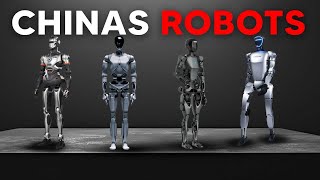
A rundown of ten Chinese humanoid robots entering the market in 2025, from Unitree's affordable G1 to industrial models like Walker S1 deployed in automotive factories. The robots range from home assistants to factory workers, with advances in walking, running, and dexterous manipulation.
Questions this video answers
Around $16,000.
Height 132 cm (4.3 ft); weight about 35 kg.
Commercial release in 2024.
Unveiled at JITEX Global 2024.
Height 138 cm (4.5 ft); weight ~40 kg (88 lb).
Chapters
There's no doubt that humanoid robots are going to be a key part of the future. And in today's video, I'll actually take a look at China's humanoid robots that they're seemingly developing quicker than any other nation. So let's not waste any time. Starting at number one is the unitary G1 robot. This is coming from Unitree Robotics. Now this is designed primarily for research, development and academic studies and educational programs in artificial intelligence and robotics. Now this actually represents one of the most affordable and accessible humanoids currently available on the market. Starting for a price around $16,000 where many others start at around six figures. Now it's incredible. This robot has some incredible physical specifications. For example, the height is actually only at 132cm or 4.3ft it only weighs about 35kg and but is remarkably nimble and has over 41 to 43 degrees of freedom on the ultimate versions of the model. Now this version actually has extra large joint movement angles enabling highly flexible and human like motion. Now we do know that this model is capable of walking, running and jumping and doing incredible feats of agility that many other humanoids can't fathom. For example, we can see here the robot is essentially engaging in one to one physical combat with, with boxing gloves and boxing headsets on. So this is something that is truly remarkable when we look at humanoid robot feats. Now this robot is also coming with multi fingered hands, including options for three fingered or five fingered hands in advanced models allowing precise manipulation such as soldering wires or flipping food in a pan. Now they've also demonstrated the world's most advanced movements on several different occasions, such as the flip that we saw earlier and the ability to constantly get up from these attacks that it has been facing. Now, in terms of the intelligence on board this model, this actually utilizes force position hybrid control for sensitive and reliable movement, closely simulating human muscle control. It's actually driven by AI including imitation and reinforcement learning, and supports Unitree's proprietary Unifo LM unified large language model for advanced behavior and adaptability. Now it also supports secondary development, making it highly customizable for research and application tasks. Overall, the Unitree G1 is one of the most notable robots for the many feats that it has. And being so affordable, so customizable and so dexterous, makes it one of the most capable humanoid robots on this list. Next on this list is the Astrobot S1. The Astrobot S1 is an advanced AI powered humanoid robot developed by Shenzhen based Stardust Intelligence. The designed primarily as a home assistant capable of performing a wide range of household tasks with exceptional agility, speed and precision. It represents a significant leap in consumer robotics aiming to serve as both a practical helper and companion in domestic environments. There are key features and specifications that you probably do want to know. The S1 features seven degrees of freedom per arm, enabling human like movement and flexibility. Its arms can lift up to 10kg each and can execute complex manipulations such as flipping food in a frying pan, pouring wine and even shaving a cucumber with remarkable precision. With a top speed of 10 meters per second and movement repeatability within 0.3 mm, the Astrobot S1 is both fast and highly accurate and capable of performing delicate tasks such as pulling a tablecloth from under glasses and without even disturbing them. And this system is powered by advanced AI which is Stardust's proprietary system. The S1 understands and responds to voice commands, supports real time remote operation via integrated cameras, and can personalize routines such as cooking, cleaning and pet care. Now standing at 5ft 8, the S1 is designed to integrate seamlessly into human environments. Its friendly, approachable appearance and durable materials require reflect a focus on both aesthetics and reliability. Multiple sensors ensure safe operations around people, pets and obstacles and this setup is user friendly with step by step tutorials and clear manuals for easy assembly and operation. The Astrobot S1 is positioned as a premium yet accessible home robot assistant balancing advanced capabilities with a user friendly interface. And it's not just a prototype. The S1 is slated for a commercial release in 2024 and making it one of the most advanced and versatile humanoid robots available for household use now. Stardust Intelligence, the company behind Astrobot S1 is focusing on developing intelligent robots that can reliably and seamlessly integrate into daily life. So overall, this robot is essentially a state of the art humanoid robot designed to revolutionize home assistants by combining speed, dexterity, AI powered adaptability and setting a new benchmark for consumer robotics. Next let's take a look at the Kepler Forerunner K2. Developed by Shanghai Kepler Robotics Company, this represents a significant leap in humanoid robotics, particularly for industrial and commercial applications. Unveiled At JITEX Global 2024, this fifth generation robot integrates advanced hardware, AI and embodied control systems to perform complex tasks in dynamic environments. Designed through extensive Collaboration with nearly 50 target customers, the K2 addresses sector specific challenges in intelligent manufacturing, logistics, high risk operations and research. The Forerunner K2 boasts 52 degrees of freedom across its body, enabling human like flexibility and precision. This includes 11 degrees of freedom per hand, allowing the robot to perform intricate manipulations such as grasping irregularly shaped objects or tightening bolts, which with a repeatability precision of 0.3 mm. The head module features 2 degrees of freedom for rotational and tilting movement, enhancing environmental perception and interaction, and this is equipped with proprietary planetary roller screw actuators. The K2's arms and legs generate up to 8,000 newtons of thrust, enabling each hand to carry 15 kg. This makes the robot suitable for high load tasks such as moving steel beams or assembling heavy machinery. The actuators also contribute to improved rigidity in the limbs, ensuring stability during repetitive industrial operations. Now there is also tactile sensing and manipulation. Each FingerTip on the K2's five digit hand incorporates 96 contact point sensors, mimicking human tactile sensitivity. These sensors detect texture, pressure and positional feedback, allowing the robot to handle delicate objects like glassware or perform precision tasks such as soldiering. The tactile manipulators combine active and passive degrees of freedom to adapt to objects of varying shapes and sizes, a critical feature for unstructured environments. The K2 actually leverages a cloud based cognitive model integrated with embodied control system, employing both imitation learning and reinforcement learning for skill acquisition. This enables the robot to autonomously refine tasks such as quality inspection or component assembly with without explicit programming. Now let's get to talk about one of my favorite Robots, the engine PMO1. This is coming from a company called Engine AI and this is a cutting edge humanoid robot developed by Shenzhen based engine AI Robotics. Representing one of the company's three flagship humanoid models alongside the SEO1 and SAO1 now. This lightweight, highly dynamic robot showcases three significant advancements in embodied intelligence and offers an open platform for further development in the rapidly evolving field of humanoid robots. The PM01 stands at 138 cm or 4.5ft tall and weighs approximately 40 kg or 88 pounds. It features an impressive 22 to 23 degrees of freedom depending on the version, allowing for exceptional mobility and flexibility. One of its most notable physical Characteristics is the 320 degree waist rotation capability, which enables complex movements that other humanoid robots cannot achieve. Now, the robot's design includes distinctive visual elements such as high recognition, familiar style, star ring light and an integrated dynamic strip that synchronizes with its movement. Now, when it comes to movement, this thing can move. The PM01 achieves a movement speed of 4.4 mph and offers both mechanical and natural humanoid gait walking modes and its impressive mobility comes from a total body joint count of more than 233 single leg with 6 degrees of freedom, single arm with 5 degrees of freedom, maximum joint torque of 145 Newton meters and peak torque density of 130 Newton meters per kilogram. Now what sets the PM01 apart from many competitors is its end to end neural network that allows for natural walking. The robot uses optical motion capture technology to collect vast amounts of human movement data, combining end to end neural network learning with adversarial networks to rapidly evolve in simulated environments. In terms of the computing and sensing of this model, the PM01 deploys a dual chip architecture featuring Intel N97 and Nvidia Jetson Orin processors. The powerful computing setup enables cross platform algorithm deployment and validation, making it well suited for various research applications for sensing and interaction. The robot is equipped with Intel RealSense depth camera, multi array microphones with wide ranging clear pickup, an interactive core screen for personalized interaction, and surround style stereo speakers that mimic human voice direction. To conclude, this Engine AI robot represents a significant advancement in accessible high performance humanoid robotics. With its natural movement capabilities, open source architecture and competitive pricing, it has the potential to accelerate the development of embodied AI robotics and research. And as a part of Engine AI's growing lineup of robots, the PMO1 demonstrates the company's commitment to innovation in this rapidly evolving field and could play an important role in bringing capable humanoid robots to a broader audience of researchers, educators and commercial users. Now the Walker S1 is an advanced industrial humanoid robot developed by Ubtech Robotics, designed to operate in complex manufacturing and logistics environment. It stands at 1.7 meters tall or 172 cm tall and weighs 76 kg and can carry loads of up to 15 kg while maintaining balance and stability. The robot is designed closely to resemble human movement and dexterity, enabling it to perform a wide range of tasks that traditionally require human labor. Let's get into some of the key features, one of them being the advanced AI and task planning. The Walker S1 integrates a large language model for general task planning, allowing it to understand intent, plan and execute complex tasks autonomously across various industrial scenarios. It also uses a sophisticated navigation system that combines semantic perception with traditional visual simultaneous localization and mapping, giving it spatial awareness and adaptability to dynamic unstructured environments. Now the robot features end to end learning based motion control enabling dexterous manipulation, stable bipedal walking and adaptive movement even under high load or uneven terrain conditions. The Walker S1 is also built for round the clock operation with military grade structural stability, advanced joint cooling for extended use and multimodal sensing for robust performance in challenging industrial settings. Now, the Walker S1 is already deployed in major automotive and electronics factories including Audi, byd, Zeekr, Geely and Foxconn. And its roles include quality inspections such as checking for leaks in air conditioning systems, carrying out sorting parcels of various sizes, component assembly and screw tightening, working alongside autonomous logistics vehicles and automated guided vehicles. And these deployments have demonstrated significant improvements in efficiency, safety and cost reduction. For example, at B BYD's Shenzhen plant, sorting efficiency increased 120%. And at other facilities there were also improvements. To Conclude, the Walker S1 represents a major step forward in industrial automation, bridging the gap between traditional robotic arms and full human replacement on factory floors. It's designed to address the labor shortages, improve worker safety by taking over hazardous or repetitive tasks, and increase operational efficiency in modern manufacturing environments. Now, next, what we have here is the magicbot. So, Magic Lab is a rapidly emerging robotic startup that was founded in December 2023 and of course is based in China. Now, it's actually gained international attention for its advanced humanoid robot known as the Magicbot. And it's pretty incredible. The Magicbot features 42 degrees of freedom, enabling highly human like movement and dexterity. Its hands are equipped with 6 miniature high torque servo actuators and multi dimensional pressure sensors, allowing sub millimeter precision and the ability to manipulate a wide variety of objects, including fragile, slippery or deformable items. The hands can replicate around 70% of human hand gestures, supporting tasks from delicate pinching to strong gripping. Each arm can lift up to 44 pounds which is 20 kilograms, providing a combined lifting capacity of 88 pounds which is around 40 kilograms. Now, the robot is built from lightweight but durable materials, enabling it to operate for up to five hours on a single charge. The magicbot is capable of walking and running, including indoors and performing acrobatic maneuvers. Now it's actually pretty incredible. The robot has been advancing pretty decently since it's been unveiled in 2023. But the design is what is most surprising. What you guys can currently see on the screen is a team of MagicBots collaborating to perform work at a factory. It's really designed for industrial environments, performing tasks such as material handling, inspection, barcode scanning, sorting, warehouse coordination and precision assembly. And it's already been deployed in Chinese factories where multiple units work collaboratively, passing materials between each other with millimeter level precision. And this teamwork and adaptability seen as a leap forward in industrial automation. Now, it's not also just limited to industrial tasks. It's demonstrated the ability to perform everyday activities such as folding clothes, watering plants, dancing and even performing magic tricks. These demonstrations highlight its fine motor skills in interactions with people and objects. So in summary, the Magic Lab humanoid robot called the magicbot is a full size, highly dexterous and collaborative humanoid designed for both industrial and and service application. It stands out for its human like hand dexterity, strength and endurance and its ability to work in teams, making a significant step forward in practical humanoid robotics. Next, let's take a look at the XPENG Iron. The AI powered humanoid robot redefining industrial and service robotics. The Xpeng Iron represents a significant leap in humanoid robotics combining advanced AI, exceptional mobility and human like dexterity to bridge the gap between industrial automation and service applications. Developed by Xpeng Robotics, a subsidiary of the Chinese electric vehicle manufacturer Xpeng motors, Aiyon stands 1.73 meters tall, which is 5'8 and weighs around 70 kg or 154 pounds. Mirroring human proportions for seamless integration into workplaces and homes. With 60 joints and 200 degrees of freedom, Iron achieves fluid natural movements that surpass the rigidity of traditional industrial robots enabled by end to end neural networks and reinforcement learning algorithms. Now when we actually take a look at the technical specifications, Ayan has 60 high precision joints with a peak torque density of 130 newton meters per kilogram, enabling dynamic stability during complex tasks like walking on uneven surfaces or lifting 15 kilogram loads. That there are also 22 degrees of freedom for each hand, allowing sub millimeter precision for delicate operations such as component assembly and package sorting. The hands replicate 70% of human hand gestures through six miniature servo actuators and multi dimensional pressure sensors. They also have incredible vision Systems, a 720 degree eagle eye vision system combining 360 degree horizontal and vertical coverage and capable of detecting objects as small as a paperclip from 5 meters. And this system integrates RGBD cameras, LIDAR and ultrasonic sensors adapted from Xpeng's autonomous vehicle technology. At its core lies Xpeng's proprietary Turing AI chip delivering 3000 trillion operations per second to process AI models with 30 billion parameters. This actually enables real time environmental adaptation through Xpeng's World foundation model which uses 30 times more parameters than conventional vision Large language models for dynamic scenario handling. We've also got natural language interactions via the Tiangi AOIS system adapted from xpeng's smart cockpit technology supporting logical conversations and task reasonings. Now, crazily, since November 2024, AION has actually been operational in XPeng's automotive factories where it assembles components for the P7 electric sedan and the X9 SUV, reducing production time by 12% through precise screw tightening and part alignment. It also collaborates with autonomous guided vehicles to transport materials between workstations, demonstrating multi robot coordination via Xpeng's Brainnet communication protocol. What is the Pudu D9 is the first full size bipedal humanoid robot from Pudu Robotics. This is a company renowned for its service robots in hospitality, retail, healthcare and logistics. Developed by the Pudu X9 lab, the D9 marks a significant step forward for the company. Building on previous innovations like the Pudu D7 and the dexterous hand. The Pudu DH11 specifications are as follows. Its height is 170 cm, it weighs 65 kg or 143 pounds. It has 42 degrees of freedom across its joints and has 352 Newton meters of torque. And its arms? It has two 7 degrees of freedom arms, each with a payload capacity exceeding 20 kg or 44 pounds. And each hand is equipped with the Pudu D11 dextrous hand for precise manipulation. It does walk upright at speeds of up to 2 meters per second, which is around 4.4 miles per hour, which is faster than the average human stroll. It's able to navigate stairs, slopes and uneven terrain and maintains balance even when jostled or encountering obstacles. And it also uses advanced algorithms for lightweight to low noise gate control, making it suitable for human environments. It also utilizes high accuracy sensors and a visual semantic navigation system. It also creates real time 3D semantic maps of its surrounding for autonomous route planning and precise self positioning. Here's an honorable mention. It isn't exactly a humanoid robot, but it's a different form factor. This is the Pudu Flashbot arm. Now this is an advanced semi humanoid robot that is developed by Pudu Robotics to designed to specifically tackle complex commercial environments such as hotels, offices, restaurants and retail spaces and healthcare facilities. It represents a significant leap from traditional delivery robots by integrating humanoid manipulation capabilities with intelligent autonomous delivery powered by cutting edge embodied AI. Now when we take a look at the statistics they have 7 degrees of freedom robotic arms and the Flashbot arm is equipped with a hand that can pretty much grab anything. It now actually has a wheeled chassis designed for exceptional mobility. The robot can traverse complex indoor environments efficiently, including navigating narrow corridors and other environments. It also integrates high precision sensors, cameras, lidar panoramic cameras, pressure sensitive skin for dynamic environmental awareness and immediate responses to obstacles, ensuring safety in human robot interactions. It also has a large language model integration and enabling the robot to understand and process user requests, plan and execute tasks autonomously, and coordinate with other robots for collaborative workflows. Now, it's really interesting to see the form factor of these robots as they are pretty different to what we are used to with Humanoids, and it's quite likely that many other companies in the service industry may take this approach.










