Top 10 NEW Humanoid Robots For 2024 (Tesla, Figure 01, Agility, Boston Dynamics and More)
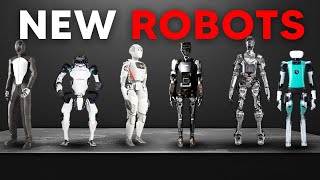
A roundup of 2024's leading humanoid robots from Tesla, Figure, Unitree, Boston Dynamics, and others. Figure raised $675M at a $2.6B valuation with OpenAI backing. Unitree's H1 hit a world record 3.3 m/s speed and costs under $90k.
Chapters
Vidya's stunning project group recently announced. And with the rise of robotics humanoid robotics coming into the mainstream, this is going to be the top 11 humanoid robotics projects that are going to be part of the future, and ones that you should really pay attention to because boy oh boy, the landscape is shaping up to be one that is super, super fascinating. Without wasting any more time, let's get into the top 10 humanoid robots for 2024 as of March 23rd and let's see all the recent updates and how surprising they are. So the first robot that we're going to be taking a look at is of course, Agility Robotics and Agility Robotics is a US based company that specializes in the development of highly capable, efficient and strong robots designed for real world applications. The company was incorporated on November 9, 2016 and operates with a workforce that ranges between 201 to 5,000 employees. Agility Robotics is known for its expertise in legged locomotion, which is built upon a foundation of academic research including the development of bipedal walking and running robot Atreus. The company leverages its expertise to create robots that address the need for rugged, efficient and highly capable mobility in various environments. One of the most notable products from Agility Robotics is Digit, a groundbreaking bipedal robot that is first multipurpose human centric robot designed for logistics work. Digit is intended to augment the human workforce by taking on repetitive and physically demanding tasks, thereby allowing humans to focus on more complex and creative work. The robot is equipped with newly designed effectors or hands optimized for grabbing then moving plastic coats commonly found in e commerce and chipping warehouses. It also features a head and eyes to improve robot to human interaction. Agility Robotics has its headquarters in Corvillis, Oregon, with additional offices in Pittsburgh, Pennsylvania and Palo Alto, California. The company's mission is to build robot partners that enhance the capabilities of the human workforce with the ultimate goal of enabling humans to engage in more meaningful and creative tasks. The company has also launched the Agility Partner Program which offers forward thinking companies the opportunity to work closely with Agility Robotics to integrate digits into their warehouse workflows, influence development of new skills and capabilities for the robot, and gain exclusive early access to for the latest generation of Digit before it becomes commercially available. Agility Robotics has received significant funding to support its mission, with the latest funding round amounting to $150 million as of April 2022. And the company continues to innovate and develop its products, aiming to address the challenges faced in logistics and other industries where automation can play a significant role in improving efficiency and working conditions now Nvidia's recent partnership on 19th March 2024, they announced project Root, a general purpose foundation model for humanoid robots and significant updates to the Nvidia Isaac robotics platform. Agility is among the leading humanoid robotics companies partnering with Nvidia to invest in computing simulation tools, machine learning environments and other necessary infrastructure to enable robots like Digit to be a part of daily life. Jonathan Hirst, the co founder and chief robot officer at Agility Robotics, expressed excitement about the partnership, which aims to accelerate the development of of robots and their integration into daily life. They also have a new CEO. They newly appointed the CEO Peggy Johnson, who is focused on the here and now, emphasizing the current capabilities of the company's robots like Digit to deliver value in warehouse operations. The company has been deploying Digit in various pilots, including with Amazon, and is not actively seeking to raise funds at the moment, although the possibility remains open. They're also opening a new humanoid robot factory in Salem, Oregon, named the Robofab, with the capacity to produce up to 10,000 units of digit per year and employ 5, 500 people. The factory is a significant step in mass producing humanoid robots, and Agility Robotics has beaten competitors like Tesla's Optimus initiative to this milestone. The robots are designed to work alongside humans in warehouses and factories, and the company plans to use robots in its own factory operations. The robots will be sold to preferred partners next year and the company is not considering rentals or leases in the near term. In addition, Amazon is testing Agility Robotics Bipedal Digit robot in its fulfillment centers, and Digit is designed to move, grasp and handle items in warehouse spaces, complementing the work of human employees. And Amazon actually sees a significant opportunity to use robots like Digit, which can actually work collaboratively with employees. These recent updates reflect Agility Robotics progress in developing and deploying humanoid robots. So the next robot that we're going to be discussing here is the Apptronic robot. So the Apptronic robot is essentially called Apollo. It's a general purpose humanoid robot designed to work in real time real world environments. Now Apollo actually stands at a height of 55ft 8 inches and weighs 160 pounds with a payload capacity of 55 pounds. It's equipped with hot swappable battery packs, each offering four hour runtime, allowing for continuous operation with simple battery changes. Apollo can also be plugged into charge or tethered for continuous operation if desired. Now Apollo is developed from Apptronic's extensive experience in robotics, including work on over 10 previous robots such as NASA's Valkyrie robot. And it is modular and can be mounted to any mobility platform, whether stationary or fully mobile. With legs, the robot features LEDs in its head, mouth and chest that work together to communicate its status. Apollo's software suite enables point and click control, allowing for easy development and integration into warehouse and manufacturing operations. Apollo is designed to automate physically demanding, repetitive and dull tasks, thus addressing labor shortages, reducing turnover by taking on undesirable tasks, improving, improving efficiency and reducing work related injuries. Its design and capabilities make it suitable for a wide range of applications in logistics, manufacturing and other sectors where tasks are traditionally performed by humans. Now, Apptronic recently has entered into a commercial agreement with Mercedes Benz to pilot Apollo in Mercedes Benz manufacturing facilities. This partnership represents Apollo's first publicly announced commercial deployment of Apollo. The robot will be used in logistics to bring parts of the production line and deliver totes of kitted parts later in the manufacturing process, automating some of the physically demanding and repetitive tasks. Now, Apollo's development and deployment highlight the advancements in robotics and AI, opening up new opportunities for supporting skilled workforces in manufacturing and beyond. Its general purpose design, combined with its humanoid form factor, enables it to work alongside people in environments designed for humans, making it a versatile tool for improving the way we live and work. Well, now if we take a look at some of Apollo's most recent updates, we can see that they actually were integrated with Nvidia's Project Groot. Essentially, Apptronics Apollo will integrate with Nvidia's new General Purpose foundation for Robot Learning Projects Group. And this collaboration aims to enhance Apollo's learning capabilities, allowing it to quickly learn new tasks from human demonstrations and tackle more complex tasks than previously possible. This integration with Nvidia's technology represents a significant advancement in AI for general purpose humanoid robots, potentially changing the way robots are used in various industries. Coming in at number three is the most recent insane one. This is the Figure robot. Known as Figure one. It's a humanoid robot developed by the AI robotics company Figure. It's designed to be a commercially viable general purpose robot capable of performing a wide range of tasks in various industries. So let's take a look at some of the key aspects of the figure. Figure 1 Robot Figure 1 is designed to address the ongoing labor shortages by undertaking labor intensive or unsafe physical tasks. It can carry up to 44 pounds of payload and run for up to five hours on a single charge. The robot is capable of autonomously navigating complex environments and is equipped with an AI system that allows it to think, learn and interact with the environment and the people around it. Figure has made rapid progress in the development of its humanoid robot and in less than a year the company went from having nothing but renderings to unveiling a prototype capable of dynamic walking. The robot's design is slim and shiny, with a focus on human robot interaction and efficiency. The FIGURE team, consisting of experts with extensive experience in AI and humanoid robotics, completed a full scale humanoid build in just six months. Figure 1 is intended for initial deployment into the workforce to help alleviate labor shortages and and eventually eliminate the unsafe and undesirable jobs. The robot actually does have some potential use cases in manufacturing, logistics, warehousing and retail. And in the long term, the company FIGURE envisions its humanoids assisting in the home, caring for the elderly and potentially even being used in space expeditions. Now for the funding and valuation FIGURE AI has raised a significant amount of funding to support the development of its humanoid Robot. As of February 2024, the company recently raised $675 million at a $2.6 billion valuation from investors including Jeff Bezos, Nvidia, Microsoft and OpenAI. This funding will be used to accelerate the development of Figure 1 and its deployment for commercial use. Now Figure actually did recently sign a partnership with OpenAI to develop the next generation of AI models for humanoid robots and this collaboration enables Figure to enhance the capabilities of humanoid robots to to perform everyday tasks autonomously. And FIGURE is also using Microsoft's Azure cloud services for AI training, infrastructure and storage. Now we all know about the recent update which was pretty incredible and essentially it demonstrated the ability to engage in real time conversations with humans, showing a remarkable level of natural understanding and speech generation. This capability is powered by a large pre trained multimodal model developed in partnership with OpenAI. The robot can describe its visual experiences by plan future actions and use common sense reasoning, reflect on its memory and explain its reasoning verbally. This advancement actually allows Figure 1 to interact more naturally and more effective with humans in various settings. Now, in terms of commercial prospects and client engagement, FIGURE actually signed and secured a significant client in BMW which plans to introduce general purpose robots like Figure 1 on its production lines. This move indicates the growing interest and confidence in the commercial viability of humanoid robots to perform various tasks alongside human workers, potentially transforming industries by addressing labor shortages and improving efficiency. Now let's take a look at Unitree. The Unitree H1 is a groundbreaking general purpose humanoid robot developed by Unitree Robotics. It is actually known for its exceptional power and performance capabilities. Here are some of the Key features and specifications of the unitree robot the H1 stands approximately 180cm tall and weighs around 47kg, making it a full size humanoid robot. If we take a look at the mobility and athletic ability, it's a actually capable of walking at speeds greater than 1.5 meters per second with the potential athletic performance exceeding 5 m s. This makes the H1 one of the fastest humanoid robots capable of running autonomously in complex terrains and environments. If we look at the joint torque and power, the robot features a peak torque density of 180Nm per kilogram and a maximum joint torque of 360 Newton meters. If we take a look at some more of the technical specifications, the H1 is equipped with a battery capacity of 864Wh, which is quickly replaceable, ensuring the prolonged operation in terms of the sensing and perception. For 360 depth sensing, the H1 utilizes 3D lidar and a depth camera enabling real time acquisition of high precision spatial data for panoramic scanning. For compute power, it actually houses 2 times Intel Core i7 i1265U processors providing substantial computing power for control and recognition task. And the H1 has five degrees of freedom in each leg, three in the hip, one in the knee and one in the ankle and and four degrees of freedom in each arm which are expandable allowing for highly flexible movement capabilities. In terms of autonomous navigation, the H1 can walk and run autonomously in complex terrains and environments thanks to its stable gait and highly flexible movements capabilities. And once again in collaboration with Nvidia, Unitree's self developed AI robo algorithm allows the H1 to independently learn high speed running, bearing weight up to 30kg, navigating up and down stairs and and performing a variety of highly dynamic dance movements and continuously learning movements. Recently, which was pretty incredible, the H1 actually set a world record for the speed of a full sized humanoid robot, achieving a world record speed of 3.3 meters per second with a potential of exceeding 5 meters per second. One of the things that's actually fascinating about the Unity robot is that it's actually pretty cost effective. The H1 is described as the most powerful and most cost effective humanoid robot on the market, offering high performance at a competitive price point. It's actually available for purchase below $90,000, making it accessible for a wide range of applications and industries. Now, the Unitree robot is actually pretty insane because there was a recent update that actually did shock me. The most recent update on the Unitree H1 highlights its groundbreaking achievement by successfully performing a backflip. I'm going to say that again, a backflip without the use of hydraulics. This feat distinguishes the H1 from the other humanoid robots such as such as Boston Dynamics which have previously demonstrated the ability to perform backflix but relied on hydraulics for the necessary power and agility. The Unitree H1 on the other hand utilizes the in house M107 electric joint motors for its movement, each offering a peak torque of 360 newton meters. This capability is particularly notable as it showcases the robot's advanced design and engineering, emphasizing the potential for electric motors to to achieve high performance in tasks traditionally thought to require hydraulic systems. The Phoenix Robot by Sanctuary AI is a humanoid general purpose robot designed to perform a wide range of work tasks. Powered by the company's pioneering AI control system called Carbon. Here are the key elements and aspects of the Phoenix robot and the Carbon system. The Phoenix robot is human like form and function. Phoenix stands at around 5 foot 7 inches tall and weighs around 155 pounds. Designed to mimic human form and function, it actually has a maximum payload capacity of 55 pounds and can move at a maximum speed of 3 miles per hour. The robot features industry leading robotic hands with 20 degrees of freedom providing dexterity that rivals human hand capabilities. The Phoenix also has an improved aesthetic design with bolder color palette and elevated textures for commercial deployment. Sanctuary AI has announced the first ever commercial deployment of its technology, marking a significant milestone in the company's progress towards full commercialization. Phoenix is actually capable of performing hundreds of tasks across various industries including healthcare, hospitality, logistics, retail and warehousing. They actually have a very innovative carbon AI control system. So the cognitive architecture is called Carbon and it's essentially a software platform that integrates modern AI technologies to translate natural language into the real world. This system enables scenics to think and act to complete tasks like a person with explainable and auditable reasoning tasks and motion plans. Now Carbon uses deep learning, reinforcement learning and photorealistic and physics world simulations for robot training and this system allows for the human in the loop, supervision, teleoperation and fleet management. Now one interesting thing about the company that it was actually founded in 2018 and is based in Vancouver, Canada. The company's mission is to generate the world's first human like intelligence in general purpose robots. And in terms of funding They've received over 100 million Canadian dollars including a $30 million investment from the Strategic Innovation Fund contribution from the Government of Canada. In addition, Phoenix has been featured as the only general purpose robot in Time's Best Inventions of 2023 and Century, AI envisions a future where general purpose robots are as ubiquitous as cars, helping to address the labor shortages and contribute to a more safer, more efficient, sustainable work environment. One of the most recent incredible Updates by Phoenix SanctuaryAI was robot being able to do this completely autonomously. You can see that in this recent demo people were arguing that this is far superior to Tesla's Optimus in terms of the speed and agility and the fluidity of it being able to complete autonomous tasks one time speed. This is a very, very impressive demo and it was something that really did shake up the industry because people are now starting to realize the true power of Phoenix Robotics and just how great this company is at making humanoid robots. GR1 humanoid robot is a general purpose robot developed by Fourier Intelligence, a company that specializes in rehabilitation technologies and has been manufacturing exoskeletons and rehabilitation devices since 2017. The GR1 represents Fourier intelligence foray into the field of humanoid robots, leveraging their expertise and exoskeleton development to create a robot with advanced capabilities suitable for a variety of applications. Some of the key features of the GR1 humanoid robot include the height and weight. The GR1 stands at 165 cm or 5 foot 5 inches tall and weighs around 55 kg or 121 pounds with a human like appearance and screen face design. It has a top walking speed of around 3 miles per hour with or 5 kilometers an hour and is capable of agile obstacle evasion, steady slope ascending and ascending and resilient impact disturbance response. The robot can carry nearly its own weight with the ability to lift and carry goods up to 50 kg or 110 lb. The GR1 has 44 full body degrees of freedom with 40 FSA Fourier Smart Actuator joints distributed throughout its body allowing for human like kinematics and motion. The robotic hands have 11 degrees of freedom, enabling the GR1 to securely grasp items and perform different tasks with precision. And these hands can imitate the range of motion like human fingers, allowing the robot to handle objects of different dimensions and configurations. The GR1 actually features an integrated emotion module, a high resolution oval display and a circular microphone array for voice recognition, making machine human interactions more natural. Now for the GR1, it's actually being deployed in various sectors including mainly healthcare and rehabilitation. The robot is particularly focused on assisting in caregiving and physical therapy, addressing the challenges posed by the aging populations and labor shortages. Next, we actually have a robot that shouldn't be on this list because we don't really have a video for it, but it is still a robot that we are really, really excited about for the future. So. 1x Robotics, previously known as Halodi Robotics, is a Norwegian AI and robotics company that has been making significant strides in the development of humanoid robots designed to work along humans in various settings. The company's NEO platform represents a significant advancement in their lineup of droids and focusing on creating a bipedal humanoid robot capable of performing wide range of tasks from household chores to more complex manual tasks in the commercial environments. Now, the NEO robot is actually designed as a bipedal Android humanoid with human hands, making it suitable for general applications. And it does stand out for its ability to assist with a broad spectrum of household tasks thanks to its human like form and capabilities. It's approximately 167cm tall and weighs around 30kg with the ability to lift up to 75kg in a deadlift or squat. This strength, combined with its dexterous hands and full range of motion allows it to perform tasks that require both precision and power. Now I'm not going to get into too many of the details here because it is a robot that isn't released yet, but the company has actually released recent demos of its EVE platform which is very, very impressive. The recent demos show a end to end neural network completing many different hardhor tasks and I would say that this is one of the most underrated robots on this list, but because it has been really overlooked thanks to some of the recent developments by figure. So I would say that this is a company that is poised to shake up the market when they eventually deploy NEO and if their humanoid platform gets even better. Now let's take a look at Boston Dynamics, a robot that you're all going to know about. Now the Boston Dynamics ATLAS robot is a highly advanced bipedal humanoid robot developed primarily by the American robotics company called Boston Dynamics with funding from the Devent's Advanced Research projects agency called DARPA. Initially unveiled to the public on July 2013, Atlas. Atlas was designed for a variety of search and rescue tasks and the robot's development was overseen by DARPA in cooperation with Boston Dynamics and its hands were developed by Sandia national laboratories and iRobot. Now Atlas is known for its exceptional mobility, dexterity, intelligence and making it a leading figure in robotics research aimed at pushing the limits of whole body mobility and bimanual manipulation. The robot is equipped with an advanced control system and state of the art hardware and enabling it to demonstrate advanced athletics agility and the ability to adapt its environment dynamically. ATLAS can interact with the world in meaningful ways using both tasks, using both hands and its full range of motion. It perceives its surroundings with depth centers to generate points of to generate point clouds of the environment. The robot uses model of its dynamics to predict and adjust its motion over time, showcasing its sophisticated control algorithms. Now there was a recent update on Boston Dynamics that I do want to talk about. So as of early 2024 they've actually showcased significant advancement in its capabilities, particularly in handling and mobility. The updates focus on Atlas improved ability to perform tasks that require precision and strength, such as inventory work and lifting medium weight objects like automotive parts. Now, in February 2024, Boston Dynamics recently released a video showcasing its new skills in picking and placing automotive struts which weighed around 30 pounds. Now, this task involves complex manipulation challenges due to the intricate shape of the struts requiring precise gripping and careful placement on the shelves. The update highlights Atlas enhanced dexterity with its hands, now featuring three fingers with two joints, allowing for a more gentle and effective grip on objects. Now, last but not least is of course the Tesla Optimus robot. Now, the Tesla Bot is a humanoid robot unveiled by Tesla during its AI event day in August 2021. The robot is designed to perform a wide range of tasks, particularly those that are repetitive, boring or dangerous or otherwise unsuitable for humans. Now, Tesla CEO Elon Musk has positioned the Optimus robot as a step towards creating a future where physical work is a choice thanks to the assistance of highly capable robots. Now, Optimus is envisioned to stand approximately 5ft 8 inches tall and weigh around 125 pounds. It's designed to navigate through the human world, operate in spaces built for human dimensions and using tools designed for human hands. The robot is expected to have a carrying capacity of 45 pounds, a deadlift capacity of up to 150 pounds, and a walking speed of up to 5 miles per hour. Its design includes a screen on the head for displaying information and the development of the Tesla Optimus robot is driven by Tesla's expertise in artificial intelligence and automation, leveraging the company's experience in developing autonomous vehicles. Now the robot is intended to incorporate Tesla's FSD full self driving computer for navigation and decision making, using real world data to navigate complex environments. It also will utilize sensors and actuators developed by Tesla, aiming for a high degree of dexterity and mobility. Elon Musk has suggested that the applications extending beyond simple manual tasks to more complex and interactive roles in both industrial and domestic settings. As of the latest updates, there have been significant strides in Tesla's Optimus development. The second generation of the Optimus robot referred to as Optimus Gen 2 has been showcased with new motion and handling capabilities. This includes the robot's ability to walk 30% faster than its previous iteration along with new sensing capabilities in its fingers enabling more deft handling of delicate objects such as eggs. And the robot has been demonstrated doing squats and picking up an egg and showcasing. So overall, let me know which of these humanoid robots you think is going to be the one controlling the future. I for one am truly excited about this entire industry. I think it's going to be fun. I think it's going to be very exciting and I think the competition is really, really ramping up and clearly it seems like this might be a winner takes all scenario because whoever gets to the end first might just be there for quite some time. So with that being said, let me know what you think and I'll see you all in the next video.










