Top AI Headlines of the Week You Can't Ignore
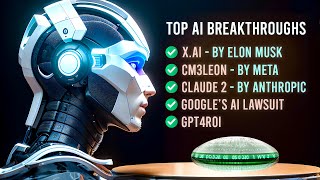
A monologue-style YouTube news roundup (by LARRUZ) summarizing several AI developments from mid-July 2023: Elon Musk's new AI company XAI aiming to build superintelligent systems for scientific discovery; Google's medical chatbot MedPalm2 being tested at Mayo Clinic; Stability AI's Stable Doodle sketch-to-image tool; Meta's CM3 Leon (Chameleon) image model; Anthropic's Claude 2 chatbot release and capabilities; a consumer lawsuit alleging Google's improper collection/use of biometric data; and a new vision-language research model (GPT4ROI) that uses spatial instruction tuning to link text to image regions.
Chapters
So it's been quite a week filled with exciting AI developments and I'm here to give you the scoop on all the important news from the past few days, including Elon Musk's new AI company called xai, Google's medical chatbot that's being tested at Mayo Clinic, and a new AI tool that can turn your doodles into photorealistic images. We'll also talk about Meta's new AI image generation model called CM3 Leon, pronounced as Chameleon, Anthropic's open source AI chatbot called Claude2, and a new AI research that introduces GPT4ROI, a vision language model based on instruction tuning, as well as Google's lawsuit over its AI privacy policy. So let's get started. The first story is about Elon Musk, who recently announced his new AI company called Xai on Twitter. The company's main aim is to build a super intelligent AI to solve complex scientific problems and deepen our understanding of the universe. Musk and his team of experts hope to create an AI smarter than humans, primarily for societal benefit. While the focus is more on solving scientific mysteries than building consumer products, Musk sees XAI as an alternative to AI giants like OpenAI and Google. However, he acknowledges that XAI is still in its early stages. Unsolved scientific mysteries like the nature of dark matter and the Fermi paradox, the why we haven't found aliens yet are areas that XAI could delve into. The goal, as stated by AI researcher Jimmy Bay, is to create an AI that can tackle humanity's most significant challenges. Musk, who has been critical of AI's risks and how AI companies use data, plans to collaborate with Tesla on this venture. But he stresses that any collaboration with Tesla must be fair, considering its separate public shareholders. Creating powerful AI requires substantial resources, but Musk suggests that XAI won't need as much as other companies. The plan is to keep the company relatively small. The Twitter introduction attracted about 34,000 listeners. The next story I want to talk about is Google's medical chatbot that's being tested at Mayo Clinic, one of the leading healthcare providers in the US So Google has been testing its new AI medical chatbot at the Mayo Clinic and other hospitals. According to the Wall Street Journal, the chatbot, called MedPalm2, is a variant of Palm2, a large language model that powers Google's bard arrival of Microsoft's ChatGPT. MedPalm 2 is designed to answer questions about medical information such as symptoms, diagnosis, treatment and prevention. It can also perform tasks such as summarizing documents, organizing research data and generating captions for images. It is trained on questions and answers from medical licensing exams, as well as a curated set of medical expert demonstrations which give it more expertise and accuracy than general chatbots. It is still in its early stages of development and testing, and Google has not commented on when it will be available for public use. However, Google said in an internal email that it believes the chatbot could be of tremendous value in countries that have more limited access to doctors. Google also said that it respects the privacy and security of the users and patients, and that it does not train the chatbot on patient data alright now Stability AI, a tech company that develops open source AI models for various domains, has introduced a new AI tool called Stable Doodle, which can turn simple sketches into realistic images. Stable Doodle is a sketch to image tool that uses a powerful text to image model called Stable Diffusion xl, which can generate images from text prompts in different styles and resolutions. It allows users to create original images by drawing basic outlines with a mouse and choosing an art style from 14 options. The tool then uses the sketch and the style as input conditions to generate an image that matches the user's intention. Users can also edit the image by changing the text prompt or the sketch. The tool is available for free on the Clip Drop by Stability AI website and app, where users can also access other features such as image editing, video generation and texture creation. However, the tool is subject to daily limits and requires an Internet connection to work. Stable Doodle is part of stability AI's strategy to explore new sources of revenue and expand its user base. The company recently raised $25 million through a convertible note, bringing its total raise to over $125 million. The company is also known for its research and advocacy on AI safety and ethics, and has collaborated with music legend Peter Gabriel on an AI animation challenge. Stability AI claims that Stable Doodle is the future of sketch to image tools as it offers more control and creativity than existing tools. The company says that Stable Doodle can be useful for professionals and hobbyists in various fields such as education, design, fashion and art. Okay now. Meta, the company previously known as Facebook, has just unveiled a new image creating AI tool called Chameleon. This clever little piece of technology can make text into images and vice versa. AI creating images isn't a new idea. There are quite a few tools like Stable Diffusion, Dall? E and Midjourney that already do that, but Meta is doing something a bit different with Chameleon and they say it works really well. Usually these kind of technologies are based on something called diffusion models. That's how stable diffusion got its name, but Chameleon uses another type of model called a token based autoregressive model. This has been known to give good results in the past, especially when it comes to the overall coherence of the image, but it's typically more resource heavy. Meta has somehow managed to make this token based model more efficient than the traditional diffusion model, even though it uses less computer power than other methods. They say Chameleon is the best at turning text into images when it comes to training. Chameleon Meta used a slightly different approach too. Instead of pulling random images from the Internet, which has landed some folks in hot water legally, they've only used images from Shutterstock that they've paid to use. This way they've avoided any potential problems with image ownership and still managed to get great results after the initial training. They fine tune Chameleon using something called supervised fine tuning, which helps the model understand and respond to complex prompts, which is handy for tasks like making images. The pictures that Chameleon can produce are pretty impressive. It can handle complicated prompts and create high resolution images, but right now it's just in the research stage. It's not clear when or if Meta will make this tool publicly available, but given how well it seems to work, it seems pretty likely that we'll be seeing more of Chameleon in the future. The next story is about Anthropic, a US based artificial intelligence company that recently announced the launch of Claude 2, a new version of its AI chatbot that can handle various tasks such as summarizing, translating, coding and more. Claude 2 is available for users in 40 languages and 230 countries, making it one of the most widely accessible chatbots in the world. It is an improvement over the previous version of Claude, which was released in March and was only available to businesses by request or as an app in Slack. Claude 2 can generate longer and more coherent responses and has better skills in math, coding and reasoning. For example, Anthropic says it scored 76.5% on the multiple choice section of the bar exam, while Claude 1.3 got 73%. Claude 2 is also more reliable and safer than its predecessor, as it is guided by a set of principles that it uses to revise its responses by itself instead of relying on human moderators. These principles are based on documents such as the Universal Declaration of Human Rights and Apple's Terms of Service, which cover issues such as data privacy and impersonation. Anthropic calls this approach constitutional AI and says it makes Claude 2 more helpful, harmless and honest than other chatbots. Unlike other chatbots such as ChatGPT, Bing and Bard, Claude 2 is not connected to the Internet and is trained on data up to December 2022. This means it cannot provide up to date information on current events, but it also reduces the risk of producing harmful or inaccurate content. However, users can still feed it with recently published websites or web pages and it should be able to process them. Another story that caught my attention this week is Google's lawsuit over its AI privacy policy. Google was sued on Wednesday by a group of consumers who claim that Google violated their privacy rights by collect and using their biometric data without their consent. The lawsuit was filed in a federal court in California, and it seeks class action status and damages for the plaintiffs. The lawsuit alleges that Google uses its AI technologies such as facial recognition, voice recognition and emotion detection to analyze and identify the consumer's personal characteristics such as age, gender, race and mood. The lawsuit also alleges that Google does this without informing the consumers or obtaining their permission, and that Google uses this data for its own benefit, such as advertising or product development. The lawsuit claims that Google's actions violate the California Consumer Privacy act, which gives consumers the right to know what personal information is collected by businesses and how it is used or shared. The lawsuit also claims that Google's actions violate the Illinois Biometric Information Privacy act, which requires businesses to obtain written consent from consumers before collecting or using their biometric data. The lawsuit is not the first one that Google faces over its AI privacy practices. In 2019, Google agreed to pay $7.5 million to settle a class action lawsuit over its Google social network, which exposed the personal data of millions of users due to a Software bug. In 2020, Google was sued by a group of activists who accused Google of illegally tracking and profiling users across the Internet using its Chrome browser. Google has not yet commented on the latest lawsuit, but it has previously defended its AI privacy policy, saying that it respects the user's privacy and security and that it gives them control over their data and settings. Google also said that it uses AI to improve its products and services and that it follows the law and industry standards in its AI practices. Okay, the last story I want to talk about is a new AI research that introduces GPT4ROI, a vision language model based on instruction tuning. Big language models like ChatGPT and Claude have been doing an awesome job in processing and understanding human language. They've opened up exciting new possibilities for creating artificial intelligence that can do lots of different things well. Now people are exploring ways to make these language models work with visual data like pictures. Models like mini GPT4 an llama adapter try to understand pictures by linking them with text. However, they are usually limited to understanding whole images and struggle with understanding specific parts of an image. To address this, researchers have been developing a model that can understand specific parts of an image, like a person or an object within a picture. They've done this by creating spatial instructions which basically tell the model where to look in the image. For example, if you ask the model what is this doing? It will look at the specific area in the image you pointed to. To make these instructions, researchers use techniques like Royalign or Deformable Attention. They change image text data sets to region text data sets where each item's location and text description in an image are given. This helps the model create a better link between the text and the specific part of the image. They've used a mix of available datasets like coco, Object Identification, refcoco and others for this purpose. The result? Their model has become better at conversation and gives more human like responses. It has been taught using data sets containing both short texts for basic understanding and longer texts for more complex concepts, so the model can understand simple and complicated ideas in both text and images. Alright, that concludes this week's AI News. If you enjoyed this video, don't forget to hit the like button, subscribe to my channel and click the Bell icon to stay updated on all my future uploads. Thanks for tuning in and I'll catch you in the next one.










