TU Wien Rendering #1 - Introduction
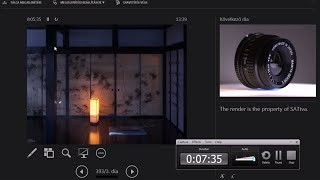
Károly Zsolnai-Fehér introduces a rendering course at TU Wien, covering how to simulate light and understand global illumination techniques. The lecture sets expectations and walks through the course topics from the start.
Chapters
We are going to start with the most difficult thing in the entire semester. It's about how to pronounce my name. Okay, can you please find the light switch for this spotlight because it's a bit hard to see. Oh, right, I forgot this. This one? Yes. Okay. So I am from Hungary, and this is pronounced as Karojourney. Karoj is essentially the equivalent of Karl in Deutsch or Charles in English. There's no equivalent for that. So I'm sorry. So it is pronounced as cow. If you imagine this as, like, an English word, then you forget the l and you just pronounce it like that. So it's. Okay. So I'd like to hear some examples. So cowe. Okay, cowboy. Yes, yes, Excellent. A bit louder. It ends with the. So it's caroi. So it's like a Y at the end. It's caroi. One more time. Louder. Caroi. Yes. Excellent. Wow. It's amazing. Okay, now. Now comes the hard part. So this is pronounced as Z. Okay? So Hungarian is a weird language where Z and S is actually one letter. So if you take a look at the Hungarian Alphabet, there's a letter that is Z, there's a letter that is S, and there's a third letter that is Z and S together. So it's pretty ridiculous, isn't it? So this is pronounced as. So the is the difficult part. Okay. Wow. Yes. Hi. Can you pronounce? Yeah, it's just coming in and immediately nailing it. Okay. Yes. Yes. Wow. Are you Hungarian? I mean, Hungarian? Yeah. Parents may be secretive or maybe. Okay. Shoreline. Yeah. Wow. It's great. It's not Shoreline. Shornhain. Okay. Yes. Okay. Is there someone who I have forgotten or. Everyone. Everyone knows what's up. Okay, so this is what we're going to be doing. So the amazing thing is that when you see images on the Internet like that, sometimes it's difficult to find out if this is if it is computer graphics or is it a real photograph. And this is one of these examples. This is another example. And this is the work of amazing engineers and amazing artists. And we are going to be talking about how to compute images like that. And if you look at this, well, when you download the slides at home, you will see that on the lens, the dust is marbled. Here you can see just some small splotches, but you can actually see pieces of dust on the lens of the camera. And this is computed with a computer program. And by the end of the semester, you are going to know everything about this. How is this exactly computed every single pixel. Just a few things about organization. There's going to be assignments. They take up 40% of your grade. And these assignments will have. Most of them will have theoretical parts, pen and paper, how to understand what's going on in nature. And there will be also programming exercises, but they are not really that programming exercises. It's mostly using programs, understanding what they are doing and maybe modifying them here and there. But you are not going to write like huge rendering engines and things like that. So don't worry about this. The 60% part is an oral exam and this is going to take place after the semester with me. So this is some friendly discussion about what you have learned, or a not so friendly discussion if you haven't learned anything. But that's never the case. So I'm just kidding. And this is going to take place soon, but you can choose. So if you would like to have the exam with Thomas, that's also fine. But I would like to note that I am an engineer and he's a brilliant physicist. So if you choose who to try to deal with, I would choose the engineer. I don't know about you, this is just a suggestion. And there can be some kind of individual contribution. So if you find some errors on the slides, if you add some figures that, hey, I don't like this figure. I've drawn something better than that. There's going to be programs that we work with. If you find some bugs in there, or if you can extend it in any way, you can get plus points. And this applies to basically any kind of contribution that you have. This is the book that we're gonna learn from. So there is. I'm trying to cover everything. And at some point I will say that, yeah, please open the book if you would like to know more about this. But whatever I tell you here is going to be enough for the exam. So it's not gonna happen that. Hey, why haven't you read, I don't know, page 859? Don't you remember that this is not gonna happen? So this is to augment your knowledge. If you would like to know more, then this is a great place to do. And this has a website. This can be bought at different places. There is some sample chapters and before buying you can take a look whether you like it enough or not. So it's pretty cool that it has some contractors. Let's start with what you shouldn't expect from this course. I'll just run through it. There's not going to be rigorous derivations of every imaginable equation that you have. So there are courses where there is this never ending infinite loop, like in programming an infinite loop of definition, theorem, corollary, definition, theorem, theorem, lemma. Raise your hand if you have been to a course like that. I'm not going to tell anyone, okay? So I'm not going to tell anyone. So I've had a lot of these courses and I've had enough. So I'm trying to do it differently. There's not going to be endless derivations, there's not going to be an endless stream of formulae as well. Without explanation, there's going to be formulae, but with explanation we are going to play with all of them and you are going to understand the core meaning of these things. And at the same time, please don't expect to understand everything. If you open, for instance, the Lux render source code, this is like a half a million line of code project, one of the best renders out there. But there's many, there's many really good renderers. You will not understand every single thing that is there, but you will understand how the light transport part works as thoroughly as possible. And the most important thing, I've put it there with bold, because this is what students love. You don't have to memorize any of the formulae. Okay? So I will never tell you that. Okay, give me this formula. And you will have to remember it off the top of your head. I don't care. I mean, if you're an engineer at a company, you sit down, you need to solve a problem. If you don't remember something, what do you do? Google and you look for it. It's not enough important to remember things, it's important to understand things. So if you look at the formula, you will have to understand what is going on. And that's intuition. This is what I would like you to have as much as possible. But you don't need to memorize any of these. Now what you should expect from this course is how to simulate light in a simple and elegant way. This is going to be a surprise at first because things are going to look complicated. And by the end we're going to derive really simple solutions for that that can be implemented in 200 lines of C. So these 200 lines can compute something that's almost as beautiful as what you have seen here. And I have written this piece of code and every theorem that we learn about you are going to see them in code. In fact, there's going to be an entire lecture on code. Review like, let's go through this renderer and see, there is Schlick's approximation, there is Snell's law, there is this and that. And every single thing that you learn here, you are going to see in code. It's not just flying out in the window. You will know why nature looks like as it does in real life. And you will be wondering that there's so many beautiful things and why. Why haven't I seen them the way they are? Why are they looking the way they are? And you will know about also most of the state of the art in global illumination. This means that, yes, we will start with algorithms from 1968 and we will end with algorithms from this year, like from two weeks ago or in the next few weeks, because the Siggraph is coming. Like the Siggraph paper is. The biggest conference with the best of the bunch is coming in the next few weeks. And I'm going to read through it and the materials will be updated to the very latest works. And another thing is that really important is that you will be able to visualize and understand complicated formulae in a really intuitive way. So I would like you to learn something that's not only live transport specific, but you will be able to use this knowledge wherever you go. Whatever kind of mathematical problems you have, this knowledge will be useful and you will see from the very first lecture. And the most important thing is that you will see the world differently. There is lots of beautiful things in nature and you won't be able to stop looking at it. So you will perhaps like taking the train or public transport a bit more than before, because there's so many intricate, delicate things to see that you haven't seen before. You have looked, but you haven't seen them before as they are.










