TU Wien Rendering #14 - Global Illumination Benefits
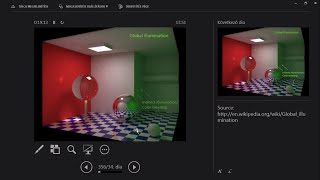
Lecture segment explaining why solving the rendering (global illumination) equation matters: global illumination produces more realistic images than recursive ray tracing by capturing indirect illumination (color bleeding), soft shadows, and caustics. The speaker contrasts ray-traced local illumination with full global illumination through visual examples and emphasizes that many complex lighting phenomena emerge naturally from solving the full equation.
Chapters
Okay, so we have these two guys in the ring and we know already how to solve the illumination equation. The illumination equation. We don't measure radiance, we measure intensity. It's not really a unit in physics. It's just some hecked up thing that happens to work in the rendering equation. We measure radiance and we have to do some kind of integration. And this is. The more you think about it, the more impossible it will sound to even the thought of solving this problem. So the first question is, what can I earn by solving this equation? Because I have to be motivated to do it. So obviously the result better look really good in order to give me the motivation and the resources to solve it. So, so this is an image from the first assignment. And this we have computed with recursive ray tracing. So you can see, for instance, hard shadows. You can see that this is a reasonably boring image. I mean, it's great compared to the simplicity of the model that we have, but it's not really the greatest. Well, what is missing? Let's take a look and look very closely. Let's take a look at the very same scene, but not with recursive ray tracing, but the global illumination algorithm. So not the illumination equation, but the full rendering equation. Take a look at the difference. Look closely. This is full global illumination. Finally. Absolutely beautiful. Let's take another look. This is recursive ray tracing and global illumination. So apparently there are some effects that recursive ray tracers cannot account for. What are these effects? Well, we have talked about indirect illumination or color bleeding. This is the very same thing. This means that I am hitting two diffuse objects, one after each other. Is this visible enough? Okay, I'll just pull a bit on this curtain so you guys can see better. Okay. Perhaps a bit better, right? Yes. Yeah. Okay, so these are, in this case, LDDE paths. What does it mean? Everyone knows you start out from the light source. You hit two diffuse objects and you hit the eye. Excellent. Now, indirect illumination is all around us, everywhere, both in the real world and both in the better computer games out there, which have approximations of indirect illumination. And you can see that on the left image, it almost looks like Photoshop. It is completely. Alien from its surroundings. It is almost as if it didn't take into consideration its surroundings. You're standing in the middle of the desert, not just somewhere. You would have to have some color bleeding effect that you get from your surroundings. And this is what usually the problem is with many of the photoshopped images. You just rip out a person from somewhere, and you put it in another photograph and it looks super fake. And yes, mostly because of the illumination conditions. But even if you try to account for that, even if you try to recolor it to have more or less the same color scheme than the rest of the photograph, you're still missing the indirect illumination effect. And the human eye is very keen in recognizing that. So you recognize that something is wrong, but you don't know what exactly is missing. And it's usually indirect illumination. But there's something else. Let's take a look at this scene with recursive ray tracing. So we have refractive materials. For instance, this glass sphere on the left, the mirror sphere in the middle, and the completely diffuse sphere on the right. Let's take a look at how the very same scene looks like with Gorman illumination. This is the difference one more time, recursive ray tracing, global illumination. So, like we have talked about this before, I can see the differences in indirect illumination. So on the. On the upper left, I can see that some of the red color is bleeding onto the other wall. And the very same with the green wall in the background, also with this diffuse ball. So even a simple diffuse sphere looks much more interesting and much more beautiful with global illumination. Don't say anything. But I say something else. I see something else as well. Not only indirect illumination. I see some other effect on this image that I couldn't compute with ray tracers before. Don't say anything. Raise your hand if you know what I'm talking about. Excellent. Almost everyone. And don't say anything. Okay, I'm talking about this and this. So this interesting light effect on the wall and below this, the glass sphere. So raise your hand again if you know what this is exactly. Okay, don't say anything because so many people know. You will have to say all of you at the same time after three. Got it? Okay, so everyone, one, two, three. What is this? Okay, what are the other guesses? That's technically a fraction. Yes, but that's not how we call the effect. Anyone else? This is what we call caustics. So what kind of light path is this? This is an interesting light path. In this case, this is lssde. Why? Because we start out from the light source. We hit the glass sphere from the outside. Then we have refraction. We hit it from the inside, and then we hit some diffuse object that is either this checkerboard down there or the red wall on the left and then to the eye. And if we have this effect, then we are going to have caustics It's a beautiful, beautiful phenomenon in nature that we can finally account for. And you can see this at many, many places. Now let's take a look at another example. This is the famous school corridor example from Luxrender. Again, we have recursive ray tracing and local illumination. So you can see lots of indirect illumination, this reddish light on the floor, and perhaps some caustics, or at least caustic looking thing in front of the lockers. So next question, what is the definition of shadows again? So what we have said before that shadows are regions that are not visible from the light source. Now an alternative definition of shadows is the absence of light. This is what definition we will use in global illumination. So you could say that there's no such thing as shadows. That's not something, that's just the absence of something else. If there is less light somewhere, then there's going to be shadows. So this is the definition of shadows in local illumination and in Zen culture. And take a look at this image. We can see some beautiful, beautiful soft shadows. And the thing is that you don't even need to do anything to compute these in global illumination. So if I have a ray tracer, what do I do? I shoot out shadow rays from these regions and I try to approximate what regions of the light source are visible from this point in global illumination. You don't need to do anything. You just solve this equation and out comes physical reality. And shadows are parts of physical reality. You don't need to do anything in order to obtain shadows. It's not like a bottom up approach like ray tracing. So you start from a baseline and you add more and more hacks to account for more and more effects. And for global illumination you will see that we will have a simple algorithm that can give you all of this. And you don't need to account for shadows and caustics and all of these things. Another beautiful example of caustics, this is caustics from the point light source, because for instance, you can take a look at the shadows. The shadows are hard, so it's likely to be a small or a point light source. And the caustics are very sharp. So they have the same behavior to large light sources as shadows have. And another beauty with caustics. Okay, so let's assess what these recursive ray tracers are capable of doing and what they cannot. Well, obviously they cannot compute indirect illumination. Indirect illumination means two diffuse bounces or possibly more. This you cannot compute correctly. We will talk about why. And you cannot compute caustics well, caustics. I have written in a few scenes ago that it was lssde so two specular pulses and delta diffuse because you have to go through the glass bone. And here I'm writing something completely different. I just say one. One specular bounds is necessary, the rest are optional. Is this true or how can we verify if this is true? In order to find out if this is true or not, I don't even need to say a word. I can just do this. Do you see the caustics? Can you two see it? Yes. Excellent. Please take a look. Just put it in front of you. No one steal it. It's my. It's my wedding ring. My. My fiance is going to kill me. Okay, you two have seen it. Got it? Yeah. Thanks. Beautiful. I was going to say before you took it. Okay, so apparently rings have caustics. Well, I start out from the light source. I hit one specular object, one mirror like object and then a diffuse which is the table and then the eye. And I have caustics. So LSDE is enough for caustics. There's no need to prove it in any other way. Just take a look at physical reality and let it be your touch always.










