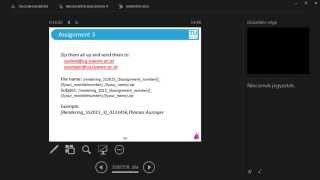
Assignment 3 has two parts: modify a 1D Monte Carlo integrator in C to compute an integral of your choice and compare results to WolframAlpha, optionally extending to higher dimensions with Halton sequences. Part B is a scene contest where you read a path tracer, render an interesting scene until it converges, and submit images for a gallery.
Questions this video answers
250 lines.
May 15, 2015.
Chapters
Let's talk about Assignment 3. This is the fun stuff. So there's a lot of writing platforms there. Assignment 2 is where you need to do quite a bit of mathematics and from then on there's only the fun stuff. So this is one of that. And the deadline for this is going to be. Way after the previous assignment. So it's not like I'm going to put the deadline of this next to the previous assignment. So after you have completed that, then you will still have enough time to do it. So lots of blah blah, blah in there. 1. Please download this zip file and there you can see the implementation of my simple 1D Monte Carlo integrator that we have created. Put together a function, any function that you like and integrate it with the Monte Carlo integrator. First write it down in some way in latex and put it in a PNG file or PDF or whatever and say that this is the integral I would like to compute. And then be the mathematician or be the engineer. So do the actual calculation through analytic intervention or, or just open WolframAlpha and let it do the hard work and then be the Monte Carlo guy and do the actual Monte Carlo sampling for this function and see if you will get the same results. So this is how you can prove that your calculations are correct. Now the Pro version of the same thing is modifying the code to be so suitable for higher dimensional integration. And then also create any function, any wacky fun, polynomial, cosine, whatever function that you would like, exponential, whatever, and do multidimensional Monte Carlo integration. This is literally one line of code of a change in the code. And then you can also integrate higher dimensional functions with this very small C program. And if you feel like a probe, you can also evaluate the speed of convergence. So how does it look like? How far are we from the solution after 10 samples? 10,000 samples. 1 million samples. Just plot the result and if you feel adventurous, you can also snatch my code in this rendering program called Small Paint. This is the one with the painted walls. You can snatch my code for the Halton low discrepancy series and you can sample the one or two or whatever dimensional function with Halton series. And you can see that. How do I stratify samples too? Second part, this is the even more fun part. There's going to be a scene contest. So we have this Monte Carlo path tracer program implemented in 250 lines. Read through the code, try to understand what's going on. But we are going to talk through this anyway and just render an interesting scene. Just put together a full scene with a given number of objects. See what you can do with this. And if you go to this website, you will be able to see a gallery of the results from previous years. And some of these guys and girls have made amazing, amazing artistry works with the program. There's going to be a contest. Submit your result and make sure to render it until it converges so no noisy images. Convert images. Don't try this in the last five minutes. This takes time, but it's insanely. And as in the previous years, we will make in this year a gallery of the submissions so you can be proud of your own work. After you're done with this course, you can show your friends how well you have done. Then obviously the. Subject is going to be the same, only you increment the number of the assignment and please send it to us. I am very excited to see your results even in the middle of the night. So I just met one of my former students at conference and he immediately told me that he has the fondest memories from the rendering course because he was one time late with his assignment. The deadline was midnight and he was not done. So he thought that, my God, I need to work on this all night to be done. So I got an email from him with his results, 3am and then he was very delighted to see that five minutes later. So five minutes after 3am he got an answer with something like past great. And he thought that, oh my God, I messed up. It's the mailer demon. Because who answers an email in the middle of the night? Five minutes later? Spouse in the mailer. He checked it out. Oh, okay. Wonderful, wonderful. Okay, that's basically it. And thank you for your attention. Yes.