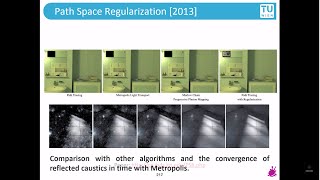
Vertex Connection and Merging uses a shrinking radius to unify biased and unbiased rendering, especially for tricky specular-diffuse-specular light paths. Path Space Regularization generalizes this with angular tolerance instead, starting diffuse and tightening toward true mirrors. Visual examples show where PSR wins.
Chapters
Now let's proceed to Vertex Connection and Merging by Ilyan Georgiev and colleagues. So what he proposes to do is that we conditionally accept this path, the vertex next to Xs, but we pretend that we indeed have the hit. What this basically means is that we have a biased connection, something that didn't really happen, but we pretend that it did, and we have this R, that's the merging radius. So what this means is that on the left side this XS, I would put on Xs instead if it is close by. And by close by we mean that it is in a circle that is of radius R. Okay, but what does this give to me? Because this is a biased technique. If you add one more trick, and this trick would be making R decay over time. So this would shrink and shrink and shrink and eventually it would get to an epsilon value and that to something that's very close to zero in an infinite amount of time. So the bias would disappear from the renderer in time. That's quite remarkable. I'll tell you in a second why some results with the vertex connection and merging technique. You can see that it can render this difficult, difficult SDS light transport situation. So this is indeed a historical moment in global illumination. Why? Because this kind of unifies biased and unbiased photorealistic rendering. And that's huge. That's huge because biased and unbiased rendering was the two biggest schools in photorealistic image synthesis. There were the unbiased guys who were the rigorous, scientific, let's sample all the light paths and let's not cut corners type of people. And there were the biased guys who said that, okay, let's cut corners because this thing takes forever. So let's use some optimization techniques. And what vertex merging gives you is essentially an algorithm that starts out biased, but it has less and less bias as time goes by, eventually ending up as an unbiased technique. So this is a historical moment that unifies unbiased and biased photorealistic rendering. Wonderful piece of work. Now a comparison. First bidirectional path tracing, then progressive photo mapping and vertex connection and merging. Make sure to check out the paper here. Onwards to path space regularization. This is a work of Anton Kaplan and colleagues. He's a super smart guy at the kit. And this is essentially a generalization of vertex connection and merging. What is happening is essentially not spatial, but angular regularization. What does this mean? What we're looking for is connecting the diffuse vertex to the specular. With vcm, what you would do is you would continue the light path from the light source, and you would hit a point that is nearby this next specular vertex, and you would set this tolerance, this radius, this merging radius R. And if it's inside, then you accept the light path. Now, this you can call spatial regularization. What Anton is proposing is angular regularization. So you would say that you will take a tolerance value in terms of outgoing values. And this intuition is slightly different, because what this essentially means is that we have delta distributions for specular reflections, but we start out with a large angular tolerance. And this means that the specular interreflections will be treated as if they were diffuse. So the mirror will show up as if it were a completely white or some colored wall, and then it will slowly, slowly converge to being a mirror. You can imagine this distribution as what you see in the right side that you have the blue, a diffuse ISH brdf. And you put your two fingers on the sides of this and you start pushing them together. And this push happens in time. So as time goes by, we go from the blue to the orange to the green, and we would even squeeze this green more and more and more until it gets to be a delta distribution. So over time, mirrors are going to be mirrors, but in the meantime, we will be able to render SDS light paths. Brilliant piece of work. And the comparison to other algorithms. What you should be looking out for is path tracing with regularization on the right. And this is the only technique that can render this EEG the Eurographics logo reflected in the mirror.