TU Wien Rendering #39 - Assignment 4, Farewell
Final assignment: select a Lux Render scene, render it with unbiased and biased methods, experiment with photon mapping, and document your findings. Optional fluids-themed render contest offers prizes including conference tickets and exam bonuses. Programming assignments and LuxRender contributions are also available alternatives.
Chapters
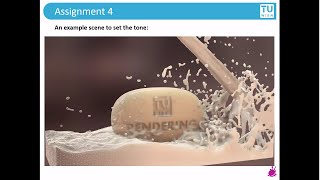
Okay, so the very last assignment, please go to this unofficial Lux Render scene repository. There's also a link below it that shows you how the individual scenes look like. Please choose a scene and render it with an unbiased method several times and merge the results together. I hope that you remember from the previous lecture how you can merge together individual runs of unbiased algorithms and hopefully get something better than the individual images. Do it with other algorithms, both biased and unbiased algorithms. I've also uploaded a settings file to help you with these different algorithms and see what happens. I don't want to spoil the fun, but obviously we expect a given class of algorithms to perform well in this regard, and some of them not so much. Also, try to experiment with photo mapping type algorithms. Place your observations in the observations. Txt file. Tell me what kind of algorithm worked, where, what are the failure cases, and why? And is this what you have expected or did you get something different? Remember when we were doing mathematics, in the very first lectures, we first always listed our expectations and then after we got the results, we discussed whether reality was in line with our expectations or not. This is a really good methodology, so please do it all the time. There will be a rendering competition afterwards where a really prestigious international committee will judge your work and there are lots of valuable prizes. We will get three tickets to the next year's CEGC conference and Pixel Vienna. So that's a total of six free conference tickets for you. I'm also holding a talk at the cegc, so I would be more than excited to meet you there. So the CEGC is the Central European Games Conference. This is Big Sol Vienna, their flyer from last year. So after you handed in your work, you may be getting one of the three prizes. The third prize is plus half of a grade on the exam, and this provided that you would already pass the course. The second prize is plus one grade on the exam and the first prize is perhaps this is the official description, perhaps an even greater influence on the exam grade. If you don't really have artistic veins or you would like to do some programming assignment instead of the Lux Render Scene contest, you're free to do that. Please contact me. Let's cook up a realistic and exciting problem for you that you can solve. So don't just start pounding away at your keyboard and doing something. Please write to me so we can discuss what you are exactly going to do. And if you do that, you are going to be subject to the very same prize. Okay, so what about the rendering contest? The contest theme? This Year is going to be fluids. It's great because we have a great fluid simulator in Blender. You have to create a scene and hand in converged images, not noisy converged images of this scene. Okay, so what is the list of things that you need to hand in? We would like to get the Lex Render scene by. Please copy every asset, every texture, every mesh, everything that you have in the scene in this Lux Render scene directory that you give to us so we can run it ourselves. We need also, like I said, a completely noise free rendered image. We would also need the blend file or if you're using a different modeler program, you're absolutely free to use that. Please be my guest. Just please send us the project file and also send us one text file with a few lines on what you try to accomplish and why you think that your work is the greatest work ever created by humanity. Third party sources for meshes are fine, but you have to give credit to the people who created it. Important. We also ask for a halfway progress report. What does it mean? There will be a final deadline for the assignment. And halfway through that there will be another deadline where I expect you to send me an email with the very same subject as the assignment itself. You send me one rendered image, which is just a rough, a really rough draft of what you are going to do. So I'd like to see your current progress and at least one line of text with your plans. What are you exactly trying to accomplish? This we do because we would like to discourage people from trying to put together some scene in the last two days of the assignment and not have enough time to render it correctly or to develop it correctly. We would just like to make sure that you are on time. And please check the course website to see what exactly are the deadlines for this. Okay, so who will be on the committee first? Jean Philippe Grimaldi. He is the head developer of Flex Render. The kindest, kindest person who has been on this committee for the third year now. And he's always very excited to see your work. Wojtek Yaros. You hopefully remember the name from before. He's the head of the rendering group of, of Disney Research Zurich and an excellent, a truly excellent researcher. Michael Wimmer, our beloved professor who is the head of the rendering group at our university. What about the programming guys? If you don't want to participate in the rendering contest, that's fine. That's perfectly fine. There's two different things that you can do. One, do something. With Lux Render, we have for instance, a bug tracker where people are asking for features and people are also asking for bugs to be fixed. So if you're interested in this, then please take a look. And if you commit something that is useful, then you will be subject to a first prize. Now, note that the first prize can be won by multiple people. If you cross a given threshold with the quality of your work, then you will be subjected to the first prize. And there may be many of you who do. And there's also the small paint line, where you can improve small paint by practically anything. You can add bidirectional path tracing, multiple important sampling, photo mapping, whatever you have in mind. But before you decide on anything, contact me. Last year's theme was volumetric caustics. I think that's an amazing theme. But this year this is not what we're going to be interested in. What we're going to be interested in is fluid simulations. This scene was created in blender so you can do sophisticated simulations like this, and even much more sophisticated than this. I have prepared some blender fluid simulation tutorials for you. So please take a look. And please make sure that your simulation is the very least 300 cube. And also an example video to set the tone. This is taken from the real flow reel from last year. It is absolutely amazing. Make sure to take a look. And the subject of the email that we're looking for is the very same. You only need to increment the number of the assignment. And that's it. It's been a wonderful journey for me, so thanks for tuning in. I was trying my very best to teach you the intricacies of light transport. And I hope that now you indeed see the world differently. I got some student feedback from many of you and I got the kindest of words. So thank you very much. I'm really grateful. And if you're watching this through the Internet, then we have a comment section. Let us know if you like the course. So thank you very much. And despite the fact that it seems that the course ends here, we have a lecture from before that we haven't published yet. There will be some more videos with Thomas, who teaches you how to compute subsurface scattering. So one more time, thank you very much and it's been a wonderful journey. Thanks. I'll see you later.










