TU Wien Rendering #5 - The Fresnel Equation and Schlick's Approximation
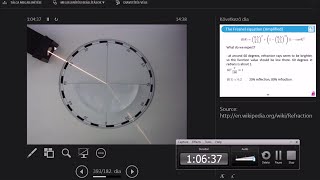
A lecture by Károly Zsolnai-Fehér on Fresnel reflection and Schlick's approximation. The speaker defines R(θ) as the probability of reflection and R0 as the reflection probability at normal incidence, derives and inspects Schlick's simplified formula, and tests intuition with examples (air–glass interface, glass n≈1.5, and vacuum–vacuum). He demonstrates where Schlick's approximation works well (air↔dielectric) and where it fails (vacuum–vacuum substitution produces incorrect nonzero values if used naively).
Questions this video answers
The probability of reflection (angle-dependent).
The probability of reflection at normal incidence (θ = 0).
n ≈ 1.5
Chapters
Now we have some image from physical reality. We have an interface that is air and glass. What I see here is that there is reflection and there is refraction. So in case not everyone understands the term reflection is licht reflexion. And refraction is right with my horribly broken German. Thank God this course is not in German. Everyone would cry. But you guys and girls have it easy because in Hungarian you would say and feinteris. So I think reflection and refraction is much better than that. At least much more convenient question, which is stronger? Which effect is stronger? Raise your hand if you think that refraction. That this is. This effect is stronger. This is a question about this example or in general in this example? Yes. So I can see that the refraction has a more pronounced effect than reflection here. Okay. Because we will deal with this in a second. And what we can do is we can actually write up the vectors that we have been talking about for a case like that. This is towards the direction of the light source. There is a surface normal. It looks like this. So the normal looks upwards. This is where it's reflected. This is where it's transmitted. We don't have a vector for that. And we have the different angles for this. Wonderful. So let's take a look at the simplified version of Fresnel's equation. The simplified version of Fresnel's equation, this one at least is called Schlick's approximation. We have no idea what this is about. This is a not so complicated thing. What this gives me is the probability of reflection. So R of theta is the probability of reflection. So as I have seen the image, I am interested in what is the probability of reflection and refraction? Because I imagine that the probability of refraction is higher in this case. And I would like to compute it in some way in my computer program. Well, let's take a quick look at this. R of theta is the probability of reflection. And this is important to remember because during our calculations, I will Forget this approximately 15 times. So may I ask your name? Lisa. Lisa. Okay. Well, if I ask you what is r theta, you will tell me that this is the probability of reflection. Probability of reflection. Yes. And exactly, because I. Seriously, I will be forgetting it all the time. R0 is the probability of reflection on normal incidence. So this means that light is coming from. If it would be coming from above, what are the chances that it gets reflected? And R0 can be given by this expression. We'll be talking about this. N1 and N2 are basically indices of refraction. We will have examples with that too. But let's quickly go through this and see if physics makes any sense. Well, for an air vacuum medium we have, let's say the index of refraction of air is one and this N1 is the medium that we go into. So for instance here, glass. And let's see what happens there. But before we do that, T is the probability of transmission. Obviously if the light is not, we forget absorption for now. If light is not reflected, then there is refraction. It's simple as that. So if I add up these two probabilities, I get one. So let's play with it. R at 0 degrees is R0. Why? Because cosine of theta. So the cosine of 0 degrees is 1. So on the right side I have 1 minus 1. So the second term is killed by this 0. Therefore I will have R0 and R at 0 degrees. This is the theta is the degrees, the angle of the incoming light 0 degrees. So it means that it comes from upwards. What is it? This is the probability of reflection of normal incidence. So this is basically the very same thing. So if it comes like this, what is the probability of it coming back, bouncing off of the glass? What's up with 90 degrees? Well, 90 degrees because sine of theta is zero. Therefore I will have both of these terms, very simple and this is going to be one. So the probability of reflection at 90 degrees is one. Because imagine that I'm coming from above, then this means that there is a very likely chance that I'm going to get through. So imagine a super crowded bus in the morning and you just cannot fit in there. How would you like to go in if you don't care about the health and the intactness of the other people? Well, you will just run in there and you know, hopefully they will make some space. I have the best probability if I run towards them. If I would be running from the side, it would be very likely that they would just push me back. There's a high chance that I would be reflected. So I want refraction, I want to get on the bus. So as I raise this angle from normal incidence, the more probability there is for the ray to bounce back. So, so this for now seems to make some sense. Yes, but it is still reflection at 90 degrees and not just the lightroom itself. You have to think in terms of limits. So what is the probability at 89 degrees it's going to get reflected. If you just raise that you are going to approach the probability of one. So this is a bit boggling the mind but you can see that there's like a continuous transition. From here. There is a high probability of refraction. As I go towards 90 degrees, there's more probability for reflection. And we define that at 90 degrees. We say that it is reflection because I am moving along the boundary. I'm not entering the glass. By the way, that's a great question. I was thinking about this too before. So let's say that index of refraction of glass is 1.5. Let's compute this thing quickly. It's 0.5 over 2.5 squared. And I do the very same substitution for the rest of the equation. But before I get this, what do I expect from the plot? That's another important mathematical principle. Do this all the time. Before you compute the result, state what you would expect from the result. Because this gives you a much higher level of understanding. Well, I'm interested in R of theta. What does R of theta mean? Probability of reflection. Excellent. Okay, Lisa nails it again. So the probability of reflection at zero degrees, I would say is something very low. Right. Okay. So I have written this here, that r of 0 is less than 0.1 because it's the probability of. I mean, r 0 is the probability of. Sorry. Yes. So the probability of reflection is low. I would say less than 10%. Okay. So if I come from upwards, refraction is likely. I'm very likely to get on the bus if I. I ram into the people from the front. Okay, what's up with, for instance, 60 degrees? Well, we know exactly what happens at 60 degrees because how many degrees do we have here? What is the incidence now? It's 60. And we can see that at 60 degrees there is a chance for refraction and reflection. And the refraction chance is higher. Exactly. So what I would imagine is that at 60 degrees there is a higher chance of reflection than the previous one. I mean, but refraction is still stronger, as you can see on the image. We are going to compute this and we are going to be. We are going to let nature be our judge whether the calculation is correct or not. So 60 degrees, I quickly converted to radians. That's more or less 1. And so R of 1 is 0.2. This means 20% chance of reflection, 80% of refraction. This seems to be in line of what I see here. But this is just my expectation and what we have been talking about, PI over two. This means 90 degree angle. I would expect it to be one. So if I convert it to radians, then this is 1.7. So R of 1.7, I expect it to be 1. Let's put all of these together and let's do what engineers do all the time. Open Wolfram Alpha and try to plot this. So I imagine that r of 0 is less than 0.1. So getting on the bus easily. Well, r at 0 is less than 0.1. So far so good. R at 1 is less than 0.2. This is the 60 degrees, mostly refraction. Well, r at 1 is less than 0. 2, so check mark. And r at around 1.7 is indeed around 1. So apparently physicists are small people and physics makes sense, so pretty good. But there is something fishy about this. So this is correct. I mean, what we see here is in line with our expectations. But there's something fishy about this plot. Raise your hand if you know what it is. Okay, I'll give you a hint. This plot R of theta, which is this is the probability of reflection. Okay. What happens after? I don't know. If I would just extrapolate, what would happen at not 1.5, but 2? What would I measure? I think it would be something like the very least minus. It's going upwards, but it would be at least three. I don't know about you, but I don't know about probabilities that can be larger than one. So this would give me some fishy results if I would substitute something like that. So let's try to shed some more light on it. What if I have a vacuum? Vacuum interaction. So below I don't have glass anymore, I have vacuum. Well, the index of refraction of vacuum is one. So let's just substitute one here. So this is going to be zero and I'm going to have the second term, one minus cosine of theta to the fifth. Why? Because this is zero and this is one minus zero. So I will keep this term. Okay, engineering mode. What do we expect from this plot? I have vacuum or air, if you wish, if you will. And vacuum again. I start a ray of light. What will happen with probability of 1 reflection or refraction? Raise your hand if you know reflection, there should be no reflection. Exactly. Why? Because there is no interaction between medium. Exactly. So the definition of vacuum is again, nothing. There's nothing in there. There's nothing that could reflect this ray of light back. If there is vacuum, we expect rays of light to travel in vacuum indefinitely. There's no way that it could be reflected. So since R0 is the probability of reflection, then this R. Sorry, R theta. What do I think this should be if there is only refraction, then this R of theta will be zero. Fantastic. Okay, well, let's plot this. This looks like one minus cosine theta to the fifth. This is already fishy, but let's take a look. Blah, blah, blah. This is what I've been talking about. So I expect it to be zero. Let's plot it. And this looks like this, which is not constant zero by any stretch. So the question is, you know what went terribly wrong here? And it's. It's very easy. The Schlick approximation is an approximation. It's good for interfaces which are vacuum or air and something and not something, something. Okay, so A and B, it works well, but it's, it's a quick approximation because this is the original Fresnel equation and this is much more expensive to compute. And this other one was much quicker, but it's a bit limited in use, so let's give it a crack. So what would this say about the vacuum vacuum interaction? Well, I would substitute n1 and n2 equals 1. This is the index of refraction of vacuum. I get the very same thing back, just the N1's and N2s are gone. I'm going to use a trigonometric identity which says that the square root of one minus the sine of square something is a cosine. Okay? So let's substitute these for the cosines. So what I see here is the cosine of theta minus cosine theta. So what is this expression exactly? How much is it? Two. It's zero. Exactly. And this is what I was expecting. So apparently physicists, again are smart people.










