TU Wien Rendering #6 - Snell's Law and Total Internal Reflection
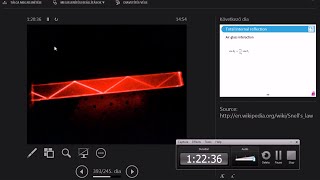
LARRUZ explains how light bends when moving between materials using Snell's law. A ray hitting glass at 60 degrees from air bends to about 34.75 degrees. Beyond a critical angle, light bounces back entirely instead of passing through, a phenomenon called total internal reflection.
Questions this video answers
LARRUZ
March 25, 2015
1.5
300,000,000 m/s (300 million m/s)
≈200,000,000 m/s (200 million m/s)
Chapters
There is still one thing that we don't know, and it's about angles. So we know about probabilities. Whatever you give me, I can tell you what is the probability that light gets reflected or refracted. I know the probabilities, but I don't know about angles. And what we need to know is that light rays of light slow down. They travel with the speed of light, but they slow down as they enter a medium because there is a atoms, particles in there and it's more difficult to get through. So light slows down. The index of refraction tells you by exactly how much. So the index of refraction of the medium is given by this fraction, the speed of light in vacuum that we know over the speed of light in this medium. So this is how we can write it up. Let's look at an example. The index of refraction of glass is 1.5. So we know exactly what the speed of light inside glass is. Well, it's 300 million meters per second in vacuum. And what we know is this equation. So this is the index of refraction. So I can just reorder this thing and conclude that light, if it Travels in vacuum 300 million meters per second, but in glass, it loses the third of its velocity and it's only 200 million meters per second. So that's a pretty easy calculation and it's pretty neat. And another absolutely beautiful thing. Hopefully you have studied the Maxwell equations and Poynting vectors in physics. Light is ultimately a wave. So here above and below, you can see some wave behavior. And the ray is essentially the wave front of these waves. So light can be imagined as rays. If you take into consideration that I would need to compute many of these wave fronts in order to take account for the wave behavior. And don't look at the red, only look at the blue. This is above, this is vacuum. And below this could be, for instance, glass. And you can see that the waves slow down in this medium. And what this means. If we go back to the definition of the wave fronts, the red lines, then they are essentially bending because the wave fronts are going to look like this. So it's very interesting because if you imagine light as a wave, it only slows down. But if you imagine light as a ray, then it bends, it changes direction. So I think that's absolutely beautiful. And the question is, why is the light refracting inwards? Because what I would imagine is that it continues normally, it continues its way with this theta T equals theta I, because it would just continue its way and it doesn't continue its way, but it fends a bit. And the question is why? And now we have Khan Academy time. Raise your hand if you know Khan Academy. Okay. Awesome. Awesome. Well educated people. So this is shamelessly stolen from Khan Academy because this is the best way to describe how refraction works. So basically you imagine that you have a large car and the air vacuum interface is now road and mud. I mean the road is the air and mud is glass, for instance. And imagine as you are approaching this boundary line between the two, then the first wheel of the car, like the lower left on this image, is entering the mud. But on the other side the wheels are still on the road. So therefore this wheel will slow down in the mud. But this is still going as fast as it used to be. So what will the car do if this happens? It will start to turn. And you know exactly where it would turn because this is going slow, this is going faster. So therefore it will turn inwards. So this is I think an amazing interpretation of the whole thing.
I think also it's easy to explain with the waves because when the waves slow down, then the direction then we can see that the circles will get a bigger radius. And if you go perpendicular to the waves exactly.
Then we will go down exactly like in the previous figure. That's another intuition that I just wanted.
To ask if this is actually physically happens, because I don't think so.
No, this is intuition.
That's why it's a bit misleading and it's a nice.
This is strictly intuition. Okay, so if you would start to model rays of light like trucks on going road, you're gonna encounter problems.
You could technically integrate it as part of the wave hits the medium first and by that the entire wave gets rotated. That's like how I would interpret.
No, they said I tend to give multiple ways to interpret things because, you know, different minds work differently. Some graphical ways are working for different people better. Okay, so Stan's law and we're almost done for today. Stan's law tells you in what angle refracted rays are going to continue their path. And this is given by this expression. Sines of the angles against velocities against the reciprocal of indices of refraction. Okay, so let's do the air class example of the previous image. Let's state our expectations before we go. So I'm interested in the relation of theta I versus theta T. So I know these expressions exactly how much is theta I in decrease? So the citizen it's 60. Okay, excellent. How much is beta t? In degrees, it's. It's. It's something around 35. Exactly. Okay, so the light is reflected inwards. Therefore, the theta T must be less than the theta R. So this must be less than this. Let's compute the equation and see if this works. And if it doesn't work, we're going to call out the physicist Song. So let's just reorder some things and let's put there the indices of refractions and the incoming light angle that we know. And just some very simple reordering. We are almost there. And if we actually compute the sine of 60 degrees, we get this. Well, this is. We can also carry out the division. But at this point, I'm not interested in the sine of theta T. I'm interested in theta t. So I would multiply both sides, invert the equation by multiplying with the inverse of the sine. So this theta T should be the arc sine of this. And if I compute everything back to degrees, then I will get this theta t, which is 34.75. So whoever said that 35 was very close to the actual result. But also, not to forget that there's different kinds of glasses. I mean, there's multiple ways of creating and manufacturing glasses, and they have different indices of refraction, more or less the same, but it's still different. But we can see that this is in really good agreement with what we see in real life. Well, what did we say? Theta T should be less than theta I, but 35 is definitely less than 60. So, again, physics works, and physicists are smart people. And just another example, if you think about the CAR example or whichever example you like better, you will hopefully immediately see that if we would be going with the yellow arrow, this is going to bend inwards after going back from the water to the air. Now, whoa. Hold it right there. What is happening? I don't see any reflection whatsoever. Right. So it seems to me that if I go back at around. How much is this in degrees? That's 50 degrees. Exactly. So something fishy happens at 50 degrees. Well, I don't know what is happening. I'll tell you the name. And we're going to compute whether this is possible or not. Well, if it's not possible, then our math sucks. So let's see. So what we call this is total internal reflection. There is a critical angle, and after this critical angle, there is no more refraction. There's only. There's no more refraction. Only reflection happens. And there's many examples of that and there's many applications of that. This is one of the more beautiful examples. So let's compute what's going on here. What I know is that I have the indices of refractions. I know, I know this degree that we just dealt with. And something interesting should happen here. And something interesting already happened. So I just plugged in everything what I have seen on this image and I get this. And this is awfully, horribly, terribly wrong. Someone please help me out. Why is that? Okay, yes. Sine can't be bigger than one. Exactly. So the support of the sine is between one and minus one, at least according to my experiences. So it's saying that the sine of an angle is more than one is mathematically not possible. So it says that there's no such angle. What would be the angle of refraction? If I would use using 50 degrees, then it says something that mathematically doesn't make any sense. So math actually suggests to you, if you use the right numbers, it suggests to you already that this total internal reflection would happen. Let's try to compute the critical angle. And this I just reordered things. This is hopefully the critical angle that I will be trying to compute. Well, if I have this theta one, this is a relatively small number, then there is going to be refraction. There is this critical angle on the second figure at which I have this 90 degree refraction. So it says that at the critical angle, this thing is going to be 90 degrees. And after that, so this is smaller than this. After this critical angle, there's only going to be reflection. Now let's try to compute this. Note. Notice the 90 degrees here. So what I put here is, this is what I'm interested in. And this happens when this refraction is at 90 degrees. So I put there this 90 degrees explicitly. And I want to know this theta one, that's going to be the. That's going to be the critical angle. Well, if I actually do the computation with the 90 degrees, then I'm going to get one for the sine. So this is N2 over N1. Well, I'm still not interested in the sine of this angle. I'm interested in the angle. So I have to invert the other side, both sides of the equation. And this is the definition of the critical angle. And if you write it in Wikipedia, critical angle, you are going to get the very same formula. But the most interesting thing is that you can actually derive this yourself. And this is not a huge derivation. This is very simple. This is where this 90 degree refraction happens. So what is our expectation for this critical angle? Let's look at the reality again.
On the right side.
What? So this is. I'm just trying to hint without saying telling you the solution. So let's try it without hints. What could be the critical angle here? Raise your hand if you know the answer. Okay, sorry. I will. For pedagogical reason, I will ask someone who I have a best. Okay, let's see if it's correct. I have asked you. Have I asked you before?
Nothing important.
Nothing important. Okay, now you get an important question.
It should be something smaller than 50 degrees, because now it's only.
Exactly. So. So, so the. The. The usual answer, what I get is that 50 degrees, because I see total internal reflection. But total internal reflection means that at some point after that there's only going to be reflection. So it doesn't mean that if. It doesn't mean that this is that point. Because if I would be trying 60 degrees, I would also see reflection. But this doesn't mean that 60 degrees is the critical angle. It's before that, at some point. Was this your answer too? Okay. Was this your answer as well?
Yes, but I was thinking that if it's critical angle, for example, let's say 50 is critical angle. Maybe we'd have also reflection and then a horizontal one.
Exactly. Yes. What you have seen on the figure. So at the critical angle, you see this instead of this. So this is over the critical angle. So it has to be less than 50 degrees. Less than 50 degrees. Okay, so this is very simple. From here, let's just substitute the indices of refraction 41.81. Wonderful physics works and we are still alive. So that's basically it for today. We have used reality to be our judge. We are not just writing formulae on paper. And then be happy about how much we can understand or how much we can memorize of them. We put everything to use. And you will see all of this in C code not so long from now. So that will be the introductory course and I'll see you next week. Thank you.










