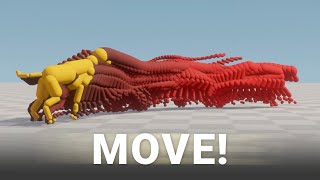
Ubisoft developed an AI that predicts how virtual characters move in real time. It learns from fewer examples than older systems, works with different body types and environments, and lets developers control movement on the fly without expensive retraining.
Dear fellow scholars, this is 2 Minute.
Papers with Dr. Zsolnai. Today we are going to take an AI and use it to synthesize these beautiful crisp movement types. And you will see in a moment that this can do much, much more. So how does this process work? There are similar previous techniques that took a big soup of motion capture data and outbid each other on what they could learn from it. And they did it really well. For instance, One of these AIs was able to not only learn these movements, but even improve them and even better adapt them to different kinds of terrains. This other work used a small training set of general movements to reinvent a popular high jump technique, the Fosbury Flop. By itself, this allows the athlete to jump backward over the bar, thus lowering their center of gravity. And it could also do it on Mars. How cool is that? But this new paper takes a different vantage point. Instead of asking for more training videos, it seeks to settle with less. But first, let's see what it does. Yes, we see that this new AI can match reference movements well, but that's not all of it. Not even close. The hallmark of a good AI is not being restricted to just a few movements, but being able to synthesize a great variety of different motions. So can it do that? Wow, that is a ton of different kinds of motions. And the AI always seems to match the reference motions really well across the board. Bravo. We'll talk more about what that means in a moment. And here comes the best part. It does not only generalize to a variety of motions, but to a variety of body types as well. And we can bring these body types to different virtual environments too. This really seems like the whole package. And it gets better because we can control them in real time. My goodness. So how does all this work? Let's see. Yes, here. The green is the target movement we would like to achieve, and the yellow is the AI's result. Now here, the trails represent the past. So how close are they? Well, of course, we don't know exactly yet. So let's line them up. And now we're talking. They are almost the same. But wait, does this even make sense? Aren't we just inventing a copying machine here? What is so interesting about being able to copy an already existing movement? Well, no, no, no. We are not copying here. Not even close. What this new work does instead is that we give it an initial pose and ask it to predict the future. In particular, we ask what is about to happen to this model. And the result is a messy trail. So what does this mess mean? Well, actually the mess is great news. This means that the true physics results and the AI predictions line up so well that they almost completely cover each other. This is not the first technique to attempt this. What about previous methods? Can they also do this? Well, these are all doing pretty good. Maybe this new work is not that big of an improvement. Wait a second. Oh boy. One contestant is down and now two have failed. And I love how they still keep dancing while down. A for effort little AIs. But the third one is still in the game. Careful. Ouch. Yep, the new method is absolutely amazing. No question about it. And of course, do not be fooled by these mannequins. These can be mapped to real characters in real video games too. So this amazing new method is able to create higher quality animations, let us grab a controller and play with them, and also requires a shorter training time. Not only that, but the new method predicts more and hence relies much less on the motion dataset we feed it and therefore it is also less sensitive to its flaws. I love this. A solid step towards democratizing the creation of superb computer animations. What a time to be alive.
This episode has been supported by Lambda GPU Cloud. If you're looking for inexpensive cloud GPUs for AI, check out Lamda GPU Cloud. They've recently launched Quadro RTX 6000, RTX 8000 and V100 instances and hold on to your papers because Lambda GPU Cloud can cost less than half of AWS and Azure plus they are the only cloud service with 48gb RTX 8000. Join researchers at organizations like Apple, MIT and Caltech in using Lambda Cloud instances, workstations or servers. Make sure to go to lambdalabs.compapers to sign up for one of their amazing GPU instances today. Our thanks to Lamda for their long standing support and for helping us make better videos for you.
Thanks for watching and for your generous support and I'll see you next time.