Unitree's NEW AI AGENT Humanoid ROBOT BEATS Boston DYNAMICS! (Unitree G1 Robot)
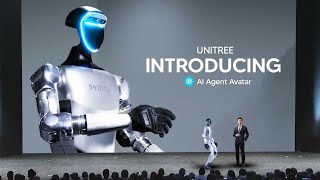
Unitree's G1 humanoid robot costs around $16,000 and can match Boston Dynamics' recent demos in speed, stability, and hand dexterity. It crushes walnuts, opens cans, and survives hard impacts. The robot ships in five months and uses simulation training to learn complex behaviors.
Questions this video answers
May 13, 2024.
$16,000 (presenter notes prior listings of $91,000 and $150,000).
3.3 meters per second (presenter reference to prior demo).
Approximately five months from the trailer ("ships out in around five months").
Chapters
So Unitree have just released their trailer for their Unitree G1, which is their humanoid agent AI avatar. And this robot is actually surprising in terms of the flexibility, the dexterity and just all around how capable this robot is. So I'm going to show you guys the quick trailer and then I'm going to dive into exactly why this robot is so fascinating. Sa. Sam. So there we have it, ladies and gentlemen, a very, very fascinating trailer for this robot. Now there are a few things that I do want to talk about because there is a lot to dissect here. And this is actually genuinely a game changing robot. So one of the first things that I think a lot of people might have just realized when they were watching this robot release was the fact that this robot actually resembles the recently unveiled Boston Dynamics new spot robot. Well, not the spot one, the new one, whatever they're going to call it, because they do have an all new Atlas robot which is very similar to this one in terms of how the robot got up. And this is showing us that I don't think that, you know, Unitree managed to create the robot in such a short amount of time because it's literally three weeks since that trailer. So I'm guessing that it's not possible for them to have done this in three weeks because this does take a really long time. But what it does show us is that this company is evolving quicker than many have expected, because this is a remarkable feat in terms of what this robot is able to do at its price point, because the robot is currently only $16,000, which is cheaper than any other humanoid robot that can do the same thing. Now, one of the most incredible things that I think was really, really demonstrated in this robotics demo was of course, the movement ability. You can see that this robot is extremely and extraordinarily flexible, which is remarkably important because like I said in previous videos, humanoid robots are going to be better than humans in a huge number of ways. And a lot of people might think that you might be limited by the human levels of movement and the human degrees of freedom, but these robots are going to have a lot more degrees of freedom than we are because they're going to be able to swivel around. As you can see, the robot here, it just literally swivels around and, you know, says hello and it's going to be able to move its legs in completely different ways. And you can see right here that if you see this bit right here, the hollow joint wiring, essentially what that means is that the wiring is now inside the robot, which means that this robot is able to do a lot more efficient moves and it's able to be a lot more compact, like this right here, which is pretty good for storage and just a variety of other different reasons. But I think this shows us that where we are headed now in terms of the robotics, I mean, the robot race is clearly on. Because I don't think anyone predicted that Unitree were going to release this so soon. I would definitely have suspected that something like this would have come straight out of Boston Dynamics. And of course, while Boston Dynamics might be using hydraulic actuators or it might be completely electric, as we saw in the recent trailer, I think this shows us with this kind of movement, in terms of how robots are, they're going to be able to do a huge range of different tasks that maybe we just haven't even thought of. And another thing that I did think that they did show us that was truly, truly impressive was, of course, this right here. Now, essentially what we're able to see is we're able to see how stable the robot is when taking impacts from punches or forces. And this is good for a variety of reasons. Now, I'm not advocating for the abuse of robots, of course, that is, you know, dependent on where you are in terms of looking at AI apocalypses where robots try to, you know, kill all humans, because we did a few things to them in the early days, like punching them in the chest to see how stable they were. But I think what this does show us is the remarkable, you know, stability of this robot, because it shows us that, you know, in real life, you might get hit by something. You know, you might have wind, you might have debris, you might have something that happens. Which means that these robots are going to be able to work in pretty hazardous environments, which means that if they do take a hit, if they do stumble, they're going to be able to stay completely stable. And I would argue that this is pretty incredible because a lot of humans, if you take a punch in the chest, a lot of them are going down. So this is a really, really, really interesting improvement because we've seen this before in previous demos of Unitree where they had their H1 robot and it was remarkably stable. They kicked it a billion different times, and it was able to stay completely stable. But I think this is really, really, really incredible because if you look at some of the top humanoid robots, I can promise you now, if you do this act to any of those humanoid robots, they're going completely over and you're going to need to be able to pick them straight up. So I think this is a remarkable achievement because I don't think I've ever seen any other robot do this. I mean, I've seen one or two, but they weren't humanoid robots. They were just like, you know, those robot dogs that are able to stay completely stable, but this is staying stable on two legs as a humanoid. So we must really not underestimate how crazy this is, because another thing, which is why this is truly impressive, is because this is a robot that doesn't even have a string on it. Lots of the times in robotics demos, what you'll see is you'll see a robot, you know, walking around or whatever, and you'll see, like, a string holding on up to, like, the ceiling or something with a wire and just so that the robot doesn't fall over. And that's something that robots really do struggle with in the early days of building. So the fact that they've got to a stage now where they can literally punch it in the chest, they can kick it, and it's able to be 100% completely stable, and they've managed to do the wiring inside of the robot, that is a completely, completely remarkable feat. And if you want to know what I'm talking about, I'm going to show you guys the previous robot, the H1. There was actually something in there. I don't actually have the video now, but the speed of this as well, I thought it was really fascinating because if you look at the. You can see that this robot was able to get up to 3.3 meters per second. So it doesn't break the previous world record, but it is. Well, the world record was set by them. But the speed of this robot is also another fascinating thing. Like 2 meters per second running, like, borderline running. We haven't seen that from any of these other humanoid robotics companies. Like, we've seen the Tesla bot. It's walking pretty fast and pretty smoothly. But being able to move this quickly, we just completely, completely haven't seen someone kicking the Tesla bot and stuff like that. We just haven't seen figures. Robot 1X's robot, we just, you know, sanctuary robot. I would argue that, you know, right now this is probably one of the best in class humanoid robots up there in terms of what it's able to do. Now, later on in the video, we did see some very impressive stuff. And this was one of the things that really, really did impress me was, of course, this right here. So essentially what we have is the robot doing certain Actions which were learned in simulation. So it shows us that this is imitation and reinforcement learning driven. And this is where we have a robot in simulation. So they've taken the same platform of this robot and they've placed it in a robotic simulation. By the looks of things. This seems to be Nvidia's Isaac Sim or Isaac gym, where robots can figure out and, you know, do a lot of different tasks. And then of course you can essentially when those tasks are figured out, you can then apply that to real world scenarios. And you can see that this is how the robot is able to do this completely autonomous. And what's crazy about this is that you might think that this is really simple. But if we actually take a look at the robot and how it's moving, we can see that the joints right here, they're moving in such small and subtle ways that the stability is quite, quite impressive. So this is something that I think is going to be a remarkable, remarkable research platform for many researchers doing robotics. Because previously the H1 was a really, really good platform, but it was just really expensive. Now this is where we get into some of the really impressive stuff. So we can see that this robot could literally crush warnots and you know, control of dexterous hands, manipulation of all things. So a lot of people complained that previous robots didn't have, you know, the hands or whatever. Like they didn't have certain hands for certain things. Like the unitry for example. This one right here, people complain that it didn't have hands, but we can see that, you know, right here, this robot actually has hands that are able to, you know, manipulate objects. Which means that this is going to be applied for, like I said before, you know, a lot of research cases and a lot of many other use cases. So it's able to grab a walnut and it's able to then, you know, smash the walnut. Which is a really interesting because it shows how sturdy and how rigid the robot is in terms of it being able to do that and still stand on its feet. And this one was really, really, really surprising. Like that is really, really, I, I don't even know how they pull that off. I don't think it's teleop. But you know, a robot being able to just, you know, whip open a Coke can like that is a, a remarkable feat. And then they also talk about a unifo lm a unit tree robot, unified large model. The only problem is they don't have enough information on the web about this. But I'm guessing what they do have is they have some kind of model which is able to perform these tasks autonomously. And yeah, this is pretty, pretty impressive. They're able to flip a piece of bread, then, you know, throw it onto the plate there. So they also talk about how, you know, sturdy the robot is, and there isn't that much details released just yet. But I'm guessing as more blog posts come out, I'll update the description with exactly what's going on. And right here, what they're showing, if you don't know, they're showing this robot being able to do very, very precise movements. So this is why they're able to show this robot soldering something together. So the reason why this is so impressive is because the thing that was, you know, great about the unitary, and you can see right here, I've got this checkout page. The reason that this, the G1 is so crazy is because you can see that this starts at $16,000. The humanoid agent AI avatar. Why is $16,000 so crazy? Because this website has it for $91,000 and another website on their official website has it for $150,000. Now you can see basically the price has come down from $150,000 to $16,000. So that's basically a 10x decrease in the price of a robot. Okay, not exactly 10x, but $150,000 to $16,000. You know, we could say like a 9.5x or whatever. That's a huge decrease and there's a lot more capability in terms of this robot. Now, the reason is, is because recently researchers were exploring with their other platform, the Unitree H1. And we can see here Shanghai Tech and Mars Lab presented humanoid parkour learning. This framework trains humanoids to use vision and proprioception to navigate on rough terrain, such as jump on a high platform, leap over hurdles, long gaps, and more. And essentially this is completely end to end, which is a remarkable feat in terms of robotics. So we can see the robot just immediately looking at the information and then selecting quickly the policies that it needs to navigate the environment completely end to end in this environment. And this is remarkable, okay, because the problem is that. So if you're watching some of the videos that I recently spoke about, I spoke about how academia is struggling in terms of their investments to AI and robotics because they don't have the funding of these big AI private companies. And when you have robots that literally cost, you know, $150,000 or 91,000 pounds, it's pretty hard to, you know, get them funded. But if you have something that's a lot cheaper, like $16,000. You know, we're going to see a lot more in terms of the research aspects of this, which means that, you know, the whole field is going to improve quite a lot. I mean, the previous unitary H1, we actually saw this robot literally do a complete backflip. And if you would have told me that this robot can backflip, I genuinely would not have believed you, because that is just an incredible, incredible feat for such a robot that, you know, only has these basic, basic actuators. So you can see right here, it's trained in simulation. And then this was mapped onto the robot. So it's pretty, pretty incredible with how fast they're moving. And a little Easter egg that they did leave at the end of the video was they actually left this right here, which I found pretty cool, which is where you can see a X ray of this, the G1, and you can see all of the different actuators that exist within the robot. So we can see one here, we can see all of them right here. So we can see how this robot is managing to move. So apparently, this robot ships out in around five months. And I'm truly excited to see what some of the researchers do with this, how they manage to, you know, use this robot, you know, all of the different things they do. Especially now, since this version actually does have manipulators, so it's going to be a lot more useful than the previous one. So the robot race, surprisingly, I honestly didn't expect this yet, has shown us that, you know, worldwide, you know, China is definitely taking this seriously, and they are a huge force to be reckoned with.










