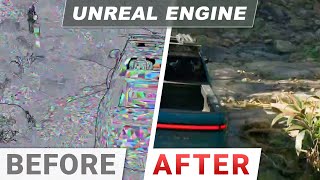
Dr. Zsolnai walks through Unreal Engine 5.2's real-time simulation tools: Lumen's global illumination system that handles dynamic lighting instantly, physical details like tire deformation and fluid interaction, and procedural environment generation. Research that used to take hours to render now runs in real time.
Questions this video answers
Unreal Engine 5.2: Incredible Simulations!
Dr. Zsolnai (Two Minute Papers)
July 24, 2023
Lumen
Weights and Biases
Chapters
Dear fellow scholars, this is Two Minute Papers with Dr. Zsolnai. Today we are going to see how Unreal Engine, a popular game development platform, puts up a clinic on simulations. Now, I am sure you are asking, okay, Doctor, but what kind of simulations? And the answer is that here, every single thing that you can possibly imagine is simulated. This is going to be real good. In a previous episode, we already saw how it can recreate real people and put them into virtual environments. And today, first, we are going to have a look at this. Yes, it can simulate how all this beautiful foliage would look like in reality. These are not perfect renderings. Reality looks a little different. However, they are extremely convincing. And, oh, my. They run in real time. So the appearance is being simulated here. Then, since all this runs in real time, we can grab a controller, jump into this virtual electric vehicle. We can control it so the movement of the vehicle is simulated. And look, it also interacts with the environment beautifully. That is also simulated. So much so that even the interaction of the suspension with the environment is computed as well. And here comes the two Minute paper special simulating interaction with fluids. Yummy. I absolutely love this. And it even simulates how this interaction would sound in reality. Even the compression and deformation of the tires is simulated. Something that was possible through this earlier paper from Nvidia. Two years ago, this was a paper, and now it is right there in a product that we can use right now. Incredible. And since this is a virtual world, the rules of the real world don't apply, only our rules. So let's refinish this car with a beautiful old opal material. Oh, my goodness. Look at those specular interactions. My eyes are popping out of my head. They look so good. This is a type of material where multiple layers and even iridescence is simulated. Now add some dirt to it. And look, tire deformation, too. And all this in real time. Pinch me. What a time to be alive. And when we drive, even the hand movement on the wheel is shown. Now, we keep driving a bit longer and something happened. Did you catch it?
Look again.
Something big happened. Do you see it? Well, up until this point, artists created this environment by hand. But from this point on, the entire environment is generated procedurally. In other words, nearly completely, automatically. Look, we can add to it so easily. And if you don't like this new part here, just grab it and move it like that. Wow. Now, in games like Fortnite, they are using their new rendering system called Lumen, which is capable of computing global illumination in real time. That is, I don't Even know what to say. Global illumination means an intricate simulation of light where even indirect illumination can appear. This is the bleeding effect of light as it bounces through multiple diffuse surfaces and is a beautiful phenomenon in nature, but unfortunately less so in many virtual worlds because it is so slow and expensive to compute. But here, whenever the environment changes it, its effect is now computed properly. And not just the direct effect of the light that you see here, but the indirect effect. In other words, how it bounces around in the scene, this also changes. Fantastic. And this means that whenever a wall is destroyed, the lighting of the whole scene changes once again, not just direct illumination, but indirect illumination as well. And I hear you asking, OK doctor, the geometry is quite simple here. Can it also shoulder more complex scenes? And the answer is, look here. This is a light transport researcher's dream. Just look at that. This used to take hours if not days to compute. And now once again, real time. I cannot believe it. We now live in a time where we can create little virtual worlds where the light of every single candle is computed convincingly. I am so happy to see all of these amazing research works coming together in one place and in real time. Two minute papers exist because I want to draw your attention to human ingenuity. I want to show you what can be done and that you can do it too. And my goodness, isn't this an amazing celebration of human ingenuity. Bravo. My apologies for not being able to report on this as quickly as the keynote came out, but there is just so much happening in the world of research. There is so much I want to share with you and fortunately progress is so quick, sometimes I don't even know where to start. We have a ton more amazing works coming, so if you like this one, consider subscribing and hitting the bell icon to not miss them.
Weights and Biases provides tools to track your experiments in your deep learning projects. What you see here is their amazing sweeps feature which helps you find and reproduce your best runs. And even better, what made this particular run the best? It is used by many prestigious labs including OpenAI, Toyota Research, GitHub and more. And the best part is that Weights and Biases is free for all individuals, academics and open source projects. Make sure to Visit them through wnb.com papers or just click the link in the video description and you can get a free demo today. Our thanks to Weights and Biases for their long standing support and for helping us make better videos for you.
Thanks for watching and for your generous support and I'll see you next time.