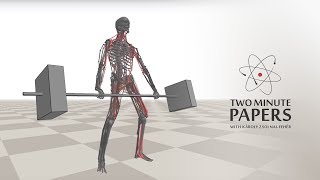
A short video (Two Minute Papers style) presenting research that builds virtual human characters with skeletal systems and over 300 muscles, trains them to perform realistic movements (kicking, jumping, walking), and uses the simulation to test conditions (bone deformities, stiff joints, muscle deficiencies), prosthetic designs, and surgical interventions to observe effects on gait and range of motion.
Chapters
Dear fellow scholars, this is two minute papers with this work is about creating.
Virtual characters with a skeletal system, adding.
More than 300 muscles and teaching them.
To use these muscles to kick, jump.
Move around and perform other realistic human movements. Throughout this video you will see the activated muscles with red.
I am loving the idea, which to turns out comes with lots of really interesting corollaries.
For instance, this simulation realistically portrays how increasing the amount of weight to be.
Lifted changes what muscles are being trained during a workout.
These agents also learned to jump really high. And you can see a drastic difference between the movement required for a mediocre.
Jump and an amazing one.
As we are teaching these virtual agents.
Within a simulation, we can perform all kinds of crazy experiments by giving them horrendous special conditions such as bone deformities, a stiff ankle, muscle deficiencies, and watch.
Them learn to walk despite these setbacks. For instance, here you see that the muscles in the left thigh are contracted resulting in a stiff knee.
And as a result, the agent learned an asymmetric gait.
If the thigh bones are twisted inwards. Ouch. The AI shows that it is still.
Possible to control the muscles to walk in a stable manner.
I don't know about you, but at this point I'm feeling quite sorry for these poor simulated beings. So let's move on.
We have plenty of less gruesome but.
Equally interesting things to test here. In fact, if we are in a.
Simulation, why not take it further?
It doesn't cost anything. That's exactly what the authors did. And it turns out that that we can even simulate the use of prosthetics. However, since we don't need to manufacture.
These prosthetics, we can try a large.
Number of different designs and evaluate their.
Usefulness without paying a dime.
How cool is that? So far we have hamstrung this poor.
Character many, many times. So why not try to heal it with this technique?
We can also quickly test the effect.
Of different kinds of surgeries on the movement of the patient with this.
You can see here how a hamstring surgery can extend the range of motion of this skeleton. It also tells us not to try our luck with one legged squats.
You heard it here folks.
Thanks for watching and for your generous support and I'll see you next time.