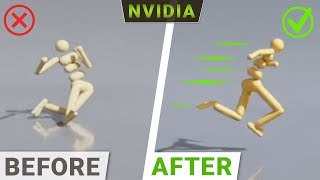
Transcript of a Two Minute Papers episode (Dr. Zsolnai) describing NVIDIA researchers training a muscle-driven simulated agent (150+ muscle-tendon units) to learn walking, jogging, and running. The narrator highlights fast learning (minutes to achieve jogging; 15–17× speedup over prior methods), discusses visualization of activated muscles, and includes a Cohere AI sponsorship and closing remarks.
Chapters
Dear fellow scholars, this is Two Minute Papers with Dr. Zsolnai. Today is going to be a really fun day where we do this and this and this. In a previous episode, we talked about creating virtual characters with a skeletal system, adding more than 300 muscles and teaching them to use these muscles to kick, jump, move around and perform other realistic human movements. You see the activated muscles with red. I am loving the idea, which turns out comes with lots of really interesting applications. For instance, this simulation realistically portrays how increasing the amount of weight to be lifted changes what muscles are being trained during a workout. These agents also learned to jump really high. And you can see a drastic difference between the movement required for a mediocre jump and an amazing one. And now, scientists at Nvidia had a crazy idea. They said, what if we take a similar model and ask it to learn to walk from scratch? Now that is indeed a crazy idea because they proposed a model that is driven by over 150 muscle tendon units and is thus very difficult to control. So let's see how it went. First, it started to. Hmm, hello. Well, a for effort, little AI but unfortunately this is not a great start. But don't despair. A little later it learned too well fall in a different direction. However, at least some learning is hopefully happening. Look, I wouldn't say that it has finally taken the first step, but at least it is attempting to take a first step. Is that good news? Let's see. Oh yes, yes it is. Because a little later it learned to jog. This concept really works. And if we wait for a bit longer, we see that it learned to run as well. Fantastic. Now let's have a closer look and see if the colors of the muscles indeed show us which ones are activated at a given moment. And that's right. When slowing the footage down, we see the difficulty of the problem. And that is different tendons need to be moved and every single moment. So while we look at this technique learning other tasks, we ask one of the most important questions here. And that is how fast did it learn to run? It had to control 150 different tendons continuously over time without falling. So how long did it take? Did it take days? And now hold on to your papers because it hasn't taken days. It only takes minutes. After starting out like this, by the 17 minute mark, it has learned so much that it could jog. How amazing is that? And that is one of the key value propositions of this paper. It can not only teach this AI agent difficult tasks, but it can also learn up to 15 to 17 times faster than previous techniques. That is absolutely amazing. Bravo. So it seems that now we have learning based algorithms that could teach even a complex muscle actuated robot to walk. What a time to be alive.
This episode has been supported by Cohere AI. Cohere builds large language models and makes them available through an API so businesses can add advanced language understanding to their system or app cor quickly. With just one line of code, you can use your own data, whether it's text from customer service requests, legal contracts or social media posts, to create your own custom models to understand text or even generate it. For instance, it can be used to automatically determine whether your messages are about your business hours, returns or shipping. Or it can be used to generate a list of possible sentences you can use for your product descriptions. Make sure to go to Cohere AI papers or click the link in the video description and give it a try today. It's super easy to use.
Thanks for watching and for your generous support and I'll see you next time.