Watch Tesla’s Self-Driving Car Learn In a Simulation! 🚘
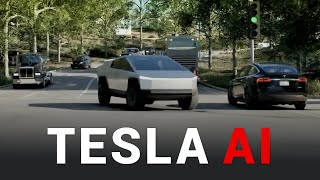
Dr. Zsolnai breaks down Tesla's self-driving approach: eight cameras feed into transformer networks that fuse the data, then spatiotemporal models predict what other cars will do. Tesla handles rare edge cases two ways: collecting real-world fleet data and training on photorealistic simulated environments to generate corner cases that almost never happen in reality.
Chapters
Dear fellow scholars, this is Two Minute Papers with Dr. Zsolnai. Today we are going to see how Tesla uses no less than a simulated game world to train their self driving cars and more. In their AI Day presentation video, they really put up a clinic of recent AI research results and how they apply them to develop self driving cars. And of course there is plenty of coverage of the event, but as always, we are going to look at it from a different angle. We are doing it paper style. Why? Because after nearly every two Minute Papers episode where we showcase an amazing paper, I get a question saying something, okay, but when do I get to see or use this in the real world? And rightfully so. That is a good question. And in this presentation you will see that these papers that you see here get transferred into real world products so fast it really makes my head spin. Let's see this effect demonstrated by looking through their system. Now first, their cars have many cameras, no depth information and just the pixels from these cameras. And one of their goals is to create this vector space view that you see here that is almost like a map or a video game version of the real roads and objects around us. That is a very difficult problem. Why is that? Because the car has many cameras. Is that a problem? Yes, kind of. I'll explain in a moment. You see, there is a bottom layer that processes the raw sensor data from the cameras mounted on the vehicle. So here in go the raw pixels and out comes more useful high level information that can be used to determine whether this clump of pixels is a car or a traffic light. Then in the upper layers, this data can be used for more specific tasks. For instance, trying to estimate where the lanes and curbs are. So what papers are used to accomplish this? Looking through the architecture diagrams, we see transformer, neural networks, BIFPNs and REGNET, all papers from the last few years. For instance, REGNET is a neural network variant that is great at extracting spatiotemporal information from the raw sensor data. And that is a paper from 2020 from just one year ago, already actively used in training self driving cars. That is unreal. Now we mentioned that having many cameras is a bit of a problem. Why is that? Isn't that supposed to be a good thing? Well look, each of the cameras only sees parts of the truck, so how do we know where exactly it is and how long it is? We need to know all this information to be able to accurately put the track into the vector space view. What we need for this is a technique that can fuse information from many Cameras together intelligently. Note that this is devilishly difficult due to each of the cameras having a different calibration, location, view, directions and other properties. So who is to tell that a point here corresponds to which point in a different camera view? And this is accomplished through. Yes, a transformer neural network. A paper from 2017. So does this multi camera technique work? Does this improve anything? Well, let's see. Oh yes, the yellow predictions here are from the previous single camera network. And as you see, unfortunately, things flicker in and out of existence. Why is that? It is because a passing car is leaving the view of one of the cameras and as it enters the view of the next one, they don't have this correspondence technique that would say where it is exactly. And look, the blue objects show the prediction of the multi camera network that can do that. And things aren't perfect, but they are significantly better than the single camera network. That is great. However, we are still not taking into consideration time. Why is that important? Let's have a look at two examples. One, if we are only looking at still images and not take into consideration how they change over time, how do we know if this car is stationary? Is it about to park somewhere or is it speeding? Also two, this car is now occluded, but we saw it a second ago, so we should know what it is up to. That sounds great. And what else can we do if our self driving system has a concept of time? Well, much like humans do, we can make predictions. These predictions can take place both in terms of mapping what is likely to come. An intersection, a roundabout and so on. But perhaps even more importantly, we can also make predictions about vehicle behavior. Let's see how that works. The green lines show how far away the next vehicle is and how fast it is going. The green line tells us the real true information about it. Do you see the green? No. That's right. It is barely visible because it is occluded by a blue line, which is the prediction of the new video network. That means that its predictions are barely off from the real velocities and distances, which is absolutely amazing. And as you see with orange, the old network that was based on single images is off by quite a bit. So now a single car can make a rough map of its environment wherever it drives. And they can also stitch the readings of multiple cars together into an even more accurate map. Putting this all together, these cars have a proper understanding of their environment. And this makes navigation much easier. Look at those crisp, temporally stable labelings. It has very little flickering still not perfect by any means, but this is remarkable progress in so little time. And we are at the point where predicting the behaviors of other vehicles and pedestrians can also lead to better decision making. But we are not done yet. Not even close. Look, the sad truth of driving is that unexpected things happen. For instance, this truck makes it very difficult for us to see. And the self driving system does not have a lot of data to deal with that. So what is a possible solution to that? There are two solutions. One is fetching more training data. One car can submit an unexpected event and request that the entire Tesla fleet sends over if they have encountered something similar. Since there are so many of these cars on the streets, tens of thousands of similar examples can be fetched from them and added to the training data to improve the entire fleet. That is mind blowing. One car encounters a difficult situation and then every car can learn from it. How cool is that? That sounds great. So what is the second solution? Not fetching more training data, but creating more training data. What? Just make stuff up? Yes, that's exactly right. And if you think that is ridiculous and are asking how could that possibly work? Well, hold on to your papers because it does work. You are looking at it right now. Yes, this is a photorealistic simulation that teaches self driving cars to handle difficult corner cases better. In the real world we can learn from things that already happened, but in a simulation we can make anything happen. This concept really works and one of my favorite examples is is OpenAI's robot hand that we have showcased earlier in this series. This also learns the rotation techniques in a simulation and it does it so well that the software can be uploaded to a real robot hand and it will work in real situations too. And now the same concept for self driving cars. Loving it. With these simulations, we can even teach these cars about cases that would otherwise be impossible or unsafe to test. For instance, in this system, the car can safely learn what it should do if it sees people and dogs running on the highway. A capable artist can also create miles and miles of these virtual locations within a day of work. This simulation technique is truly a treasure trove of data because it can also be procedurally generated. And the moment the self driving system makes an incorrect decision, a Tesla employee can immediately create an endless set of similar situations to teach it. Now. I don't know if you remember, we talked about a fantastic paper a couple months ago that looked at real world videos, then took video footage from a game and improved it to look like the real world. Convert video games to reality. If you Will, this had an interesting limitation. For instance, since the AI was trained on the beautiful lush hills of Germany and Austria, it hasn't really seen the dry hills of la. So what does it do with them? Look, it redrew the hills. The only way it saw hills exist, which is covered with trees. So what does this have to do with Tesla's self driving cars? Well, if you have been holding onto your paper so far, now squeeze that paper because they went the other way around. Yes, that's right. They take video footage of a real unexpected event where the self driving system failed, use the automatic labeler used for the vector space view, and what do they make out of it? A video game version. Holy mother of papers. And in this video game it is suddenly much easier to teach the algorithm safely. You can also make it easier, harder, replace a car with a dog or a pack of dogs and make many similar examples so that the AI can learn from these what if situations as much as possible. So there you go. Full tech transfer into a real AI system in just a year or two. So yes, the papers you see here are for real, as real as it gets. And yes, the robot is not real. Just a silly joke for now. And two more things that make all this even more mind blowing. One, remember they don't showcase the latest and greatest that they have. Just imagine that everything you heard today is old news compared to the tech they have now. And two, we have only looked at just one side of what is going on. For instance, we haven't even talked about their amazing dojo chip. And if all this comes to fruition, we will be able to travel just cheaper, more relaxed and also perhaps most importantly, safer. I can't wait. I really cannot wait. What a time to be alive. This video has been supported by weights and biases. Check out their recent offering Fully Connected. A place where they bring machine learning practitioners together to share and discuss their ideas, learn from industry leaders and and even collaborate on projects together. You see, I get messages from you fellow scholars telling me that you have been inspired by the series but don't really know where to start. And here it is. Fully Connected is a great way to learn about the fundamentals, how to reproduce experiments, get your papers accepted to a conference and more. Make sure to visit them through WNB me or just click the link in the video description. Our thanks to Weights and Biases for their long standing support and for helping us make better videos for you. Thanks for watching and for your generous support and I'll see you next time.










