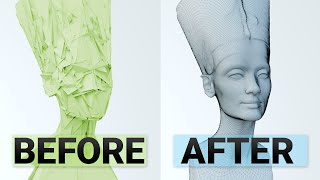
A Two Minute Papers episode (narrated by Dr. Zsolnai) explaining differentiable rendering: how photographs are matched to photorealistic material models so real materials can be placed into virtual scenes. The video compares prior material-only methods (which fail to capture geometry) with Wenzel Jakob's joint geometry+material approach, noting issues such as tangled meshes, loss of high-frequency detail, and unstable/jumpy reconstructions. The new work demonstrates improved convergence and introduces an isotropic remeshing step that recovers geometry and texture details; the clip closes with a sponsorship CTA for Cohere AI.
Questions this video answers
Dr. Zsolnai (Two Minute Papers)
Cohere AI
Chapters
Dear fellow scholars, this is Two Minute Papers with Dr. Zsolnai. Today we are going to learn how to take any shape in the real world, make a digital copy of it and place it into our virtual world. These can be done through something that we call differentiable rendering. What is that? Well, simple. We take a photograph and find a photorealistic material model that we can put in our light simulation program that matches it. What this means is that now we can essentially put this real material into a virtual world. This work did very well with materials, but it did not capture the geometry. This other work is from Wenzel Jakob's group and it jointly found the geometry and material properties. Seeing these images gradually morph into the right solution is an absolutely beautiful sight. But as you see, high frequency details were not as good. You see here, these details are gone. So where does this put us? If we need only the materials, we can do really well, but then no geometry. If we wish to get the geometry and the materials, we can use this. But we lose a lot of detail. There seems to be no way out. Is there a solution for this? Well, Vencel Jakob's amazing light transport simulation group is back with guns blazing. Let's see what they were up to. First, let's try to reproduce a 3D geometry from a bunch of triangles. Let's see. And. Ouch. Not good, right? So what is the problem here? The problem is that we have tons of CEPH intersections leading to a piece of tangled mesh geometry. This is incorrect, not what we are looking for. Now let's try to improve this by applying a step that we call regularization. This guides the potential solutions towards smoother results. Sounds good. Hoping that this will do the trick. Let's have a look together. So what do you think? Better. But there are some details that are lost. And my main issue is that the whole geometry is in fluctuation. Is that a problem? Yes, it is. Why? Because this jumpy behavior means that it has many competing solutions that it can't choose from. Essentially, the algorithm. Maybe this. Or not. Perhaps this instead. No, not this. How about this? And it just keeps going on forever. It doesn't really know what makes a good reconstruction. Now hold on to your papers and let's see how the new method does with these examples. Oh my. This converges somewhere. Which means that at the end of this process it settles on something. Finally, this one knows what good is. Fantastic. But now these geometries were not that difficult. Let's give it a real challenge. Here comes the dragon. Can it deal with that. Just look at how beautifully it grows out of this block. Yes, but look, the details are not quite there. So, are we done? That's it? No, not even close. Do not despair for a second. This new paper also proposes an isotropic remeshing step which does this on the count of 1, 2, 3. Boom. We are done. Whoa. So good. And get this, the solution is not restricted to only geometry. It also works on textures. Now, make no mistake, this feature is not super useful in its current state, but it may pave the way to even more sophisticated methods two more papers down the line. So, importing real geometry into our virtual worlds? Yes, please. This episode has been supported by Cohere AI. Cohere builds large language models and makes them available through an API so businesses can add advanced language understanding to their system or app quickly. With just one line of code, you can use your own data, whether it's text from customer service requests, legal contracts, or social media posts, to create your own custom models to understand text or even generate it. For instance, it can be used to automatically determine whether your messages are about your business hours, returns, or shipping. Or it can be used to generate a list of possible sentences you can use for your product descriptions. Make sure to go to Cohere AI papers or click the link in the video description and give it a try. Today, it's super easy to use. Thanks for watching and for your generous support, and I'll see you next time.