We Should ALL Be Worred About Boston Dynamics
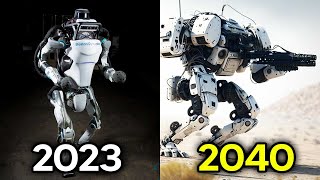
Boston Dynamics has built increasingly sophisticated robots like Spot and Atlas over two decades, culminating in Hyundai's 2022 acquisition. The company's non-AI approach differs from typical AI fears, but experts worry about job displacement, weaponization, and what happens when these machines malfunction in real workplaces.
Questions this video answers
1992.
Acquisition announced December 2020; acquisition finalized June 2022.
2019.
Designed to move over 35° inclines, pull 340 pounds, and travel at about 4 mph.
2010.
Chapters
Technology in the last few years made a significant impact on our lives. It is implemented in all industries and it is used as much as it can. In order to achieve more complex goals, people started combining artificial intelligence with the apps and machinery they have. This leads us to a certain point where it is considered for robots to replace people. The technology of the future is thought to be robots. There is a lot of work to be done with the implementation of robotics technology in the workplace. Every day, businesses are building amazing robots with increased capabilities that are also learning from their mistakes. Multitasking robots that could genuinely replace humans are still decades away. However, there are many successful robots nowadays that are the roots of change. Boston Dynamics is one of the most developed robotics companies that might become a threat. As a Massachusetts Institute of Technology spin off, Boston Dynamics is an American engineering and robotics design firm that was established in 1992. Boston Dynamics has been a part of the Hyundai Motor Group since December 2020. However, the acquisition wasn't finalized until June 2022. Big Dog, Spot, Atlas and Handle are just a few of the dynamic, highly mobile robots that Boston Dynamics has developed. Boston Dynamics Spot became the first robot to be made commercially available in 2019. The company has declared its intention to commercialize other robots as well. The goal of Boston Dynamics is to design and build extraordinary robots that improve people's lives. A significant engineering issue is to creating robotic machines that can come close to human and animal mobility, skill and agility. If you open the official Boston Dynamics website, you will find the overall explanation of the work of the company. They claim that their work on robotics is driven by their curiosity and respect for nature. They also state that they find the end result of their effort as the next stage in the development of machines to minimize the risk, repetition and physically demanding parts of work. The desire to create dynamically stable legged machines is one of the factors that distinguishes Boston Dynamics from other companies. The first person in the world to start addressing this issue was Mark Raibert. Since then, Boston Dynamics has continued with their work for almost 35 years. They have been motivated by and working towards this objective for so long. They have developed methods for making robots function that isn't found in any technical manuals or books. Boston Dynamics states they have the knowledge which is necessary to construct walking machines of any size, shape, type or power source. These unique characteristics provide the robots the ability to navigate territory that is inaccessible to others and carry out automatic activities in unpredictable situations. Before we go into more detail about their developed robots, it's interesting to mention that Boston Dynamics is recognizable for its Legged robots Many of you will ask why? As explained, Boston Dynamics focuses on the mobility and agility of its robots. They have long believed that legs were necessary for mobility because they allowed anybody to reach both the constructed and natural worlds. As a company, they started working on this goal more than 30 years ago, first in academia and later as a team at Boston Dynamics. They saw this as a fascinating technological challenge and it was necessary for them to achieve their objective of creating a highly mobile robot. Their team intended to create a robot that could move around like a human. This is important because jobs that are often referred to as dull, nasty and dangerous don't just happen on a clean factory floor. They also occur in environments that were created by humans. In these environments, being effective requires carefully navigating rocky pathways, climbs, catwalks, doorways or crowded small passages. Boston Dynamics takes inspiration for the robots from the outside world and combines that with a superb design. In order to come up with this design, the Boston Dynamics team observed balance and dynamic motion in animals. The robots can easily handle challenging, unstructured, unfamiliar or dangerous terrain. In part due to the advantages of dynamic motion. Robots on wheels and tracks are constrained by stairs, holes, obstacles on the ground like cables and staging materials, and slight height differences in the floors. Legged robots are not confronted with the same difficulties in these situations. As we mentioned, Boston Dynamics developed a few robots that can be used in different circumstances. In collaboration with Foster Miller, the Jet Propulsion Laboratory and the Harvard University Concord Field Station, Boston Dynamics developed the quadrupedal robot big dog in 2005. This is their first ever developed robot. DARPA financed this robot in hopes that it could act as a robotic pack mule to follow soldiers in areas that are too harsh for vehicles. Unfortunately, the project was canceled after Big Dog was considered too noisy to be used in war. Big Dog moved on four legs rather than wheels, enabling it to overcome obstacles that wheels couldn't handle. It was created to move over rocky terrain at a 35 degree inclination while pulling 340 pounds beside a soldier at 4 mph. It was labeled as the world's most ambitious legged robot. Little Dog is a small four legged robot created by Boston Dynamics for the DARPA study. It was released in 2010. The DARPA information Processing Technology Office is charged with financing the production of Little Dog. Little Dog, in contrast to Big Dog, is managed by Boston Dynamics and is meant to serve as a test platform for other organizations. Each of Little Dog's four legs has three electric motors to power them. The range of mobility in the legs is great. The robot is capable of climbing and moving in dynamic motion. The PC level computer handles communications, actuator control and detection. The sensors in Little Dog track, foot, ground contact, joint ankles, motor currents and body orientation. Through the Boston Dynamics Robot API, control programs can connect with the robot. Remote operation and data analysis are supported through wireless connections and data logging. However, lithium polymer batteries provide continuous use for 30 minutes without recharging. This makes this robot a bit limited when it comes to working hours. The Cheetah is a four legged robot that can run at 28 miles per hour, setting a land speed record for robots with legs. As of August 2012, the biometric robots Lab at MIT created a comparable but independently created robot known as cheetah that by 2014 was able to jump over obstacles while sprinting. The robot could climb stairs by 2018. A bipedal robot called Petman Protection and Symbol Test Mannequin was created for testing chemical protective gear. It is the first dynamically moving humanoid robot to resemble a person. Alphadog, often referred to as Legged Squad Support System, is a militarized version of Big Dog. It is built to be strong for military use and it can function in hot, cold air, damp and dirty conditions. The goal of LS3 is to combine a pack mule's skills with a trained animal's intellect. LS3 can respond to verbal or visual orders and navigate through terrain using an onboard GPS system and computer vision. Soldiers in the field found it challenging to interact with this bot because it would mistakenly carry out commands that were not given to it because of its capacity to track spoken commands. Based on Boston Dynamics earlier Petman Humanoid Robot the agile anthropomorphic robot Atlas is a five foot bipedal humanoid robot that is developed for some research and rescue operations. The Next Generation is a YouTube clip that Boston Dynamics posted in February 2016. The robot is seen in the video completing a number of activities that the earlier humanoid robots would have found challenging or impossible, but it didn't stop there. The robot is seen effortlessly sprinting up two foot high steps onto a platform in the video Parkour Atlas, which which was uploaded to the Boston Dynamics channel on YouTube in 2018. In a more parkour YouTube video from September 2019, Atlas is shown performing even better skills. One of the most popular Boston Dynamics robots is the spot. The four legged dog inspired spot weighs only 55 pounds and is lighter than Boston Dynamics other products. It was launched in 2016. The spot is Boston Dynamics quietest robot so far. An interesting video of the Spot opening a door for another robot in November 2017 received over 2 million views and made a boom. In a video taken that same month, Spot continued trying to unlock the door without human involvement. Later that year, according to the company's plans, the first 100 spots should have been developed and sold. Journalists were informed in September 2019 that the robots were going to be leased to certain business partners rather than soldiers. The Spot was first used as a robot police officer and in the bomb squad of the Massachusetts State police unit in November 2019. Later, it was even given for sale. A research robot called Handle has two movable wheels for legs and two hands for moving and carrying objects. It can speed at 9 mph and jump 4ft in the air. It has a battery life of roughly 15 miles and uses electricity to power a variety of electric and hydraulic actuators with only approximately 10 actuated joints. Handle is substantially less complicated than Boston Dynamics other robots. However, this doesn't stop it from utilizing the same Dynamics. Another essential development is the Stretch robot. Boston Dynamics unveiled the Stretch robot for warehousing operations. The robot was launched in 2021 and it was announced via YouTube video. The device's suction cup array allowed it to lift things weighing up to £50. Pick is a robot like Stretch, but it's fixed in one place. It is made to move boxes. It takes less than a second to recognize a box. The machine automatically throws out the cardboard sheet. In 2021, the factory safety Service robot was released. It was the company's first joint venture with the Hyundai Motor Group. The robot is based on the current robot spot from Boston Dynamics. Its integrated thermal camera and 3D lidar technology assists in monitoring fire threats, detecting open and closed doors, and detecting individuals nearby. All of these robots have significant advantages in everyday work and tasks. However, it is clear they progress pretty quickly. Can maybe this be a risk to society? As we are all aware, robots are becoming part of our lives. They are present everywhere and in every industry. But besides the help we get from them, like reaching areas that are unapproachable, there are some threats to humanity. Boston Dynamics claims that the robots are only used for improving our tasks and for easily reaching our goals. But can they guarantee that these robots won't turn on us? One of the most popular topics nowadays is artificial intelligence. This AI is based on huge amounts of data inserted into robots so they can finish tasks. However, this is not the case with Boston Dynamics robots. In contrast to AI based robots, Boston Dynamics still need to get in order to do something. They don't operate on their own and they don't think independently. Some of the biggest fears of advanced robots are job automation and automatic weapons. Many firms have already begun to implement change, particularly for employees who do repeating and scheduled tasks. Here we're talking about positions in the hotel industry, warehouse labor market analysis and many more fields. Fewer people will be needed to perform the same tasks as robots become more intelligent and skilled. Jobs requiring advanced degrees and post college education are at risk from machines in terms of the automation of weapons. People fear that Boston Dynamics may implement weapons as some of their robots are developed in order to aid the military. Boston Dynamics claims that this won't happen. Their robots are not created expressly for military or government missions. Their team will not approve or collaborate with people who want to use their robots as weapons or autonomous aiming systems. This is stated in their ethical principles, as specifically stated in their terms and conditions of sale. Weaponizing the robots is forbidden. All buyers are restricted from such use. If one of Boston Dynamics products is being misused to cause harm, the company promises that it will take the necessary steps to prevent it. However, this is only one thing that Boston Dynamics promises due to the rapid progress of robots and newer models. As mentioned previously, it is more than sure that advanced robots will not only bring jobs to the verge of extinction, but they could even make bigger harm to society. What we're trying to say is that if these robots come to a point where they feel much more powerful than us, they might tend to destroy our species. For example, Boston Dynamics robot Spot is being used instead of police officers in order to be sent into more dangerous situations. However, if a newer version of this robot is launched, it may result in officers losing their jobs and robots feeling superior. But since we are all still far from this scenario, we should have a look at something more common and realistic. Since many years ago, factories and other workplaces have employed robots extremely effectively to improve processes, make them more cost and time effective, and in many cases safer. Since the Industrial Revolution, we have been creating ever sophisticated machines to increase production and do monotonous, unpleasant and occasionally dangerous activities. However, the range of situations in which machines or robots can be useful is continuously growing. This is demonstrated by the employment of robots in difficult surgery. For example, in the nhs, the precision advantage of robotic surgery over traditional surgery is currently widely established. The potential risk that robots could pose to their co workers should not be ignored. If we consider how fast technology advances, robots and people will work together much more closely. As a result of this trend toward merging work environments, businesses must conduct thorough risk analysis to secure their employees and themselves both legally and financially. An unfortunate example of robot Malfunction is the death of Robert Williams. Williams entered the area where the robot was working since it wasn't working properly. In one moment, the robot arm swung and struck him in the head and he died immediately. Ford was not held responsible for the employee's death. It appears quite simple at first glance. The the robot is a product. Therefore, if it causes an issue, either the product or the operator is to blame. The robot has been developed, tested and programmed to carry out a certain task. Who would be guilty if it failed to work and injured someone if the manufacturer's instructions and safety recommendations were followed? This is still an unclear area of law. The function and constraints of the robot must be well defined. Also, the robotic software must go through multiple thorough tests. Both the software and mechanical engineers must agree and approve these in the case of an issue, this can assist in locating the issue. Businesses must guarantee that the proper health and safety protocols are followed. This can involve giving an appropriate training and supervision when operating machines. Another security measure can be installing cages and barriers to secure workers. Businesses are less likely to be held responsible for employee injuries if the proper safety measures are in place. If you remember, we mentioned that LS3 could sometimes misunderstand whether a command is given to it or whether you're just speaking with your colleague. This is pretty much a big problem that can cause serious consequences in some situations. So to avoid all of this and all unwanted scenarios, business owners are encouraged to only utilize robots for the purposes of which they are intended to always go by the manufacturer's instructions, to make sure all employees are properly trained and to impose stricter safety regulations. Boston Dynamics is probably one of the top robot companies with the most progressed robots. That's why people are getting worried. Some of their biggest worries are job automation, automatic weapons, the security of the employees, and even destroying the human race. We are not surprised that people think robots can even affect our whole humanity as there are many interviews with human like robots that state how they want to destroy us. Luckily, this has not been the case so far with Boston Dynamics. This company claims that they take care of their robots, but that they won't allow their robots to use weapons and that their goal is not to replace an employee with a worker. Instead, they launch their robots in order to help people finish tasks in some areas that they can't even reach. What's more, their robots aren't even AI based, one of the most feared technologies nowadays. Due to this, people might relax a bit. But still, can you fully trust machines that act like humans? Even if everything is perfectly well regulated, they there is still a possibility for these robots to turn on us. But if we look from another point of view, can Boston Dynamics be threatened by AI based robots? If Boston Dynamics only uses its robots for higher effectiveness and job accomplishments, maybe the more advanced robots will destroy them. Or maybe they will have a significant impact on Boston Dynamics robots, so they will have to implement artificial intelligence in the machines. Although all of this sounds just like one unrealistic scenario, it may become pretty much true in the next decades. Technology and robotics are improving as days go by, so why shouldn't we consider these facts? It's better if we are ready for everything than be unprepared.










