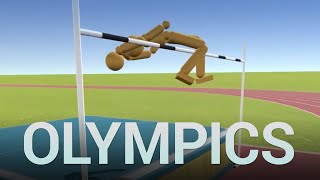
AI agents trained in physics simulations learn to high jump, cartwheel, and backflip by themselves, rediscovering human techniques like the Fosbury flop. The algorithm explores what happens with injuries or on Mars, and outperforms motion-capture models that never saw high-jump examples.
Chapters
Dear fellow scholars, this is Two Minute Papers with Dr. Zsolnai. Today it is possible to teach virtual characters to perform highly dynamic motions like a cartwheel or backflips. And not only that, but we can teach an AI to perform this differently from other characters. To do it with style, if you will. But today we are not looking to be stylish. Today we are looking to be efficient. In this paper, researchers placed an AI in a physics simulation and asked it to control a virtual character and gave it one to jump as high as it can. And when I heard this idea, I was elated and immediately wondered. Did it come up with popular techniques that exist in the real world? Well, let's see. Yes. Woohoo. That is indeed a Fosbury flop. This allows the athlete to jump backwards over the bar, thus lowering their center of gravity. Even today, this is the prevalent technique in high jump competitions. With this technique, the takeoff takes place relatively late. The only problem is that the AI didn't clear the bar so far, so. So can it. Well, this is a learning based algorithm, so with a little more practice it should improve. Yes, great work. If we lower the bar just a tiny bit for this virtual athlete, we can also observe it performing the Western roll. With this technique, we take off a little earlier and we don't jump backward, but sideways. If it had nothing else, this would already be a great paper. But we are not nearly done yet. The best is yet to come. This is a simulation, a virtual world, if you will. And here we make all the rules. So the limit is only our imagination. The authors know that very well and you will see that they indeed have a very vivid imagination. For instance, we can also simulate a jump with a weak takeoff lag. And see that with this condition, the little AI can only clear a bar that is approximately one foot lower than its previous record. What about another virtual athlete with an inflexible spine? It can jump approximately 2ft lower. Here's the difference compared to the original. I am enjoying this a great deal and it's only getting better. Next, what happens if we are injured and have a cast on the takeoff knee? What results can we expect? Something like this? We can jump a little more than two feet lower. What about organizing the Olympics on Mars? What would that look like? What would the world record be with the weaker gravity there? Well, hold on to your papers and look. Yes, we could jump three feet higher than on Earth and then. Ouch. Well, missed the foam matting, but otherwise very impressive. And if we are already there, why limit the simulation to high jumps, why not try something else again? In a simulation we can do anything. Previously the task was to jump over the bar, but we can also recreate the simulation to include instead jumping through obstacles. To get all of these magical results, the authors propose a step they call Bayesian Diversity Search. This helps systematically creating a rich selection of novel strategies, and it does this efficiently. The authors also went the extra mile and included a comparison to motion capture footage performed by a real athlete. But note that the AAS version uses a similar technique and is able to clear a significantly higher bar without ever seeing a high jump move. The method was trained on motion capture footage to get used to human like movements like walking, running and kicks, but it has never seen any high jump techniques before. Wow. So if this can invent high jumping techniques that took decades for humans to invent, I wonder what else could it invent? What do you think? Let me know in the comments below. What a time to be alive. This episode has been supported by Lambda GPU Cloud. If you're looking for inexpensive cloud GPUs for AI, check, check out Lambda GPU Cloud. They've recently launched Quadro RTX 6000, RTX 8000 and V100 instances. And hold on to your papers because Lambda GPU Cloud can cost less than half of AWS and Azure. Plus Our thanks to Lambda for their long standing support and for helping us make better videos for you. Thanks for watching and for your generous support and I'll see you next time.