Wow, A Simulation That Looks Like Reality! 🤯
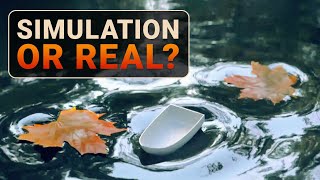
Dr. Zsolnai breaks down recent computer graphics research on fast fluid simulations that look photorealistic. New techniques using spatial adaptivity and surface-only liquid models are closing the gap between graphics shortcuts and rigorous computational fluid dynamics, making it possible to render complex water behavior in real time.
Questions this video answers
2022-10-09.
Nature Physics (short comment article).
100 instances for $1.10 per hour versus $4.10 per hour (73% savings).
Chapters
Dear fellow scholars, this is two minute papers with Dr. Zsolnai. I am so happy to tell you that today my dream came true. I can't believe it. So what happened? Well, I am going to show you my new paper that just came out. This is a short comment article published in Nature Physics where I had the opportunity to be a bit of an ambassador for the computer graphics research community. You see, this is a small field, but it has so many absolutely amazing papers. I am really honored for the opportunity to show them to the entire world. So let's marvel together today as you will see some amazing papers throughout this video. For instance, what about this one? What are we seeing here? Yes, what you see here is a physics simulation from a previous technique that is so detailed it is almost indistinguishable from reality. So what you are seeing here should be absolutely impossible. Why is that? Well, to find out, we are going to look at two different branches of fluid simulations. Scientists who work in the area of computational fluid dynamics have been able to write such simulations for more than 60 years now. And these are the really rigorous simulations that can accurately tell how nature works in hypothetical situations. This is super useful for instance for wind tunnel tests, for cars testing, different aircraft and turbine designs, and more. However, these simulations can easily take from days to weeks to compute. Now here is the other branch. Yes, that is computer graphics. What is the goal for computer graphics simulation research? Well, the goal is exactly what you see here. Yes, for us graphics people a simulation does not need to be perfect. The goal is to create a simulation that is good enough to fool the human eye. These are excellent for feature length movies, virtual worlds, quick visualizations and more. And here is the best part in return. Most computer graphics techniques don't run from days to weeks. They run in a few minutes to a few hours at most. So computational fluid, slow but rigorous computer graphics, fast but approximate. These are two completely different benches. Now of course, any self respecting scholar would now ask ok, but Karoj, how do you optimize an algorithm that took weeks to run to now run in a matter of minutes? Well, here are two amazing ideas to perform. That one is spatial adaptivity. What does that do? Well, it does this. Oh yes. It allocates most of our computational resources to regions where the real action happens. You see these more turbulent regions with dark blue? The orange or yellow parts indicate calmer regions where we can get away with less computation. You see, this is an approximate model, but a really good one which speeds up the computation a great deal at a typically small Cost. That's the hallmark of a good computer graphics paper. 2. In my opinion, this is is one of the most beautiful papers in all of computer graphics. Surface only liquids Legendary work. Here we lean on the observation that most of the interesting detail in a fluid simulation is visible on the surface of the liquids. So why not concentrate on that? Now of course this is easier said than done and this work really pulled it off. But we are not stopping here. We can also use this amazing paper to add realistic bubbles to a simulation. And you will see in a moment that it greatly enhances the realism of these videos. Look at that. I absolutely love it. If the video ends here, it is because I cannot stop looking at and running these simulations. Ok, it took a while, but I am back. I have recovered. So the key to this work is that it does not do the full surface tension calculations that are typically required for simulating bubbles. No, no, that would be prohibitively expensive. It just says that, look, bubbles typically appear in regions where air gets trapped by the fluid. And it also proposes an algorithm to find these regions. And the algorithm is so simple I could not believe my eyes. I thought that this was some kind of a prank. And it turns out we only need to look at the curvature of the fluid and only nearby, which is really cheap, simple and fast. And it really works. I can't believe it. Once again, this is an approximate solution, not the real deal. But it is extremely simple and fast and. And it can even be added as a post processing step to a simulation that is already finished without the bubbles. How cool is that? Loving it. Now wait, we just said that surface tension computations are out of reach. That just costs too much. Or does it? Here is an incredible graphics paper from last year that does just that. So what is all this surface tension thing good for? Well, for instance, it can simulate this paperclip floating on water. That is quite remarkable because the density of the paperclip is eight times as much as the water itself and yet it still sits on top of the water. We can also drop a bunch of cherries into water and milk and get these beautiful simulations. Yes, these are not real videos. These are all simulated on a computer. Can you tell the difference? I'd love to know. Let me know in the comments below. And get this. For simpler scenes, we only need to wait for a few seconds for each frame. That is insanity. I told you that there are some magical works within computer graphics. I am so happy for the opportunity to share them with you. However, wait a second. Remember we said that these graphics Works are fast and approximate. But is this really true? Can they really hold the candle to these rigorous computational fluid dynamics simulations that are super accurate but take so long? That is impossible, right? A quick simulation on our home computer cannot possibly tell us anything new about aircraft designs, can it? Well, hold on to your papers, because it can. And it not only can, but you are already looking at it. This is a devilishly difficult test. A real aerodynamic simulation in a wind tunnel. In these cases, getting really accurate results is critical. For instance, here we would like to see that if we were to add a spoiler to this car, how much of an aerodynamic advantage we would get in return. Here are the results from the real wind tunnel test. And now let's see how the new method compares. Wow. Goodness. It is not perfect by any means, but seems accurate enough that we can see the wake flow of the car clearly enough so that we can make an informed decision on that spoiler. Yes, this and even more is possible with computer graphics algorithms. These approximate solutions became so accurate and so fast that we are seeing these two seemingly completely different branches, computational fluid dynamics and computer graphics, getting closer and closer to each other. Even just a couple years ago, I did not dare to think that this would ever be possible. And yet these fast and predictive simulations are within arm's reach. And just a couple more papers down the line and we might be able to enter a world where an engineer is able to test new ideas in aircraft design every few minutes. What a time to be alive. So all this came about because I am worried that as the field of computer graphics is so small, there are some true gems out there and if we don't talk about these works, I am afraid that almost no one will. And this is why two Minute papers and this paper came into existence. And I am so happy to have a common paper accepted to Nature Physics and now to be able to show it to you. By the way, the paper is a quick read and you can read it for free through the link in the video. Description I think we are getting so close to real life like simulations. Everyone has to hear about it. So cool. If you wish to help me spread the word about these incredible works, please consider sharing this with your friends and tweeting about it. I would also like to send a big thank you for this amazing opportunity to write this paper and to Christopher Batty who sent super useful comments. So what do you think? What would you use these techniques for? Let me know in the comments below. If you're looking for inexpensive cloud GPUs for AI. Lambda now offers the best prices in the world for GPU Cloud Compute. No commitments or negotiation required. Just sign up and launch an instance. And hold on to your papers. Because with Lambda GPU Cloud you can get all on demand a 100 instances for $1.10 per hour versus $4.10 per hour with AWS. That's 73% savings. Did I mention they also offer persistent storage? So join researchers at organizations like Apple, MIT, and Caltech in using Lambda Cloud instances, workstations or servers. Make sure to go to lambdalabs.compapers to sign up for one of their amazing GPU instances today. Thanks for watching and for your generous support, and I'll see you next time.










