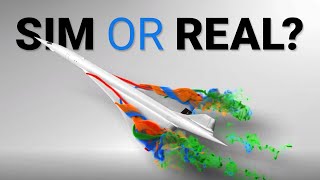
Researchers created a fluid simulation for thin shells like leaves and aircraft that matches real wind-tunnel results. An airplane simulation runs in about 60 minutes, a major speedup over previous methods, with practical applications for engineering design.
Questions this video answers
January 27, 2022
60 minutes
Quadro RTX 6000, RTX 8000, V100
48gb RTX 8000
lambdalabs.compapers
Dear fellow scholars, this is Two Minute.
Papers with Dr. Zsolnai. Today we are going to look at an incredible new paper where we are going to simulate flows around thin shells rods the wind blowing at leaves airflow through a city. And get this, we will produce spiral vortices around an aircraft and even perform some wind tunnel simulations. Now, many of our previous videos are about real time fluid simulation methods that are often used in computer games and others that run for a long time and are typically used in feature length movies. But not this. This work is not for that. This new paper can simulate difficult coupling effects, which means that it can deal with the movement of air currents around this thin shell.
We can also take a hairbrush without.
Bristles and and have an interesting simulation. Or even better, add tiny bristles to its geometry and see how much more of a turbulent flow it creates. I already love this paper. So good. Now onwards to more serious applications. So why simulate thin shells? What is all this useful for? Well, of course, simulating wind turbines. That is an excellent application. We are getting there. Hmm, talking about thin shells, what else? Of course, aircraft. Now hold on to your papers and marvel at these beautiful spiral vortices that this simulator can create. So is this all for show or is this what would really happen in reality? We will take a closer look at that in a moment. With that. Yes, the authors claim that this is much more accurate than previous methods in its class. Well then let's give it a devilishly difficult test. A real aerodynamic simulation in a wind tunnel. In these cases, getting really accurate results is critical. For instance, here we would like to see that if we were to add a spoiler to this car, how much of an aerodynamic advantage we would get in return. Here are the results from the real wind tunnel test. And now hold on to your papers and let's see how the new method compares.
Wow.
Goodness. It is not perfect by any means, but seems accurate enough that we can see the wake flow of the car clearly enough so that we can make a decision on that spoiler. You know what, let's keep it. So we compared the simulation against reality. Now let's compare a simulation against another simulation. So against a previous method. Yes, the new one is significantly more accurate than its predecessor. Why? Because the previous one introduces significant boundary layer separations at the top of the car. The new one says that this is what will happen in reality. So how do we know? Of course we check. Yes, that is indeed right. Absolutely amazing. And note that this work appeared just about a year ago. So much improvement in so Little time. The pace of progress in computer graphics research is out of this world. Ok, so it is accurate, really accurate. But we already have accurate algorithms. So how fast is it? Well, the proper aerodynamic simulations take from days to weeks to compute, but this airplane simulation took only minutes. How many minutes? 60 minutes to be exact. Wow. And within these 60 minutes, the same spiral vortices show up as the ones in the real wind tunnel tests. So good. But really, how can this be so fast? How is this even possible? The key to doing all this faster is that the new proposed method is massively parallel. This means that it can slice up one big computing task into many small ones that can be taken care of independently. And as a result, it takes advantage of our graphics cards and can squeeze every drop of performance out of it. That is very challenging for an algorithm of this complexity. Of course, the final simulation should still be done with the old tools, just to make sure. However, this new method will be able to help engineers quickly iterate on early ideas and only commit to week long simulations when absolutely necessary. So we can go from idea to conclusions in a matter of an hour, not in a matter of a week. This will be an amazing time saver so the engineers can try more designs. Testing more ideas leads to more knowledge. That leads to better vehicles, better wind turbines. Loving it. And all this improvement in just one year. If I didn't see this with my own eyes, I could not believe this. What a time to be alive.
This episode has been supported by lambda GPU cloud. It if you're looking for inexpensive cloud GPUs for AI, check out Lamda GPU Cloud. They've recently launched Quadro RTX 6000, RTX 8000 and V100 instances. And hold on to your papers because Lambda GPU Cloud can cost less than half of AWS and Azure plus they are the only cloud service with 48gb RTX 8000. Join researchers at organizations like Apple, MIT and Caltech in using Lambda Cloud instances, workstations or servers. Make sure to go to lambdalabs.compapers to sign up for one of their amazing GPU instances today. Our thanks to Lambda for their long standing support and for helping us make better videos for you.
Thanks for watching and for your generous support and I'll see you next time.