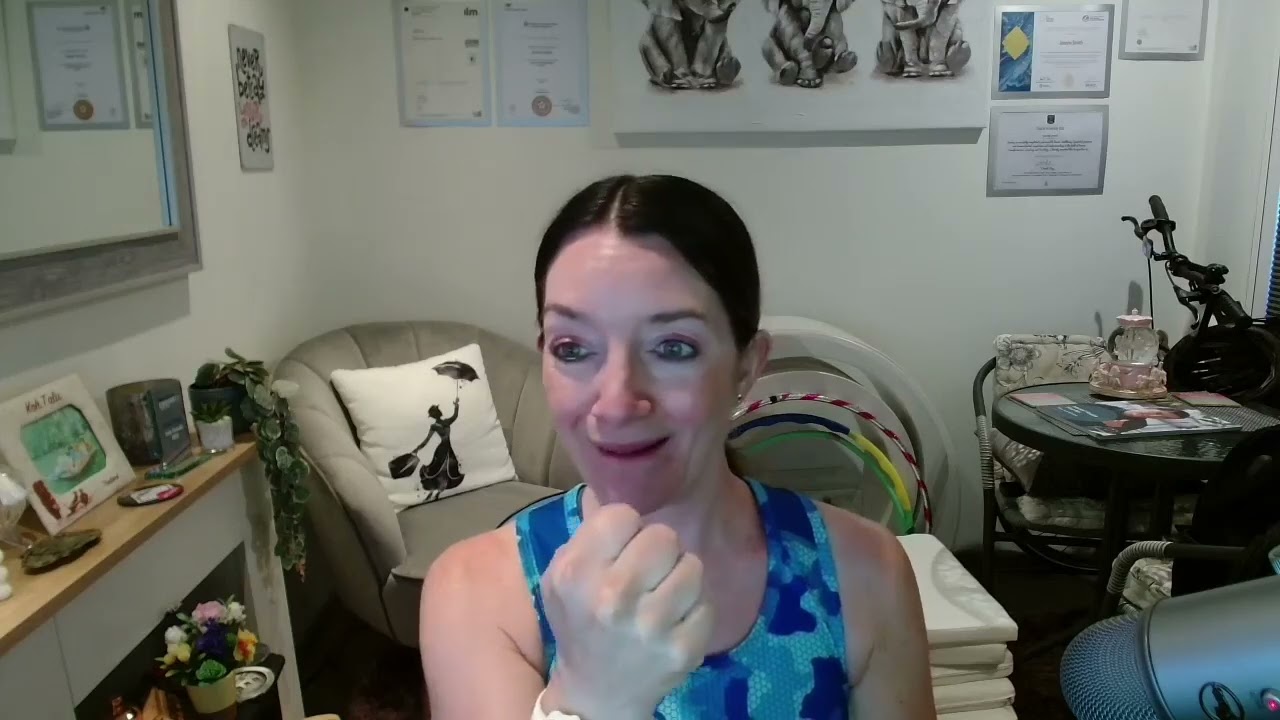
Joanne Smith explains why recovery from chronic pain and fatigue feels stuck even when you're doing everything right. She uses a clenched-fist metaphor to show how tension and overthinking amplify symptoms, and argues that relaxing and reframing stress, starting with breathing, can shift what's possible.
Chapters
Hi there, everybody. Welcome to Bend and Snap Active People Getting Back on Track. Sorry about the couple of minutes delay there. I um, I went into a little bit of a relaxed state there, and I just looked down at the clock and I was like, whoops, I've not gone live yet. So. Apologies for that, but here I am, and today I'm going to be talking to you about why can recovery be, for many people who will probably relate to this, say, why can it be so challenging? Why can it be so difficult, tough, whatever it might be? A lot of people say that it's not easy, but it is possible. So I want to talk to that for today because, I mean, I've got plenty of experience in this department to be sharing that hopefully will be helpful for some of you lovely people in this group. So I'm hoping that my journey can help others to find it a lot less challenging. That's the hope. And I hope you're all enjoying the sun in England because we're having some beautiful weather. We've had a really nice bank holiday weekend. I was away in Blackpool just overnight, just last night. We went yesterday morning, stayed overnight, and then came back this morning after breakfast. Didn't get much sleep last night. Wherever we stayed, we stayed on a really noisy street, loud street, and we had the windows open all night, so it was so noisy. But anyway, We had fun. We had a good, a good day out, and we had a nice time and went on the beach, um, and that was really nice. Outlots had some really nice donuts. I really enjoyed them donuts. I had Biscoff donuts, and they were worth every minute. Really enjoyed them. So I hope you've all had a great weekend too, and I'm gonna get right into the session now. Sorry about not applying— replying, not applying. I'll blame that on, on the lack of sleep. Sorry about not replying to any comments. I'll keep a little eye and hopefully they'll start working because they're not always very efficient on Facebook Lives. So here we go then. I'm going to talk about a subject that comes up a lot with people that I work with, people that I work with behind the scenes, clients that I coach, It's just that frustration about how difficult it can be when you feel like you're completely stuck in chronic, chronic symptoms, chronic, chronic issues, whatever it might be, whether it's fatigue, whether it's pain, whether it's symptoms. It talks to all of that stuff because it can feel really tough. It can feel like you're Doing all the things that have been recommended that make sense to do, and then it can feel like just not making any progress sometimes despite doing those things. And it's like a lot of people get frustrated because they're like, when, when is it going to start to help? Even though I've been doing this for however long it might be, when will it start to help? So it can get really hard. So I'll just start with, like, maybe some of the common expectations that— I'm just gonna get a little comfy on my seat— some of the common expectations that people may have going into this kind of approach. Like, I'm gonna just set a little scene here because Let's say, for example, you know you've been checked out medically, nothing structural has been found, all the physical structural cause has been ruled out, so you've been given the go-ahead, you've been given the all-clear, or you could be like me and you've been given the go-ahead to go out there and get on with your life, do the best you can. You've been told that you've got a diagnosis that is incurable. So for me, that was fibromyalgia. I was diagnosed, I was told just go do the best you can because you're never going to get well, there is no known cure. So that's another scenario. So Either way, medicine didn't have an answer or a solution. They may be able to help with certain things just to ease, ease the symptoms, you know, here's a medication that you can try for some pain relief or whatever it might be, but you've gone away and you found out about this approach which is becoming more and more and more mainstream, and this is the approach to Getting well from chronic pain and chronic symptoms using mind-body as an explanation, and you've kind of got a little bit of background knowledge, so you've kind of done your research and you know that this stuff is for you, and you've started to implement the approach that's been recommended, and you're doing all the things, you're following the You know, all the things that I talk about every single week here, and still no change, nothing's happening. I'm hoping that everything's working here because it's saying that I'm frozen, so I'll just keep talking and hopefully we're going to be okay and it's not going to be too bad because I'm plugged in with a wire, so the Wi-Fi should be good. So please comment in the chat if there are any technical issues. Um, I'm just refreshing that just to make sure. Okay, I'm gonna keep going. Um, so yeah, you're doing all the things and it can be frustrating. And it can feel really deflating when nothing's changing. So this is why I really wanted to talk today about why it's not uncommon, it's not an uncommon thing, and it doesn't mean that it's not working, it doesn't mean that you're failing if you're not seeing a change. In the physical pain or the symptoms, it still doesn't mean that you're broken. It doesn't mean that you are a different kind of broken or that your body is beyond repair. Struggling doesn't mean that you can't still recover, okay? So just relax in knowing that. Just take a few nice breaths. But Breathing, the most beautiful, beautiful thing ever that we can do. So let's just dive in here really, and I'll just keep talking to this a little bit more, because if we're in that situation where we're trying so desperately to get well, but actually what's happening is we're living in a Feeling of tension, pressure. A good way to describe it is like this fist, you know, squeezing like this. How long can you hold that before it starts to get tired? And how long can you hold this before it starts to get tired? How can— how long can you hold that? Just an example, but if you're living in this pressure, this urgency, this fear, this Overthinking, think, think, think, you know, this busy mind, busy mind. I've got to get my snow globe for this one. Look at the snow, that's the busy mind. So if you're living like that and feeling really stuck, well, what happens is everything gets even more amplified, louder and louder and louder, you know, everything. goes so high, the volume is on 10 times, if not more. So it can make recovering really, really difficult. And it might not even just be the symptom itself, it's just all the chaos.