America Just KILLED China's Tech Industry
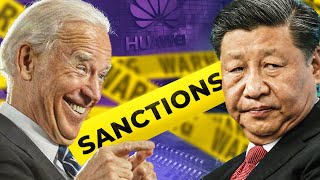
John Coogan argues US export controls on semiconductors, AI chips, and telecom gear have launched economic war on China. The US spent $52 billion on the CHIPS Act to rebuild domestic manufacturing, while restricting Nvidia's most advanced GPUs to force China to develop its own tech.
Questions this video answers
$52 billion
About 37% in 1990, declining to around 10% (by the period discussed).
The A100 and the upcoming H100 series.
October 7, 2022.
About $120 million each.
America and China are officially at war, at least economically speaking. For the last few decades, China has been waging a covert economic war through state sponsored hacking, corporate espionage and market restrictions. The United States is now responding with a huge set of policies aimed at keeping China out of the market for semiconductors, telecommunications equipment, optics and artificial intelligence. It's a complex situation, but the consequences of this will be absolutely massive.
Are relations between the two biggest powers in the world, China and the United States, on an unstoppable collision course? We want to break the historical cycle that a rising power and a ruling power usually resolves in conflict. Strategic partners, strategic competitors, or strategic enemies. And what does it mean to you, to me, and to the rest of the world? China is certainly a rising superpower that wants to take the United States place in the world. They've said that openly.
Throughout the second half of the 20th century, the United States played a critical role in helping the Chinese government build a booming economy, develop advanced scientific technologies and become a global superpower. The common belief among US Leaders was that China's rise would lead to cooperation, diplomacy and free trade. But China had another plan in mind. The China dream was less about cooperation and more about replacing America as the world's dominant superpower. Just as America had replaced the British Empire, China was planning to leapfrog America, all without firing a single shot. The China plan was simple. Leverage, low cost labor to develop a booming manufacturing sector, all while importing complex technology to build up future industries. And this plan was working at least until an American national security advisor named Michael Pillsbury started popularizing the idea that an economic war with China was inevitable. Economics and trade issue gets mixed together with the chances of war and are improving Taiwan's deterrence status, then it's going to cause an overall deterioration in our relations with China that's going to affect the market, I'm afraid. His writings served as the foundation for Donald Trump's plan to get tough on China. And they continue to influence the Biden administration's China policy today. Back in 2019, Trump signed an executive order that blocked Chinese telecommunication companies like Huawei from selling equipment in the United States. Huawei was just the first step, and this ban was relatively easy to implement. The company was added to what's called the entity list, which catalogs people and companies supporting or engaging in terror acts. Now, no one was saying that Huawei, or which is best known for making smartphones, was building bombs or anything like that. It was a little more complicated. See, the list includes anyone who helps enhance the military capabilities of governments that have repeatedly supported international terrorism. And the US Government determined that Huawei's relationship with Iran fit this description. This was just the official justification, though. Most analysts didn't believe that Huawei was a current and present danger to the United States. So I don't think that there's a widespread consensus across the technology industry that Huawei represents a significant enough national security threat. The ban was more about what could happen in the future. Huawei was grabbing huge market share in telecommunications equipment. Before the ban, it was estimated that they would wind up controlling over 60% of the 5G market. This alone wouldn't have been that big of a deal. But then the US Government found backdoors in Huawei's hardware that would allow China to access worldwide Internet traffic. Huawei has deep ties to the Chinese military and isn't subject to any American privacy rules. When the FBI demanded that Apple help them unlock iPhones, Apple refused. Can the government compel Apple to write software that we believe would make hundreds of millions of customers vulnerable around the world, including the US In China, that's not an option. If Huawei was allowed to deploy 5G towers around the world, China would have an unstoppable global surveillance system. So the US Government added Huawei to the entity list and banned them from selling 5G hardware to American allies. The ban also restricted Huawei's ability to buy supplies from factories that use U.S. tools and software. This kind of economic warfare would only heat up in the years to come. Trump had set the stage for a confrontation, but no one was sure if Biden would continue the aggressive stance. After all, the media narrative during the 2020 election insisted that Trump and Biden couldn't be more different.
Would you listen? First of all, I guess I'm debating you, not him. But that's okay. I'm not surprised. The fact is that everything he's saying so far is simply a lie. I'm not here to call out his lies. Everybody knows he's a liar but you. I just want to make sure. I want to make sure. You ordered last in your class. First in your class.
Watching news coverage made it seem like they disagreed on every single issue. But here's the weird thing. When Biden took office in 2021, he didn't change course on China. Dealing with increased US China competition had become a bipartisan issue. So Biden doubled down. First, he passed the Chips act, which set aside $52 billion in grants and incentives for U.S. semiconductor manufacturing. This was a big deal because it was the first time that The US Government had publicly acknowledged that America was falling behind. America's share of global semiconductor manufacturing had fallen from 37% in 1990, down to barely 10%. Manufacturing semiconductor chips is critical to enabling the development of future technologies. But America was struggling for three key reasons. First, investment in semiconductor startups had fallen significantly. American venture capitalists had been focused on chasing software companies that didn't need as much money to scale. Instagram raised less than 60 million before selling to Facebook for a billion. WhatsApp also needed just $60 million in funding, and they sold for $16 billion. Semiconductor startups need a lot more money up front, and it's also a lot riskier. That risk led to America falling behind both in the number of semiconductor startups getting funded and the amount of money getting invested into them. Alone, this wouldn't be such a problem. But it wasn't just American startups that were struggling. Large manufacturers weren't investing in the United States anymore. This was because while other countries were subsidizing chip manufacturing, the United States government was actually penalizing it. Overregulation had led to long lead times to start new projects, with approvals taking years. Instead of offering tax incentives to chip companies, most of these new projects were penalized by the government for even trying to build. This led to factor number two, declining investment in semiconductor equipment in the United States. Lastly, even if the investment had been there to support these projects, the talent just wasn't. The United States is falling behind in STEM graduates. And for the past two decades, the best jobs for engineers were all in software. Why go work a hard job in a struggling semiconductor factory when you could have a cushy job optimizing ads at one of the big tech companies? America hasn't been producing enough engineers. And the problem gets even worse. Two thirds of STEM PhD students in the United States are foreigners. They want to stay after graduation, but they can't because of restrictive immigration policies. So the first step in turning the ship around was just to throw money at the problem. And that's exactly what the CHIPS act did. But reinvigorating a dying industry is no easy task. Two of the biggest semiconductor manufacturers, intel and tsmc, both have access to the same equipment. But only TSMC can make the best chips profitably at scale. Understanding the evolution of these two companies over the past few decades is is crucial if we want to predict what will happen between the US And China. Both intel and TSMC are semiconductor manufacturers, but their approaches couldn't be more different. Intel is integrated, meaning they both design and manufacture Chips. This is why you'll see ads and product reviews for intel branded CPUs all over the place. They make the chips, but they also sell them directly to consumers under the intel brand. You'll never see Linus tech tips reviewing a TSMC branded processor. That though that's because TSMC is a pure play foundry and has pursued a modular approach. They make the chips in iPhones, Nvidia, graphics cards, and so much more. The consumer never sees the brand, but they still benefit from the TSMC manufacturing process. The tradeoff between modular and integrated has been a source of both strength and weakness for these companies. Intel's integrated model delivered extremely high margins. For years, their chip design team worked directly with their manufacturing manufacturing team to produce the highest quality products. And for years, intel was the best in the business. Throughout the 1990s and the early 2000s, CPUs were getting a lot better each year. Every new intel chip was better than the last. So they kept upgrading their manufacturing plants to support the latest and greatest products. These chips were top of the line, so intel could charge a high premium for them. There was a problem though. Because the intel chip design team took orders from the manufacturer manufacturing team. They routinely had to design chips that would work with the equipment that they already had on hand. They were making great profits. But failing to keep up with the cutting edge of manufacturing. TSMC took the opposite approach. They didn't have a chip design team. Apple, Nvidia and their other customers were the ones designing chips. And they demanded the best from tsmc. Chip fabs are insanely expensive to build, but once you have them up and running, the individual chips are relatively cheap. TSMC was able to capitalize on this. They still have fabs that are more than 20 years old, pumping out chips every day. Plenty of companies need cheap chips to power basic products like toasters and thermostats. And for tsmc, this is basically pure profit. Intel never focused on that kind of contract manufacturing. So all of their older fabs were slowly converted to new processes. The march towards better and better chips required rethinking semiconductor manufacturing. And this is where intel really started to fall behind. In the early 2000s, there was a big transition from 200 millimeter wafers to 300 millimeter wafers. Intel partnered with Nikon to scale up their process, but it resulted in lower throughput. DSMC knew that they couldn't remain competitive if they started to slow down. So they partnered with ASML to design an entirely new process for 300mm. This was the start of a long term partnership between TS and TSMC and asml. And it's this partnership that is now driving so much of the conflict between the US and China. These two companies, TSMC and asml, they continued to innovate together, developing immersion lithography to further increase precision and then finally working on extreme ultraviolet lithography or euv. Back when they were working on this, no one knew if EUV lithography was possible. It honestly sounds insane when you hear how it works. A generator ejects 50,000 tiny droplets of molten tin per second. Then a high powered laser blasts each droplet twice. The first blast shapes the tiny tin so the second can vaporize it into plasma. The plasma then emits extreme ultraviolet radiation that gets focused into a beam and bounced through a series of mirrors. That beam hits the silicon wafer with such precision that it can draw transistors into the wafer with features measuring only 5nm. And then it does this billions or trillions of times to create a computer chip. It's truly the most advanced technology humanity has ever developed. These machines cost $120 million each and they have more than 100,000 parts. ASML is responsible for making these machines and they're based in the Netherlands. But they can't do it alone. There are more than 800 suppliers involved in making a single EUV machine. And this supply chain is overwhelmingly controlled by the United States and its allies. China has been trying to catch up though. They're quickly developing the technology to manufacture faster and faster chips. But they still rely heavily on equipment from international suppliers like asml. At best, China is several years behind, but they are incredibly motivated to solve this problem. The US couldn't just wait around for China to copy this cutting edge technology though. That's why the Biden administration started restricting sales of high end processors to China back in September. The ban was targeted specifically at Nvidia's top of the line graphics processing units. These GPUs are way more powerful than the gaming cards that are typically found in your average desktop computer. The A100 and upcoming H100 series of Nvidia GPUs are critical for training cutting edge AI models. Not only are they faster than consumer cards, but they have a lot more memory and bandwidth. When AI researchers want to train a new model, they need tons of these high end chips working together in a cluster to to get the best results. Preventing China from buying these Nvidia chips basically meant preventing China from building powerful AI. It was a massive hit to the Chinese tech industry. But it wasn't exactly a death blow that would come later. The response to the Nvidia ban was swift.
A torrent of Chinese aircraft, missiles and ships move towards Taiwan. Beijing's provocative actions are a significant escalation in its long standing attempt to change the status quo.
But when you look at the history of US China relations over the past decade, it starts to look absolutely insane. China has banned nearly every American tech company from operating in the country. YouTube and Facebook are banned in China, but TikTok is allowed to operate in the United States.
We're looking at TikTok. We may be banning TikTok.
Clearly things are out of balance. Tension between the United States and China has been rising for years now. But October 7, 2022 will likely be a date remembered for decades.
US President Biden extended a Trump era national emergency rule banning U.S. firms from investing in Chinese military linked companies.
Basically, China would no longer be able to buy certain semiconductor chips made anywhere in the world with US equipment. Now, not only was China banned from purchasing critical chips, but they couldn't even buy the machinery to make those chips by themselves. The it got more complicated though. Because of these new restrictions, Americans who were working in China were forced to choose between quitting their jobs and losing American citizenship. Tons of executives and engineers left their jobs to comply with the new rules, leaving Chinese semiconductor manufacturers massively understaffed. These were the broadest set of export controls issued in a decade. And while they were similar to the Trump crackdown on Huawei, these new rules were far wider in scope. Restricting access to high performance computing was a declaration of economic war on the future of China. The United States was now openly attempting to undermine China's future military capacity and technological development. The impact of these restrictions will dramatically reorder China's priorities. Over the past few decades, China has transformed its economy by becoming the world's manufacturer. We've all seen made in China labels on everything from McDonald's Happy Meal toys to brand new iPhones. But even though it feels like China manufactures just about everything, they are missing a few key pieces of the puzzle. China has specialized in labor intensive manufacturing. The country has over a billion people, and the vast majority of Chinese workers were living impoverished lives until just recently. This gave China a huge advantage in simple manufacturing. Clothes, toys and many other products were way cheaper to make using Chinese labor. So companies across the globe started outsourcing. The Chinese economy boomed, and even after wages started to rise, the Chinese manufacturing ecosystem was so robust that it still had major advantages over other countries. Any entrepreneur could visit China and leave with a reliable manufacturing partnership in just a few weeks. But even though China had become dominant in this labor intensive manufacturing, they had failed to invest in capital intensive manufacturing. Products like semiconductors were still made in the United States, Europe, Japan and Taiwan. Even though the iPhone was assembled in China, the chip that powered it was not. The Huawei ban shined a light on this issue. If China could no longer import chips to power their new 5G towers, they would need to make them domestically. All of a sudden, tiny Chinese companies that made inferior chips were the only option for a company like Huawei. So money started flooding into the high tech manufacturing manufacturing sector. China is still behind in semiconductor manufacturing, but for the last few decades this wasn't a problem because they could just buy and import them from other countries. Not anymore. They need to start making them locally and fast. The path to cutting edge chip manufacturing in China will be a rocky one. They don't just need to build their own tsmc, they also have to build their own ASML and all of ASML's suppliers. The mirrors, the lasers, every single one of those thousands of parts will need to be built independently of the traditional supply chain. It feels like an impossible task, but China doesn't really have any other option. They simply can't afford to fall behind technologically. The big question now is how long will it take them to catch up? Even though it will be a monumental task, China does have some tailwinds that should speed things up. First off, they don't really need to develop anything entirely new here. They already know that extreme ultraviolet lithography works. They've seen ASML machines in action, and they just need to replicate what the rest of the world has already done. Chinese chip companies are already working on this problem and they are producing some results. The yields are low and these aren't profitable manufacturing operations. But that doesn't really matter in this case. The government needs this to happen and will invest any amount of money to get results. And if they pull it off and develop their own TSMC equivalent, well, then we'll have a new set of problems. In the past, China's dependence on foreign technology companies has been seen as a key bargaining chip. Why would China invade Taiwan when they need to keep TSMC's manufacturing facilities online? Chip manufacturing is extremely precise. One of these factories isn't going to withstand a rocket hitting it. So if you want to keep them producing chips, you can't invade Taiwan. Well now the cost of a Taiwan invasion has just decreased. China can't access TSMC chips Anyway, so it's a lot less risky to go to war. But a lot of analysts believe that China's military response won't target Taiwan at all. Instead, China might look to the Ukraine Russia conflict as a way to flex their independence. When these chip bans were first floated earlier this year, one possible scenario was that America could use the potential trade restrictions as leverage to keep China from entering the Ukraine conflict. The Russian military has had their own semiconductor problems. The Russian military is taking chips from dishwashers and refrigerators to fix their military hardware because there are no semiconductors anymore. Even though China isn't able to manufacture cutting edge chips, they could still help supply Russia with plenty of resources for their war machine. Now that these bans are in place, the United States has one less card to play in diplomatic relations with China. Let's hope it doesn't escalate further. There are other steps China can take in response to the chip bans though. First, there are always loopholes. The Biden administration is likely to clarify exactly what is and is not restricted in the coming months. Right now the rules are extremely broad, but the United States has a narrower goal here. Essentially, this is entirely about artificial intelligence. The Biden administration is very worried about the transformative potential potential of AI and believes that there are serious national security implications. That's why the bans are designed around certain fixed performance metrics. Right now, only a small fraction of chips fit these cutting edge definitions. But over time, more and more chips will be restricted. The United States is basically saying AI technology is the future and China can't come with us. The bans are designed to only restrict AI related products. So China should be able to find loopholes, poles to keep other kinds of manufacturing online. After all, American companies still enjoy cheaper Chinese manufacturing. And as more and more products become smart and Internet connected, they will need a ready supply of chips. The chip that powers your smart toaster is much less sophisticated than a top of the line Nvidia gpu, though those basic chips will still trade freely between the United States and China. But the economic war over artificial intelligence will rage on. But here's where it gets really complicated. It's pretty clear that the United States is purely focused on high end AI chips. They see it as a key strategic advantage and have put these restrictions in place to help the US retain dominance there. The risk is that China won't see it this way. They could interpret these bans as an all out economic war and feel forced to retaliate. So if they do retaliate, what would that look like. Well, if America is punishing Chinese tech companies, what if China punishes American tech companies? The biggest American tech company with operations in China is Apple. But restricting Apple might hurt China more than the United States. There are millions of Chinese citizens working for Apple, either directly at Foxconn or in various parts of the Apple supply chain. Restricting Apple could force iPhone production to move to another country. AirPods are already starting to be assembled in Vietnam, and it would be impossible for Foxconn to find find another company like Apple to work with. China has a trade imbalance with the United States. Exports to the United States are much more important to the Chinese economy than vice versa. This is a big part of the reason why the Trump tariffs hurt China more than America and why Biden kept them in place. They were an effective economic tool. So China is in a tough spot. They clearly don't want to lose out on the next major technological era. Artificial intelligence is of keen interest interest to global superpowers. Vladimir Putin once said that the nation that leads in AI will be the ruler of the world. China recognizes the key role that AI will play in the coming years. So they are clearly going to do something. But the real question is, why haven't we heard from them yet? Well, the timing of these chip bans couldn't be worse from a Chinese perspective. They landed just as the Chinese Communist Party was conducting the 20th National Congress, where party delegates meet to select a leader. Xi Jinping was further consolidating power, and dealing with the United States would have to wait. He cemented a third term and packed the leadership with devout loyalists. His message was one of military strength and technological superiority, and no dissent would be permitted. Every rival had been successfully dispatched, and no clear successor was named. Previously, the Chinese Communist Party had followed an informal retirement guideline whereby officials over the age of 68 would say, step aside. Despite now being 69 years old, Xi is determined to stay in control. During the Congress, there was even a dramatic moment when his predecessor, Hu Jintao, was abruptly escorted out. No one knows if Xi supports Xi remaining in power indefinitely. So now the stage is properly set for economic war between China and the United States. Xi has made it clear that he will not back down to any foreign superpower. So we just have to wait. These two giant economies have become so intertwined that perhaps disputes were inevitable. We can only hope that the conflict remains confined to the economic realm. One of the last questions remaining is what will happen to Taiwan's semiconductor industry? And to understand that, you have to watch my video on the history of tsmc next. Thanks for watching.










