Answering ALL your STARTUP Questions: Salary, Equity, My Experience, and MORE!
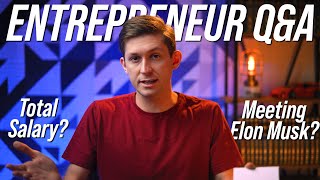
John Coogan answers questions about his path from Northeastern to Soylent to co-founding Lucy, his coding skills in Python and JavaScript, and his approach to founder salary benchmarks and equal equity splits. He occasionally angel invests and mentors, and he's most excited about AI.
Questions this video answers
January 28, 2022
Economics at Northeastern University
From 2012 until about 2016–2017
~$60,000
A little over $100,000
How much money do you make? What was it like meeting Elon Musk? Hey, welcome back to the channel. Little bit of a different video today. I thought I'd do a Q and A. The channel's grown a ton, and I thought it'd be interesting just to answer some questions. So let's kick it off. Are you doing this unscripted video because you got Covid and you didn't have time to make a full video? That's ridiculous. I can't believe someone would ask that. Are you Tom Holland's older brother? I do get that a lot. No, I'm not related to him, but I think it's a compliment. He's a pretty talented guy. What is your educational background? So I grew up in Pasadena. I went to high school out here, and then I went to college in Boston. I studied economics at Northeastern University, and I thought I was going to go into finance, but in my junior and senior year, I started using Python to run some more complex economic models. Once Excel kind of topped out and I kind of saw how cool programming was, then I kind of shifted everything and went into startups. As soon as I graduated, I. I grabbed a friend from high school, moved to Silicon Valley, and kind of did the traditional startup school y Combinator thing. No formal training in technology, really, or I didn't study computer science. I just kind of picked up software engineering and then eventually started programming full time, then ran a team, and now I don't program that much. But I still have software developers that. That report into me and I feel comfortable managing software engineers since I do know enough about coding. That's kind of the second question here. Yeah. Can you code? Yes. I definitely feel comfortable saying I can code. I'm not an amazing programmer or anything. I'm not developing entirely new algorithms, but I feel comfortable writing Python and getting what I need to get done on the Internet and building things. I know a little bit of JavaScript. I've messed around with Closure to learn what a lisp is and how that works. And I've written some objective C for iOS and I've touched most of the programming language a little bit, but Python's the one that I keep coming back to. Cause it's so fun and so easy to use. Why did you leave Soylent? So Soylent was my first startup. Was there from 2012 till about 2016, 2017. Great experience. The company grew tremendously. We sold a ton of product, millions of dollars in sales the first month, and then just kind of grew from there. There were 50 people at the company when I left. And that's a big part of why I decided to move on and do a new startup. The company, the company had grown so much, we were kind of out of that innovation mode and we were more in execution. Let's just get the product into every store, let's just distribute. Distribute, that's the name of the game. So we hired a bunch of people who know distribution really well and kind of let them take over. And then me and one of my co founders at Soylent and our creative director and our head of R and D were able to go and start this next company, Lucy, that helps people quit smoking, it sells nicotine products. And that company was just not, that idea was not appropriate for the Soylent brand. So it had to be a different company. So we were able to step back and go build something new. It's always tough kind of leaving this family that you've built and stepping back from this whole team that you've built. But it's kind of a natural part of the startup life cycle. How much money do you make? This is a very funny question. It's very gauche to ask, but on the Internet when you put videos out, people naturally ask you this type of thing. So as an entrepreneur I don't make a lot of money from my businesses because I am hoping to sell the business and then I have equity in the business. So I usually benchmark to other what other startups are doing. And it's not a lot like pre series seed, like when the company has not raised a lot of money, I might pay myself 60k, that's what I've paid myself in the past. Then post series seed, series A territory a little bit over 100k. And then once the company is really growing, maybe 200k. But really every dollar that you pull out of the business while you're in that growth mode is a dollar that you could be spending on marketing or hiring someone or your product or engineering. So it's really risky to take too much money out of the business when you're still in that growth stage. The, the, the, the real, the real benefit of all of this stuff is you want to sell the business for a lot of money and then you own equity. So the real question here, like the better question is like how much equity do you have in your companies? And I always try to find a, an even split between my co founders on the equity front. That's kind of best practice and that's what a lot of people in Silicon Valley preach. Doesn't always happen. Sometimes someone's worked a little bit harder. But in general that's kind of where I've, where I've worked to get to. What do you do in your free time? So I don't have a lot of free time because I have a full time job with my startup and then I have this YouTube channel and then I also have a 10 month old son at home and he's obviously a lot of work. But when I do have free time, I mean I love to read, I love to play video games, I love to listen to podcasts and kind of just research technologies and learn about things. But it's mostly a lot of work these days. Try and just kind of like talk to people, have interesting conversations about technology in the future. That's like most of my free time. What are your favorite books? It's hard to name a specific favorite book, but I really liked Super Founders by Ali Tomasab. He's a venture capitalist and he crunched all this data about what makes a successful founder. Like a founder that creates a billion dollar company or bigger. It disproves a lot of misconceptions. It's very encouraging because kind of no matter what your background is, there's data that supports that you can be a massively successful founder. So very inspirational book, but also very data driven, which I really liked. And then I really enjoyed Tyler Cowen's Stubborn Attachments which was published by Stripe Press, which is really cool. And it just kind of talks about how we should think about the modern economy and capitalism and economics from a very aspirational perspective. And it's just a great, it's just a great book. It's a very, very quick read as well. What YouTubers do you watch? This is a great question. I love Corridor Crew. I watch every single one of their videos. They're just incredible. I have played around with visual effects. I know a little bit of after effects and Cinema 4D, so I know the tools that they're using and it's just always really entertaining, really great storytelling on that channel. Love them. Obviously watch like MKBHD. Obviously watch Mr. Beast. Who doesn't? Smaller YouTubers, obviously. Gary Tan is like the inspiration for my entire channel. I love what he does and I love him personally. And then I've been watching these interviews done by this guy, Jesse Michaels that are just crazy. He interviews a lot of people about UFOs, but he also talks with crazy, really high profile tech people. He's super well connected in Silicon Valley, so I highly recommend his channel and then I also like Gzero World. It's a bit more of a corporate channel, but it's run by this guy, Ian Bremmer. He's this political strategist. Not he's nonpartisan, but he's just trying to tell you what's going on in the world. And very, very informative videos. Not clickbaity, he doesn't get a lot of views. But it's a really, really valuable channel if you're looking to understand kind of global politics, global global economics in a way that's not controversial or, or like left wing or right wing. It's just here's what's actually happening in the world. So great channel. How do you make these videos? So I get this question a lot because it seems kind of crazy that someone could put out a video once a week and still have a full time job. So I have a team, I have a researcher who helps me write scripts and research facts and generate ideas. That's been really helpful. He doesn't help with every script, but on a few of them he's really, really nailed it. I use a teleprompter for most of these. That speeds things up. I typically write the scripts in Google Docs and then I throw them up on the teleprompter, read them in there, and then I have a great editor who helps me combine everything and get all that great B roll and add the music and kind of speed things up and clean up any mistakes. So that's been a huge benefit. Why did you start making YouTube videos? I love this question because it took me a long time to answer it myself. Basically I was bored during the pandemic. I was locked down, didn't have anything to do. My wife was also pregnant, so I really had a lot of free time on my hands. For the first time in 10 years of being an entrepreneur, all these cool people were hanging out in clubhouse, they were socializing. And I realized that I didn't really have a way to meet new people in technology, meet new founders, talk to people. And I was just kind of bored. So I decided to turn on the camera, start talking about things. The views started coming in. It was really, really positive. The comment section was always really, really positive. So I thought it was really cool. But now I'm thinking about it like it's a great way to meet people. I think it's a great way to meet young founders that I can ultimately invest with or advise. I think it's just very important that we have more positive tech content on YouTube. If you look at a lot of the big tech channels, they're super negative. Every channel is like Theranos this, we work that, like, blah, blah, blah. Every channel, everything's a scam, everything's a fraud. And that's true. There are some bad companies out there, but we don't need to highlight them a hundred percent of the time. Obviously, the YouTube algorithm is very lean. It leans towards controversy, it loves controversy. People click on things that are scams and frauds and terrible, destroy the end of the world, like very negative content. But I think it's really bad because I think there are problems in the world. I think tech can be a solution to those problems in many, many situations. So I think we need more tech, positive content. And that's a lot of what I'm trying to do with this channel. Will you invest in my company? Maybe it's happened. I've met a few people through YouTube that I've written angel checks into their companies. I don't do a ton of investing, but I like partnering with people that are super ambitious and working on really cool things. So if you want to pitch me, you can send me a brief description of what you're working on on. On Twitter. My DMs are open. You can also send me a deck or a doc or your website or something like that. Just don't ramble for a long time and try and tell me your whole life story because it's really hard to respond to those types of messages now. I do think that you should be in a place where you are ready to take investment if you want to pitch me, because a lot of people are still at the very early stages and they haven't really crystallized, like, what the problem they're working on is, what the solution is. And you need to be able to tell if you're actually, if you have the skill set to go and build the solution that you're thinking of. Because, you know, I would love to build a time travel machine, but I have. I have no experience in how to do that, so that would be a bad startup idea. Will you mentor me? I get this question a decent amount, and the answer is probably not. Basically, I don't really do consulting. I don't really do mentorships. What I do is I invest in founders that are building companies. So if you're building a company and you think you'd like to work with me, reach out to me, we'll talk, and if I can invest, then I can mentor you for free. Actually, I'm giving you money and then you can call me whenever you want. But in terms of just like general mentorship, everything that I know I'm trying to put out on this channel for free, you can still ask me questions. You can DM me on Twitter and ask me a question. I might just answer it in a YouTube video instead of answering you directly. What technology are you most interested in right now? This is a good one. I got this after my 22 predictions. Of all the interesting tech in 2022, basically I think of there's three really interesting buckets that are going on right now. One is AI. Then there's space, like space travel, space exploration, everything that Elon's doing, space X. And then there's crypto. And crypto obviously is like a huge trend. Everyone's, everyone's talking about crypto. Out of those three buckets, I think they're all really interesting. I think they're all really impactful and important. But out of those three is the one that is the most intriguing to me just because that's the one that I've actually tinkered with. Like I've written Python code that does AI stuff and, and I also can just immediately imagine how that's beneficial to me. Like if I had a self driving car in my driveway, that would make my life better today. Whereas if you told me I could go to Mars, like it'd be really, really cool. But like that's a really harsh environment, I don't know that that's going to make my life better immediately. It's kind of unclear the value in the short term. And then with crypto, obviously you can make a ton of money, but there aren't that many people that are actually getting like real tangible day to day value. They certainly are internationally if you're, if you're in a country where there's a lot of hyperinflation, crypto can be great for you. Or if you're trying to transfer money across borders constantly and you need low fees, that's possible. Or if you're being deplatformed and you need a censorship resistant technology like crypto could definitely deliver on that. But I'm in America, I'm not being deplatformed. I don't need to send money all over the world for really low fees. So all of the main crypto benefits to me aren't as impactful. Like it's cool that you could make money if you traded effectively, but that's a lot less exciting than like a robot that does my laundry or something like that. Like, that's why I'm personally excited about AI. It just seems so intuitive that it would be beneficial. It's just like it's already here. We're using AI all the time. There's always a new app that's, that's doing something with AI. That's why, that's why I just love it. What do you think about crypto, specifically crypto? Obviously the markets are in turmoil, everyone's losing a ton of money. I still think that crypto is cool and beneficial and worth pursuing and worth having. I just don't necessarily think it's the only thing that we should be focusing on. Like, I don't see a world where crypto cures cancer. You have to get. It's a real stretch to say that crypto is going to like create more economic efficiency and that's going to be the thing that cures cancer. It's like maybe, or like maybe you're storing some cancer data on the blockchain and then that somehow becomes relevant to cancer researchers. It's a real stretch. I think crypto is good. I just don't think it's the only good technology, which is what a lot of like maxis think, a lot of maximalists think. What was it like meeting Elon Musk? This is funny. I actually haven't met Elon Musk. He has tried Soylent though. We set up a food truck in downtown LA and he just like stopped by, which was cool. So I saw a photo of him drinking Soylent, which was awesome. His chief of staff invested in my company, which is cool. And I've been to events where he's been there, but I haven't actually gotten to meet him yet. Now I don't know that I'd have a lot to ask him, even though obviously I make videos about him all the time. I think what would be more interesting would be for him to talk to another expert that can actually debate him on some of these points. I really want to see him debate Vitalik about crypto and I would love to see him talk to George Hotz about self driving cars, because I feel like they would have a much better conversation than I ever could have with someone like that. So yeah, I think in general I want to see more debates between world experts as opposed to just more. Every individual expert goes around to all of the podcasters and they do individual interviews that are okay, but they don't really ever come into contact with each other. I think that that's what, what would be really really entertaining. We used to have debates, but we don't really have them anymore because they're very, very risky to participate in. Well, that's it. If you have any more questions, just leave me a comment below. And if you're not already subscribed, please subscribe because there's more videos coming soon. Thanks a lot.










